


Welcome to Ballot Bulletin: Ballotpedia's Weekly Election Policy Digest. Every Tuesday, we deliver the latest updates on election policy around the country, including nationwide trends and recent legislative activity.
In this week’s edition, we cover 256 bills state legislatures acted on last week and look at the allowability of student IDs for voting.
The state of election legislation in the U.S.
Lawmakers in 32 states acted on 256 election-related bills last week. Twenty-seven state legislatures are in regular or special sessions. Last week, 38 bills were enacted, four bills were enacted following a veto override, 12 bills passed both chambers of a state legislature, and two bills were vetoed.
Of the bills acted on last week, 128 (50%) are in states with Democratic trifectas, 97 (37.9%) are in states with Republican trifectas, and 31 (12.1%) are in states with divided government. The most active bill categories last week were ballot measures (88), election types and stages (85), and campaign finance (70).
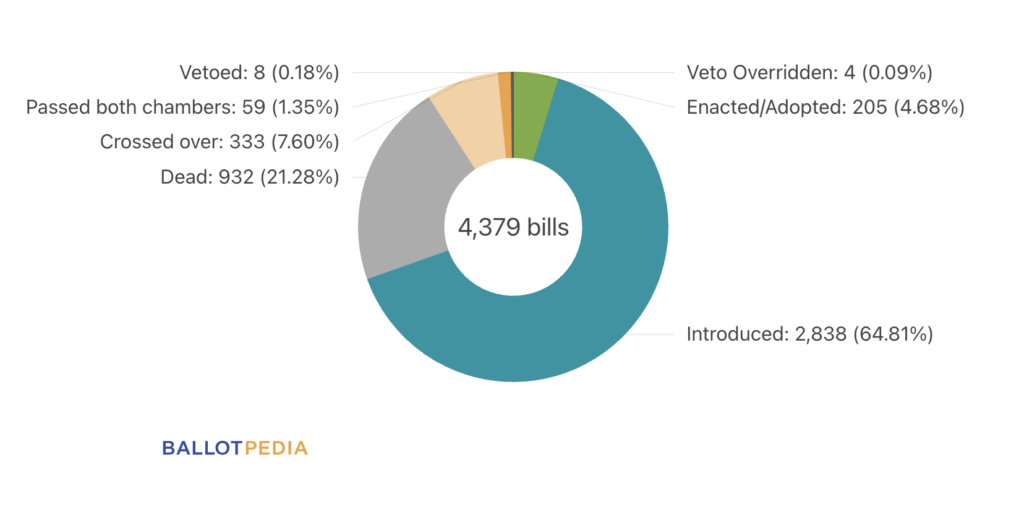
Ballotpedia is currently tracking 4,379 election-related bills across the country. We are actively processing bills filed since April 9.
The chart below breaks down the status of those 4,379 bills by where they stand in the legislative process:
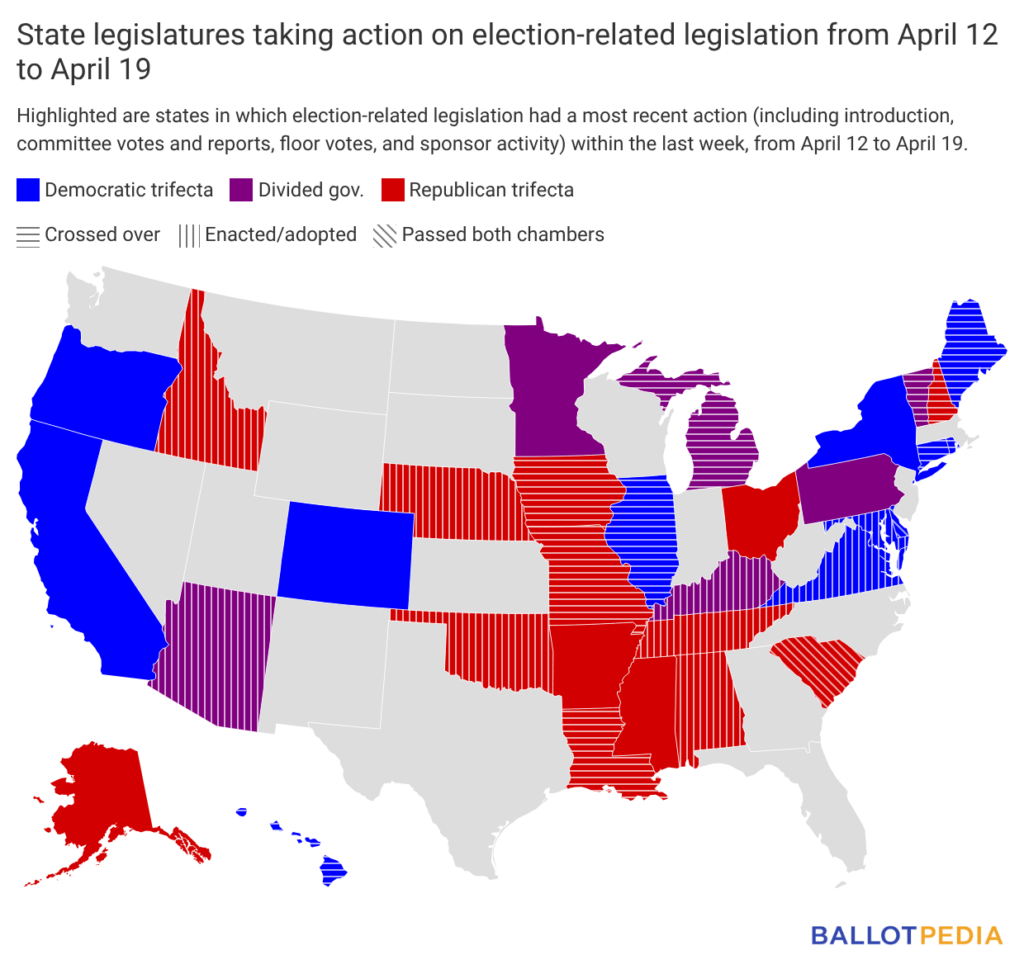
Enacted bills
On April 13, Virginia Gov. Abigail Spanberger (D) signed HB 965 into law. The bill enters Virginia into an agreement among the states to elect the president by a national popular vote, called the National Popular Vote Interstate Compact (NPVIC). Members of the NPVIC agree to award their presidential electors to the candidate that receives the most votes nationwide. The agreement would go into effect if states representing at least 270 electoral college votes adopt legislation committing them to the compact.
On April 13, Spanberger also signed HB 967 into law, modifying the Voting Rights Act of Virginia. It specifies legal standards for the evaluation of voter suppression and vote dilution claims, outlines guidance for courts to assess these claims, and lists factors courts may and may not consider when assessing claims. The bill reduces the population threshold for localities considered covered under the minority language accessibility provisions of existing law.
Thirty-six other bills were enacted or adopted last week:
- Alabama (Republican trifecta)
- Arizona (Divided government)
- Idaho (Republican trifecta)
- Kentucky (Divided government)
- Maryland (Democratic trifecta)
- Nebraska (Republican trifecta)
- Oklahoma (Republican trifecta)
- Tennessee (Republican trifecta)
- Virginia (Democratic trifecta)
Enacted bills following veto override
On April 14, the Kentucky House and Senate overturned Gov. Andy Beshear’s (D) veto of HB 139 80-20 and 32-6, respectively. The bill makes certain non-photo IDs no longer eligible for establishing proof of identity for voting and specifies that individuals flagged as non-citizens may not vote until their citizenship has been verified. It allows the State Board of Elections to enter into an agreement with the federal government to identify individuals who are deceased or non-citizens but still appear on the voter rolls.
Three other bills were enacted following a veto override by a state legislature:
Bills passing both chambers
On April 14, Delaware SB 3 passed the Senate. The bill provides for an amendment to the state constitution that establishes a right to vote by absentee ballot without an excuse and specifies the requirements for requesting and voting by absentee ballot. In Delaware, constitutional amendments do not require voter approval but must be passed twice in separate sessions.
Eleven other bills passed both chambers last week:
- Maryland (Democratic trifecta)
- South Carolina (Republican trifecta)
- Tennessee (Republican trifecta)
To see a full list of bills awaiting gubernatorial action, click here.
Vetoed bills
Two election-related bills were vetoed last week:
All bills
The chart below shows all bills Ballotpedia is currently tracking, broken down by partisan sponsorship:
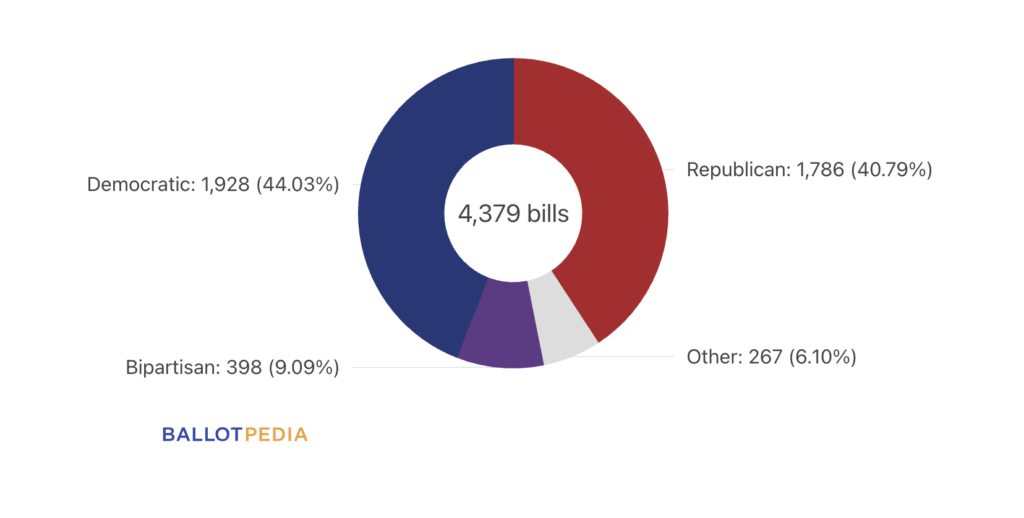
We are currently following 4,379 election-related bills, including bills carried over from the previous year.
- Trifecta status
- Democratic: 1,886 (43.1%)
- Republican: 1,605 (36.7%)
- Divided: 888 (20.3%)
- Partisan sponsorship
- Democratic: 1,928 (44%)
- Republican: 1,786 (40.8%)
- Bipartisan: 398 (9.1%)
- Other: 267 (6.1%)
In the news
On April 13, Virginia Gov. Abigail Spanberger (D) signed SB 57. It requires the commissioner of elections to apply to rejoin the Electronic Registration Information Center (ERIC), and take all necessary steps to maintain the state’s membership in good standing. The law takes effect on July 1. Virginia was previously an ERIC member but former Gov. Glenn Youngkin (R) withdrew the state from ERIC in 2023.
On March 24, Spanberger also issued an executive order directing the state to rejoin ERIC. Virginia is the second state in the last year to approve legislation requiring ERIC membership. New York enacted S 1356 in December 2025, requiring the state to join ERIC by July 31, 2026. Currently, 25 states, plus the District of Columbia, are members of ERIC. Virginia and New York will bring the number of ERIC members to 27.
States that join ERIC agree to share their voter registration data and licensing and identification data from motor vehicle departments every 60 days. ERIC then compiles this data and subsequently releases a series of list maintenance reports. After states receive a list maintenance report, they must act on it and use the information for voter list maintenance purposes. ERIC also releases reports that identify eligible but unregistered voters in each member state. Read more here.
Here are other news stories from across the country:
- On April 14, Louisiana filed a lawsuit against the U.S. Election Assistance Commission in the U.S. District Court for the Western District of Louisiana for barring the state from adding a proof of citizenship requirement to the federal National Mail Voter Registration Form. In its complaint to the court, lawyers for the state said that the EAC’s Jan. 16, 2026, denial of its request abridged its constitutional “authority to establish voter qualifications for federal elections.” The EAC’s denial letter said that requiring proof of citizenship on the federal voter registration form is unnecessary, given the existing required attestation of citizenship under penalty of perjury.
- On April 15, the Oklahoma House passed SJR 47 80-13. The joint resolution will go before voters in an Aug. 25 special election coinciding with the statewide primary runoff. The measure would add a requirement for voters to present proof of identity to election officials to the state constitution. State law currently requires such voter ID at the polls.
- On April 17, the U.S. District Court for the District of Rhode Island rejected a U.S. Department of Justice lawsuit to compel the state of Rhode Island to provide its unredacted statewide voter registration list to the DOJ. In the court order dismissing the DOJ lawsuit, Judge Mary McElroy wrote that neither the National Voting Registration Act (NVRA) nor the Help America Vote Act (HAVA) provided a sufficient basis for the DOJ’s request. Federal courts have dismissed similar lawsuits in Massachusetts, California, Michigan, and Oregon, as covered in last week’s Ballot Bulletin.
Policy spotlight: Appeals court allows enforcement of Indiana law banning student ID for voting
The story below is adapted from a recent Ballotpedia News story by Andrew Bahl.
On April 20, a federal appeals court ruled that an Indiana law removing student IDs from the list of eligible voter identification could be enforced, overturning a lower court ruling from earlier this month.
The decision from a three-judge panel of the U.S. Court of Appeals for the Seventh Circuit allows the law to be enforced for the state’s May 5 primary. Judges Michael Brennan, Michael Scudder, and Joshua Kolar issued an unsigned opinion stating, “We view the risk of disruption to Indiana’s primary election as very serious. In no uncertain terms, the district court’s injunction will alter who can cast a ballot in this election. And this change—imposed unilaterally by a federal court—comes seven days after voting in the election has already begun.”
The appellate court ruling overturned a preliminary injunction issued on April 10 by U.S. District Court Judge Richard Young. In issuing the preliminary injunction, Young wrote that plaintiffs were likely to prevail in their arguments that the policy violated the First and Fourteenth amendments to the U.S. Constitution. Following Young’s ruling, Indiana Attorney General Todd Rokita (R) appealed to the Seventh Circuit.
Governor Mike Braun (R) signed SB 10 into law last year. The legislation was passed along party lines in both the state House and state Senate 66-26 and 39-9, respectively.
On May 5, 2025, the groups Count US IN and Women4Change Indiana and an Indiana University student challenged the law in federal court, saying it would disenfranchise student voters and that it improperly targeted student IDs. The lawsuit sought both a temporary pause on enforcement of the ID ban and a more permanent ruling blocking the law.
Following the Seventh Circuit ruling, Rokita said in a social media post, “This commonsense protection is needed to close loopholes, prevent potential fraud by out-of-state or ineligible voters, ensure every ballot belongs to a verified Hoosier, and preserve public confidence in fair, honest, and transparent elections.”
In a statement posted on social media, Jalyn Radziminski, Executive & Lead Policy Director of Count US IN, said, “Despite this temporary setback, we remain firmly committed to this case and will keep fighting to permanently block SB 10 and ensure every Hoosier has a fair opportunity to make their voice heard at the ballot box.”
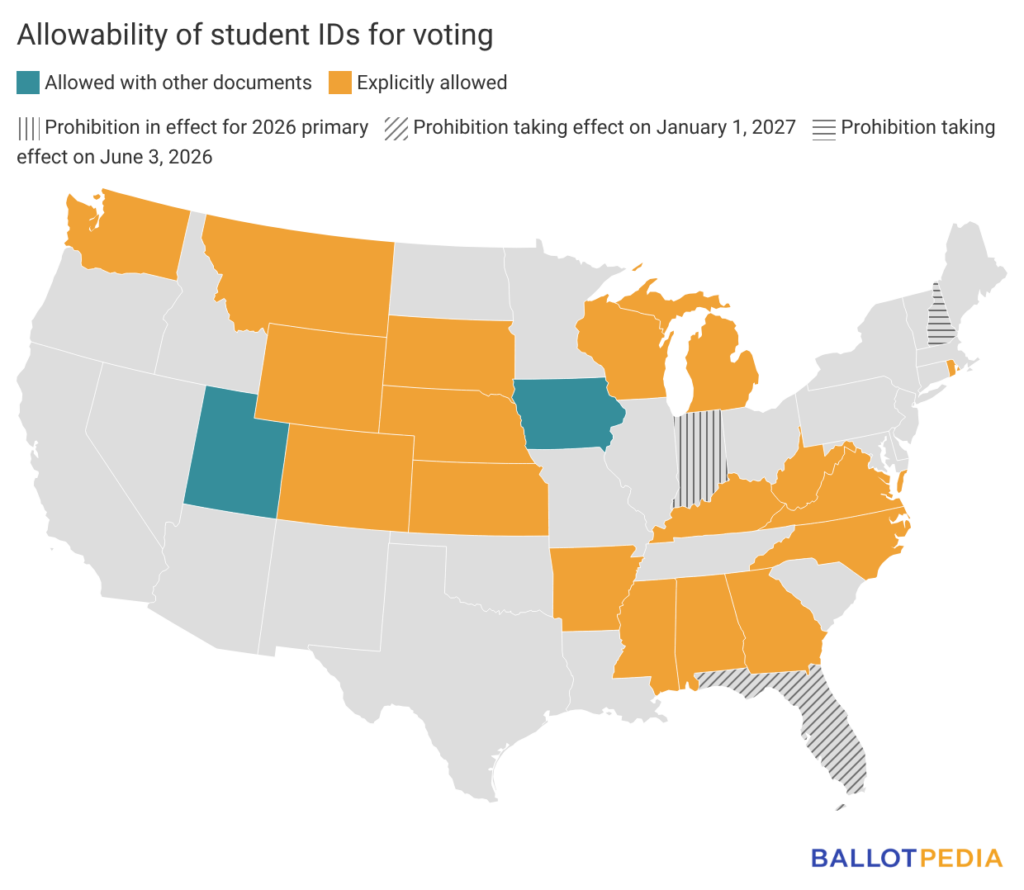
Eighteen states explicitly allow student IDs to be used for voting, while two states — Iowa and Utah — allow them to be used if presented with another form of identification. In states that do not explicitly allow student IDs to be used for voter identification, some student IDs may meet the state's voter identification criteria.
So far this year, Florida and New Hampshire have enacted legislation prohibiting the use of student IDs for voting. Florida Gov. Ron DeSantis (R) signed HB 991, which included the student ID provision, on April 1. The policy takes effect on Jan. 1, 2027.
New Hampshire Gov. Kelly Ayotte (R) signed HB 323 on April 3. The policy takes effect on June 2, meaning it will be in effect for the state’s Sept. 8 primary election.
Currently, 36 states require individuals to present identification to vote at the polls on Election Day, though many states provide exceptions to these rules. Six of those states have Democratic trifectas, 23 states have Republican trifectas, and seven states have divided government.
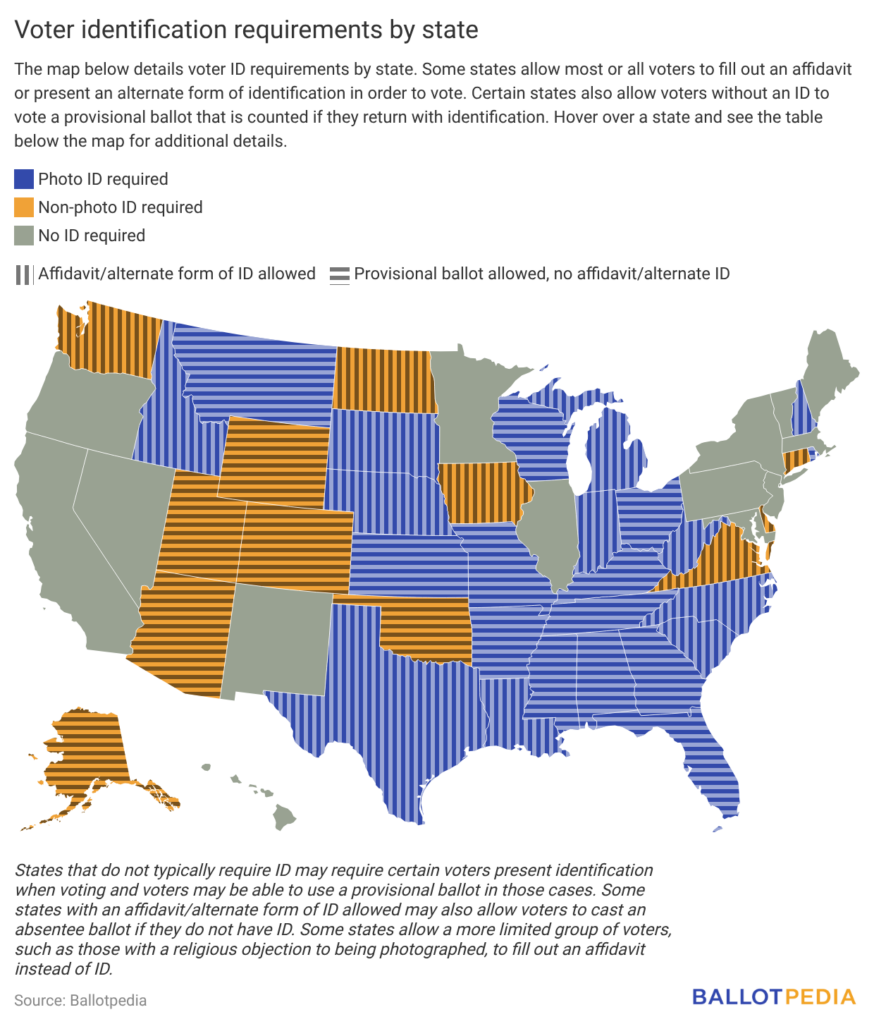
Of the states that require voter ID, 24 require ID that includes a photograph, with certain exceptions.
The remaining 14 states do not generally require voters to present identification to vote at the polls on Election Day, aside from what is required in federal law. Of the states without voter ID laws, 10 states have Democratic trifectas, and four have a divided government.
Read more about the Indiana litigation here.