


Welcome to the Wednesday, April 22, 2026, Brew.
By: Lara Bonatesta
Here’s what’s in store for you as you start your day:
- Maine voters to decide on initiative limiting sports eligibility based on sex after Legislature adjourns without a vote
- Two members of Congress sworn in, and three resigned in the last two weeks
- Appeals court allows enforcement of Indiana law banning student ID for voting and other election administration legislation updates
Maine voters to decide on initiative limiting sports eligibility based on sex after Legislature adjourns without a vote
The Maine Legislature adjourned on April 14 without voting on the initiated measure that would require public school sports teams designated for girls or boys to be limited to students of the corresponding sex. Citizen initiatives are indirect in Maine. This means that because the Legislature did not act on the measure, Mainers will vote on it on Nov. 3.
The measure would require public schools to designate athletic teams as male, female, or coeducational. Students would be permitted to participate on a sports team that is designated for the sex noted on their original birth certificate. Girls would be allowed to participate on male-designated teams when no female-designated team is available for that sport.
The initiative would also require public schools to maintain separate restrooms, locker rooms, shower rooms, and other private spaces for each sex.
The initiative would also allow students who are denied athletic opportunities or suffer direct injuries due to violations of the initiative to bring a civil action for injunctive relief, damages, and attorneys’ fees against a school or the organization that governs interscholastic or competitive school sports.
One thing still up in the air is the wording of the question that will appear on voters' ballots.
Secretary of State Shenna Bellows (D) released the proposed draft for the ballot question on April 7. It states:
“Do you want to change civil rights and education laws to require public schools to restrict access to bathrooms and sports based on the gender on the child’s original birth certificate and allow students to sue the schools?”
The public comment period for the ballot question began on April 7 and ends on May 7. Bellows will finalize the title by May 28.
In an interview with the Maine Morning Star, Bellows said, “My guidance when I write any question is the legal requirement … and simply describe the subject matter.” Bellows also released a statement saying, “I look forward to reading everyone’s suggestions and will take all of them into consideration when I finalize the question for the ballot.”
Protect Girls' Sports in Maine, the campaign sponsoring the initiative, released a statement on April 9, requesting that the ballot question be changed. It says that the drafted question has four errors, namely that the question:
- Erroneously states that the measure would change civil rights laws
- Does not mention that all private spaces are covered under the measure
- Uses the term gender instead of sex
- Is too simplistic regarding the potential for civil recourse for violations of the measure
Context on Maine’s initiative process
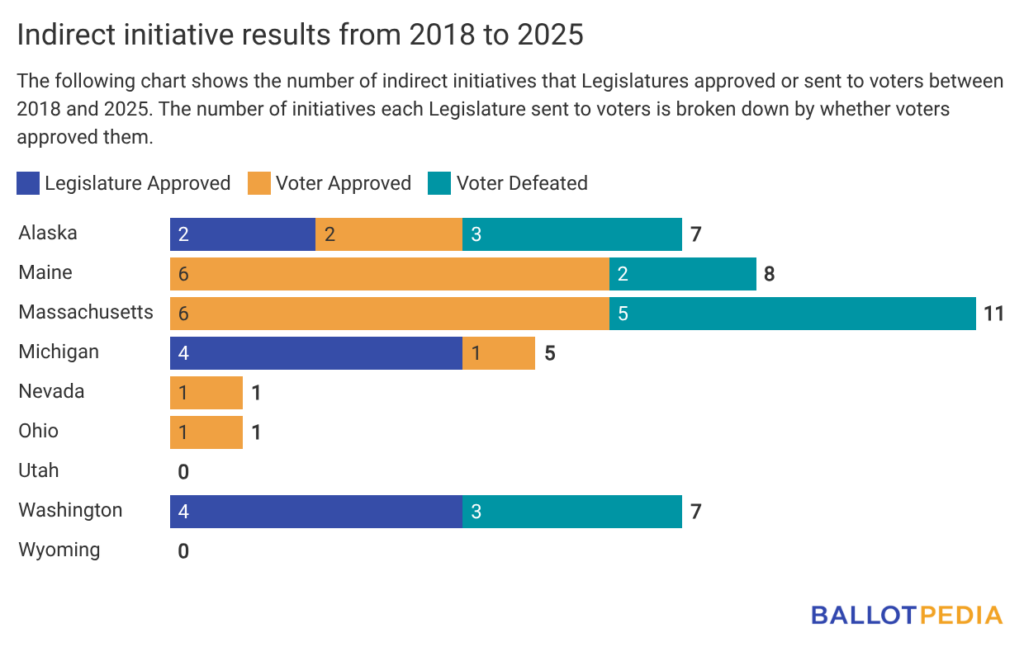
Maine is one of nine states that have indirect initiatives. This means if an initiative has enough valid signatures, it is presented to the Legislature. Legislators can then adopt or reject the initiative. If legislators take no action – as they did with the school sports initiative – or reject an initiative, it is placed on the ballot for voters to decide. If the Legislature approves an initiative and the governor vetoes it, it also goes to the ballot.
Maine has a Democratic trifecta, and Gov. Janet Mills (D) said that she does not support the measure.
Between 2018 and 2025, the Maine Legislature sent all eight indirect initiatives that it received to voters, who approved six and defeated two.
Similar measures on the ballot this year
Colorado and Washington voters will decide similar measures in November. No state has previously put a ballot measure before voters that would require public schools to limit participation on male and female sports teams to students of the corresponding sex. Although 27 states have enacted laws addressing this issue, voters have never decided such policies through ballot measures.
The Colorado Sex Requirement for School and College Sports Initiative would require student athletes to participate on men's or women's school and collegiate athletic teams that match their sex, defined as biological reproductive systems.
The Washington Sex Verification Requirements for Female School Sports Initiative would require students seeking to participate in athletic activities designated for female students to submit documentation from their healthcare provider verifying the student’s sex based on "reproductive anatomy, genetic makeup, or normal endogenously produced testosterone levels."
Voters in two other states could decide on measures related to sports eligibility requirements based on sex. Campaigns sponsoring both measures are currently gathering signatures.
The Nevada Biological Sex Requirements for School Sports Programs Amendment would require that eligibility for sports or athletic competitions in public schools and colleges is based upon the sex of the athlete recorded at birth, and that males are not permitted to participate in a sport or competition designated for females.
The Nebraska Sex Requirement for School and College Sports Amendment would establish a constitutional requirement for schools to designate sports teams as male, female, or co-ed and prohibit male participation on female sports teams. In 2025, Nebraska enacted a state statute requiring student athletes to provide a document verifying their sex, signed by or under the authority of a doctor, in order to participate on athletic teams designated as male or female.
Click here to read more about the initiative in Maine, and here to read more about ballot measures on sports eligibility requirements based on sex.
Two members of Congress sworn in, and three resigned in the last two weeks
On April 21, Rep. Sheila Cherfilus-McCormick (D-Fla.) resigned from the U.S. House of Representatives, leaving Florida’s 20th Congressional District vacant. Previously, on March 27, the U.S. House Ethics Committee announced that it had determined that Cherfilus-McCormick had violated House campaign finance rules, finding that she had misappropriated disaster relief funds for campaign purposes. A hearing was scheduled for April 21 to discuss possible sanctions.
In a post on X announcing her resignation, Cherfilus-McCormick wrote, “This was not a fair process. The Ethics Committee refused my new attorney's reasonable request for time to prepare my defense. [...] Rather than play these political games, I choose to step away so that I can devote my time to fighting for my neighbors in Florida's 20th district.”
Cherfilus-McCormick’s resignation marked the fifth change in membership of the U.S. House in the last two weeks.
On April 20, Speaker of the House Mike Johnson (R-La.) swore in Analilia Mejia (D-N.J.), filling the vacancy in New Jersey’s 11th Congressional District. The vacancy occurred when the previous incumbent, Mikie Sherrill, resigned on Nov. 20, following her election as governor of New Jersey.
On April 14, U.S. Reps. Eric Swalwell (D-Calif.) and Tony Gonzales (R-Texas) resigned, leaving Texas’ 23rd Congressional District and California’s 14th Congressional District vacant. Swalwell and Gonzales both resigned after news reports on allegations of sexual misconduct.
Swalwell, who has denied the allegations, wrote in a statement, "I am aware of efforts to bring an immediate expulsion vote against me and other members. Expelling anyone in Congress without due process, within days of an allegation being made, is wrong. But it's also wrong for my constituents to have me distracted from my duties. Therefore, I plan to resign my seat in Congress."
In a post on X announcing his resignation, Gonzales, who acknowledged having an affair with a member of his staff, wrote, "There is a season for everything and God has a plan for us all. [...] It has been my privilege to serve the great people of Texas."
Also on April 14, Johnson swore Clayton Fuller (R-Ga.) in, filling the vacancy in Georgia’s 14th Congressional District. That vacancy occurred on Jan. 5, after Rep. Marjorie Taylor Greene (R-Ga.) resigned. In a runoff election on April 7, Fuller defeated Shawn Harris (D) 57.2% to 42.8%. Fuller and Harris advanced to the runoff after no candidate received a majority in the special election on March 10.
Currently, Republicans have a 217 to 213 majority in the U.S. House of Representatives, with four vacancies. Additionally, Rep. Kevin Kiley (I-Calif.) is an independent who caucuses with Republicans.
Vacancies in the 119th Congress
So far in the 119th Congress, there have been 12 vacancies in the U.S. House and four in the U.S. Senate.
- Three U.S. Senate vacancies were filled via appointment.
- One U.S. Senate vacancy was filled when Sen. Jim Justice (R-W.Va.) was sworn into office 11 days after the start of the 119th Congress. Justice delayed his swearing-in in order to fulfill the remainder of his term as governor of West Virginia.
- Eight in the U.S. House were filled after special election winners were sworn in.
Currently, there are four vacancies in Florida’s 20th Congressional District, Texas' 23rd Congressional District, California's 14th Congressional District, and California's 1st Congressional District that have not been filled.
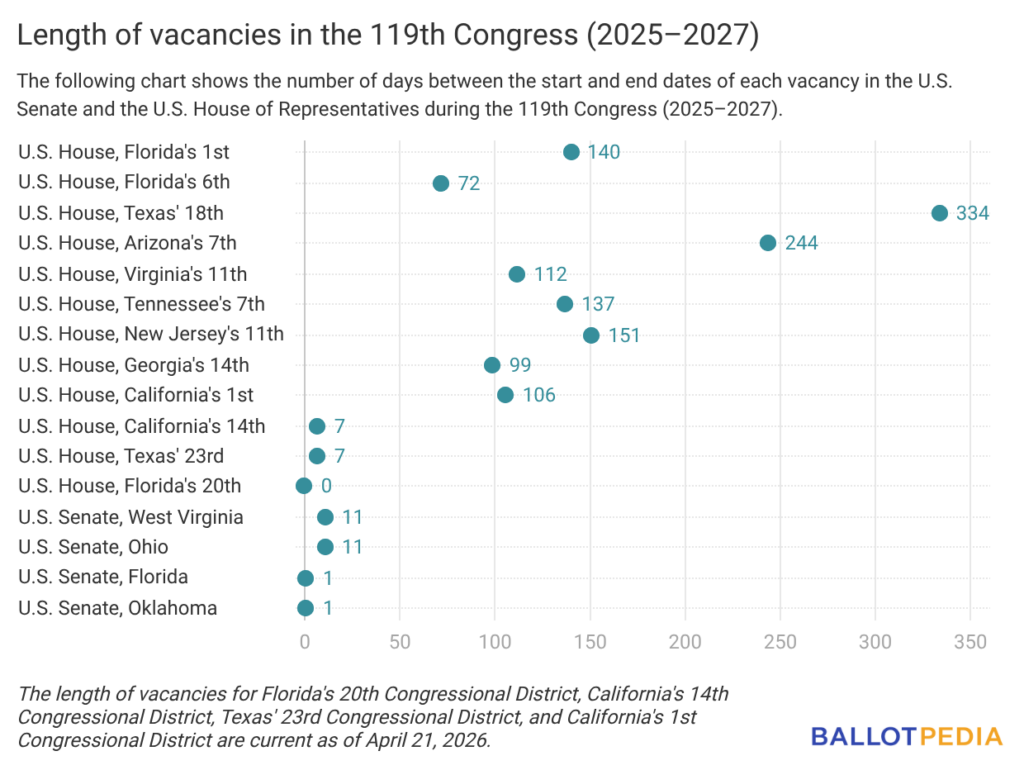
Of the 16 vacancies, the longest was in Texas' 18th Congressional District, which became vacant on March 5, 2025, following the death of Rep. Sylvester Turner (D-Texas). The vacancy ended on Feb. 2, 2026, after 334 days.
Congressional vacancies since the 113th Congress
During the 113th through 118th Congresses (2013 to 2025), there were 88 vacancies in the U.S. House and 16 in the U.S. Senate. During that period, the 117th Congress had the most vacancies at 24. Two of those vacancies were in the U.S. Senate and 22 in the U.S. House. The 114th Congress had the fewest at nine — all in the U.S. House.
The average length of a vacancy in the U.S. Senate during that period was seven days. The average length of a vacancy in the U.S. House during that period was 138 days.
The longest vacancy in the U.S. Senate during that period was in New Jersey. The vacancy occurred during the 118th Congress, when Sen. Bob Menendez (D-N.J.) resigned on Aug. 20, 2024. Following Menendez's resignation, the seat was vacant for 20 days.
The longest vacancy in the U.S. House during that period was in Michigan's 13th Congressional District. The vacancy occurred during the 115th Congress, when Rep. John Conyers, Jr. (D-Mich.) resigned on Dec. 5, 2017. Following Conyers' resignation, the seat was vacant for 359 days.
Click here to read more about vacancies in the 119th Congress.
Appeals court allows enforcement of Indiana law banning student ID for voting and other election administration legislation updates
As part of our ongoing coverage of election administration legislation, here’s an update on the number of bills we’re following and an update on the Indiana student identification legislation that we mentioned earlier this week.
Legislation update
Lawmakers in 32 states acted on 256 election-related bills last week. With 27 state legislatures currently in session, lawmakers enacted 38 bills in the past week. Four bills were enacted following a veto override, 12 bills passed both chambers of a state legislature, and governors vetoed two bills.
In the past week, there was more legislative action in Democratic trifectas. Of the bills acted on last week, 50% (128) were in states with Democratic trifectas, 37.9% (97) were in states with Republican trifectas, and 12.1% (31) were in states with divided governments.
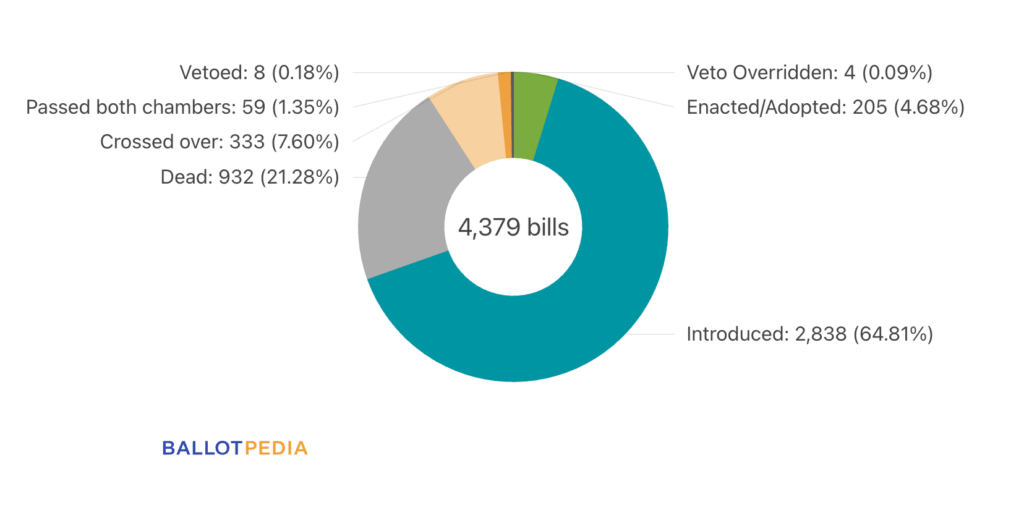
State legislators have introduced 4,379 bills on election policy and administration this year, more than the 4,324 we were following at this point last year.
So far, 59% (120) of all enacted bills have been in states with Republican trifectas, while 34% (69) have been in states with Democratic trifectas and 8% (16) have been in states with divided governments.
Notable bills that lawmakers passed last week:
On April 13, Virginia Gov. Abigail Spanberger (D) signed HB 965, SB 57, and HB 96 into law.
- HB 965 enters Virginia in an agreement among the states to elect the president by a national popular vote, called the National Popular Vote Interstate Compact (NPVIC).
- SB 57 requires the commissioner of elections to apply to rejoin the Electronic Registration Information Center (ERIC). The law takes effect on July 1. Virginia was previously a member, but former Gov. Glenn Youngkin (R) withdrew the state from ERIC in 2023.
- HB 967 modifies the Voting Rights Act of Virginia. The bill specifies legal standards for evaluating voter suppression and vote dilution claims, outlines guidance for courts to assess these claims, and lists factors courts may and may not consider when assessing claims. The bill also reduces the population threshold for localities considered covered under the minority language accessibility provisions of existing law.
On April 15, the Oklahoma House passed SJR 47 80-13. The joint resolution will go before voters on Aug. 25. The measure would add a requirement for voters to present proof of identity to election officials to the state constitution. State law currently requires such voter ID at the polls.
To learn more about the legislation states passed in the last week, check out the April 21 edition of the Ballot Bulletin.
Indiana law banning student ID for voting takes effect following appeals court decision
On April 20, a federal appeals court ruled that an Indiana law removing student IDs from the list of eligible voter identification could be enforced, overturning a lower court ruling from earlier this month.
The decision from a three-judge panel of the U.S. Court of Appeals for the Seventh Circuit allows the law to be enforced for the state’s May 5 primary. Judges Michael Brennan, Michael Scudder, and Joshua Kolar issued an unsigned opinion stating, “We view the risk of disruption to Indiana’s primary election as very serious. In no uncertain terms, the district court’s injunction will alter who can cast a ballot in this election. And this change—imposed unilaterally by a federal court—comes seven days after voting in the election has already begun.”
The appellate court ruling overturned U.S. District Court Judge Richard Young’s April 10 preliminary injunction. In issuing the preliminary injunction, Young wrote that plaintiffs were likely to prevail in their arguments that the policy violated the First and Fourteenth amendments to the U.S. Constitution. Following Young’s ruling, Indiana Attorney General Todd Rokita (R) appealed to the Seventh Circuit.
Governor Mike Braun (R) signed Senate Bill 10 into law last year. The legislation was passed along party lines in both the state House and state Senate. Republicans have a 40-10 majority in the state Senate and a 70-30 majority in the state House.
On May 5, 2025, the groups Count US IN and Women4Change Indiana, and an Indiana University student challenged the law in U.S. district court, saying it would disenfranchise student voters and that it improperly targeted student IDs. The lawsuit sought both a temporary pause on enforcement of the student ID ban and a more permanent ruling blocking the law.
Following the Seventh Circuit ruling, Rokita said in a social media post, “This commonsense protection is needed to close loopholes, prevent potential fraud by out-of-state or ineligible voters, ensure every ballot belongs to a verified Hoosier, and preserve public confidence in fair, honest, and transparent elections.”
In a statement posted on social media, Jalyn Radziminski, Executive & Lead Policy Director of Count US IN, said, “Despite this temporary setback, we remain firmly committed to this case and will keep fighting to permanently block SB 10 and ensure every Hoosier has a fair opportunity to make their voice heard at the ballot box.”
Read more about the Indiana litigation here. Click here to sign up for The Ballot Bulletin — our weekly email that follows developments in election policy around the country. You can also click here to see a full list of the bills we're following in 2026.