


Welcome to Ballot Bulletin: Ballotpedia's Weekly Election Policy Digest. Every Tuesday, we deliver the latest updates on election policy around the country, including nationwide trends and recent legislative activity.
In this week’s edition, we cover 178 bills state legislatures acted on last week and look at the redistricting implications of the U.S. Supreme Court’s decision in Louisiana v. Callais.
The state of election legislation in the U.S.
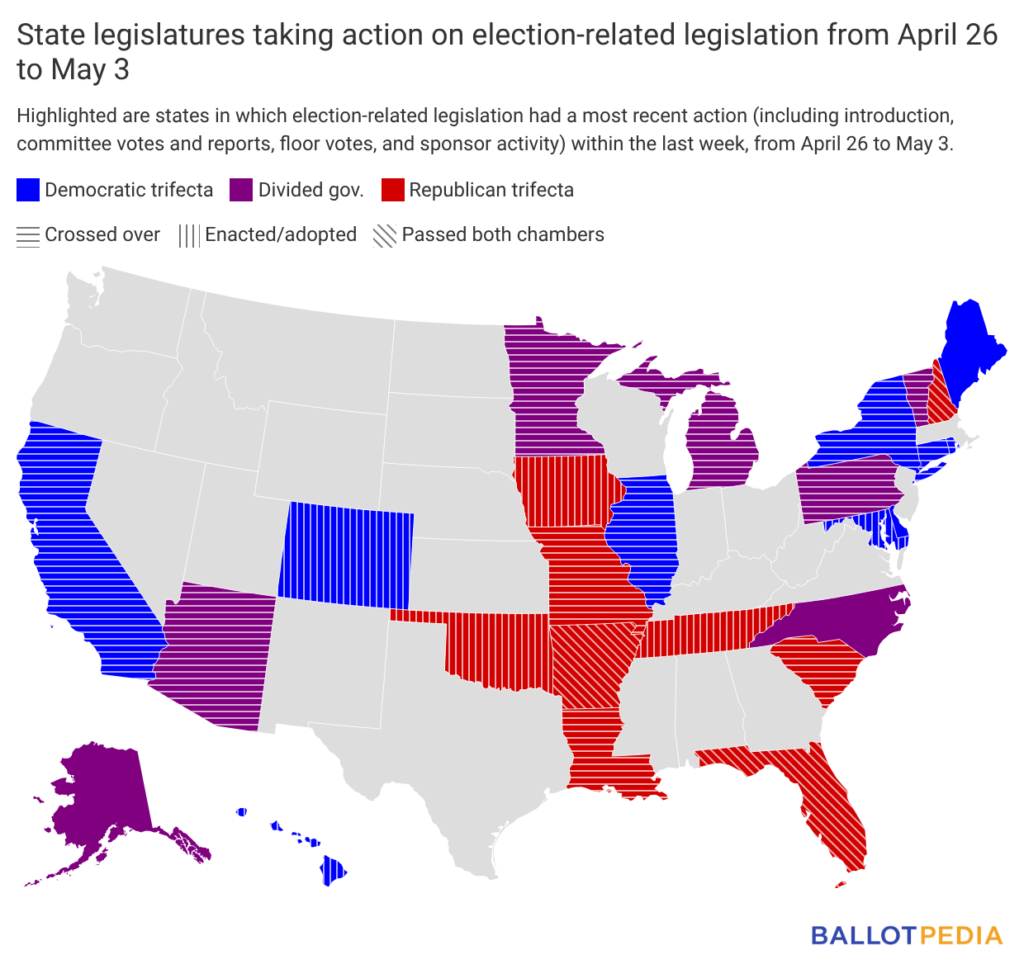
Lawmakers in 26 states acted on 178 election-related bills last week. Twenty-five state legislatures are in regular or special sessions. Last week, nine bills were enacted, seven bills passed both chambers of a state legislature, and one bill was vetoed.
Of the bills acted on last week, 78 (43.8%) are in states with Democratic trifectas, 77 (43.3%) are in states with Republican trifectas, and 23 (12.9%) are in states with divided government. The most active bill categories last week were election types and stages (58), ballot measures (53), and election dates and deadlines (39).
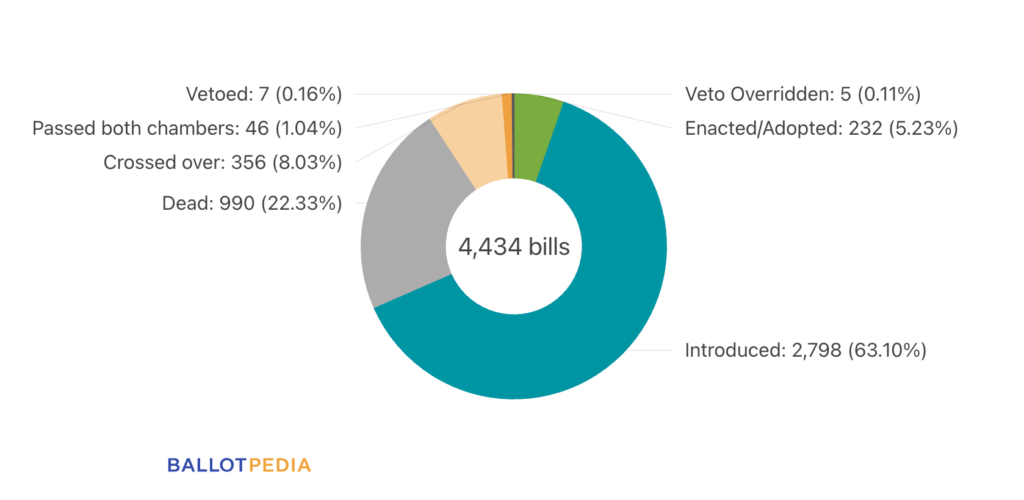
We are currently tracking 4,434 election-related bills across the country. The chart below breaks down the status of those bills by where they stand in the legislative process:
Enacted bills
On May 4, Florida Gov. Ron DeSantis (R) signed H 1 into law, redrawing the state’s 28 congressional districts ahead of the Nov. 2026 general election.
On April 28, Maryland Gov. Wes Moore (D) signed SB 255, known as the Voting Rights Act of 2026, into law. It prohibits the use of a method for electing county or municipal governing bodies that impairs the ability of members of a protected class to elect candidates of their choice or dilutes or abridges the right to vote for voters who are members of a protected class. The bill also allows the attorney general or any other person to bring an action enforcing the prohibition on electoral methods that impair the rights of a protected class.
Seven other bills were enacted or adopted last week:
- Colorado (Democratic trifecta)
- Hawaii (Democratic trifecta)
- Iowa (Republican trifecta)
- Oklahoma (Republican trifecta)
- Tennessee (Republican trifecta)
Bills passing both chambers
On April 28, the New Hampshire Senate passed HB 481, sending the bill to Gov. Kelly Ayotte (R). It would move the state’s primary election to the second Tuesday in June of even-numbered years (currently the second Tuesday in September). The bill also would specify that voters may not change their party affiliation from the first Friday in March before a primary election (currently the first Wednesday in June) to the day before the primary election.
Six other bills passed both chambers last week:
- Arkansas (Republican trifecta)
- Colorado (Democratic trifecta)
- New Hampshire (Republican trifecta)
- Oklahoma (Republican trifecta)
- Tennessee (Republican trifecta)
To see a full list of bills awaiting gubernatorial action, click here.
Vetoed bills
One election-related bill was vetoed last week:
- Alaska (Divided government)
To see a list of all bills vetoed this session, click here.
All bills
The chart below shows all bills Ballotpedia is currently tracking, broken down by partisan sponsorship:
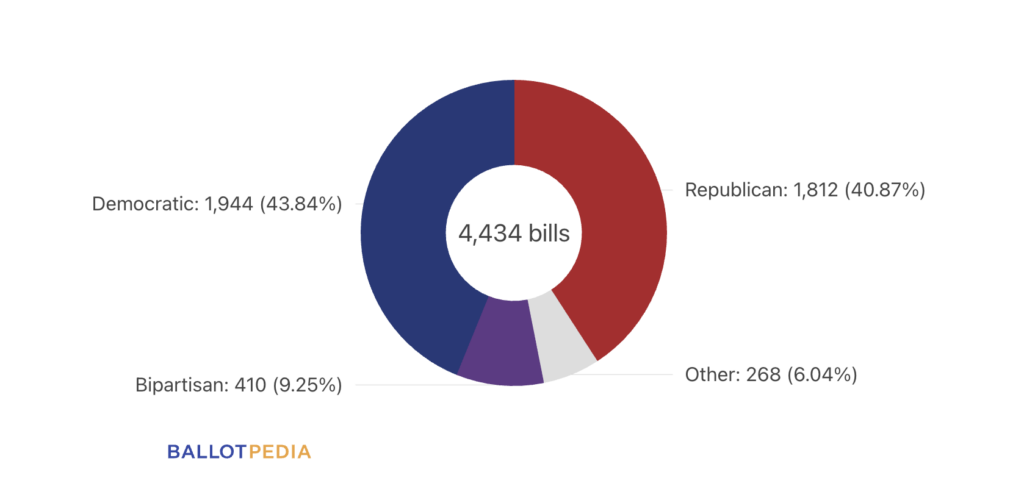
We are currently following 4,434 election-related bills, including bills carried over from the previous year.
- Trifecta status
- Democratic: 1,896 (42.8%)
- Republican: 1,620 (36.5%)
- Divided: 918 (20.7%)
- Partisan sponsorship
- Democratic: 1,944 (43.8%)
- Republican: 1,812 (40.9%)
- Bipartisan: 410 (9.2%)
- Other: 268 (6%)
In the news
On April 30, Louisiana Gov. Jeff Landry (R) issued an executive order suspending Louisiana’s ongoing U.S. House primaries in the wake of the U.S. Supreme Court’s decision in Louisiana v. Callais (discussed below in this week’s policy spotlight). Landry said the suspension was necessary to give the state time to create districts that comply with the decision. Candidates and civil rights organizations filed multiple lawsuits following the suspension of the elections.
Landry posted on X about the Supreme Court decision: “The Supreme Court has affirmed what we have said for years: drawing districts for political reasons is the States’ prerogative, not a federal civil-rights violation.” Louisiana’s six congressional districts are currently represented by four Republicans and two Democrats. They were represented by five Republicans and one Democrat under the 2022 map.
On May 4, the Supreme Court allowed its ruling to take effect early, declining to provide extra time for a request for a rehearing.
Here are other news stories from across the country:
- On May 4, Florida Gov. Ron DeSantis (R) signed H 1 into law, redrawing the state’s 28 congressional districts ahead of the November 2026 general election. On the same day, the Equal Ground Education Fund and a group of Florida voters filed a lawsuit opposing the maps, which the Florida Legislature passed the day the U.S. Supreme Court’s decision in Louisiana v. Callais was handed down. In the complaint, the plaintiffs said that the redistricting plans violate the state constitution’s prohibition on partisan gerrymandering known as the Fair Districts Amendment.
- On May 1, Alabama Gov. Kay Ivey (R) called a special session for the Legislature to alter congressional and state senate districts in the event the U.S. Supreme Court dissolves an order blocking Alabama from drawing new maps until 2030. Federal courts previously required Alabama to create a second majority-Black district. On May 1, Tennessee Gov. Bill Lee (R) called a special session for the state legislature to review the state’s congressional districts.
- On April 29, the North Carolina NAACP filed a motion in the U.S. District Court for the Middle District of North Carolina to appeal the court’s decision upholding North Carolina’s 2018 law requiring individuals to present a photo ID to vote. As we reported in the March 31 Ballot Bulletin, the court’s original ruling held that although the law created barriers to voting, it did not do so unconstitutionally.
Policy spotlight: U.S. Supreme Court's ruling in Louisiana v. Callais could spur further changes in redistricting
The story below is adapted from a recent Ballotpedia News story by Nathan Maxwell.
On April 29, the U.S. Supreme Court handed down a 6-3 decision in Louisiana v. Callais, ruling that Louisiana’s congressional map that added a second majority-Black district was an unconstitutional racial gerrymander.
In 2024, the Louisiana Legislature added the second majority-Black district in response to a court order. The initial lawsuit argued the 2022 map diluted minority votes because it included only one majority-Black district, violating Section 2 of the Voting Rights Act.
The Callais decision will affect how Section 2, which prohibits voting practices and procedures that discriminate on the basis of race, is applied in future disputes over district boundaries.
Justice Samuel Alito wrote in the majority opinion that Section 2 “requires evidence giving rise to a strong inference of intentional discrimination. If race and politics are not disentangled and a Section 2 claim is cynically used as a tool for advancing a partisan end, the VRA’s noble goal will be perverted.” Alito wrote that in the case against the original map, “Much of the cited evidence—such as the low number of black Louisianans who have been elected to Congress in recent decades—failed to disentangle race from politics.”
Alito wrote that “because the Voting Rights Act did not require Louisiana to create an additional majority-minority district, no compelling interest justified the State’s use of race in creating SB8 [the map with the second majority-Black district]. That map is an unconstitutional gerrymander, and its use would violate the plaintiffs’ constitutional rights.”
In a dissent, Justice Elena Kagan wrote, “The consequences are likely to be far-reaching and grave. Today’s decision renders Section 2 all but a dead letter. In the States where that law continues to matter—the States still marked by residential segregation and racially polarized voting—minority voters can now be cracked out of the electoral process.”
So far, six states will have new congressional district boundaries in the 2026 midterms. Virginia could be another. The Virginia Supreme Court is weighing the constitutionality of the voter-approved redistricting amendment. On April 28, the Court upheld a lower court order blocking certification of the amendment.
The table below shows the net effect of mid-decade redistricting nationwide should either, both, or neither of Florida and Virginia’s maps take effect. The figures below were calculated using 2024 presidential election results. The table also shows how these numbers could change should Louisiana pass a new map that moves one or both of its Democratic districts toward Republicans.
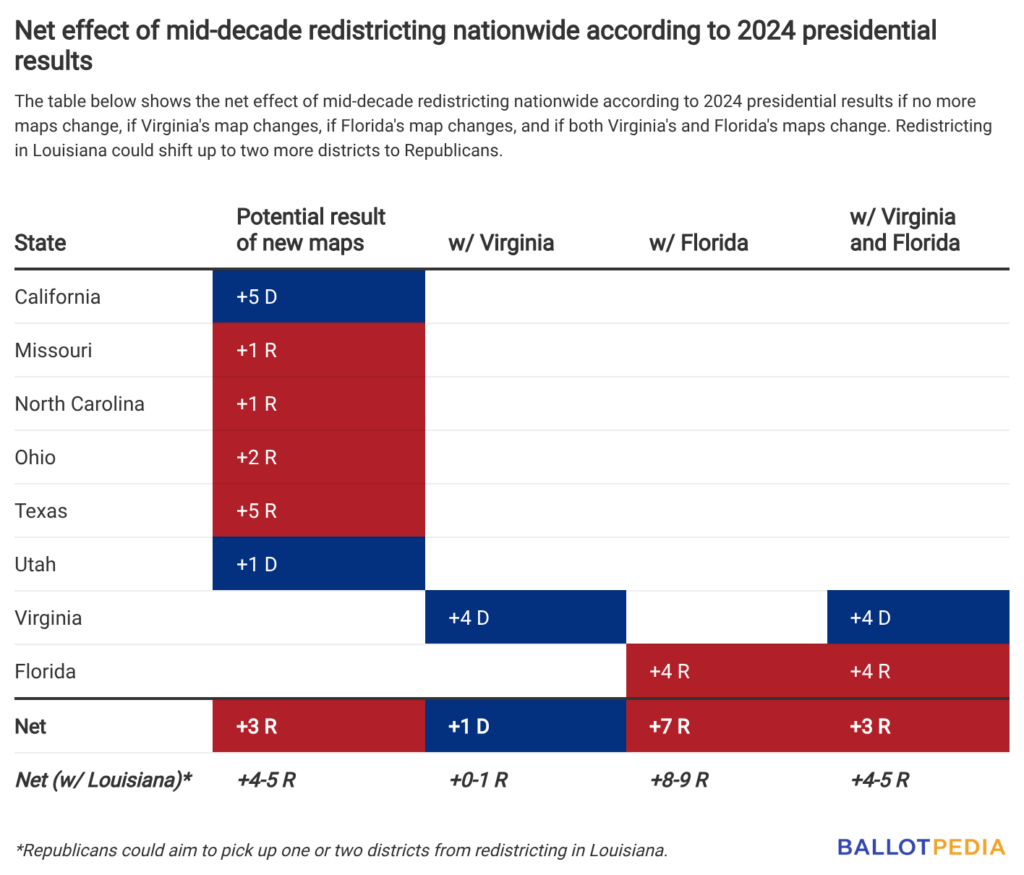
In addition to the new redistricting efforts in Louisiana, Alabama, and Tennessee, other states may pursue redistricting ahead of the 2028 elections. The Downballot identified 12 districts across eight southern states where Republicans could aim to redraw their congressional districts following the Callais decision.
Mississippi Gov. Tate Reeves (R) announced on April 24, that he was calling a special session for congressional redistricting to begin 21 days after the decision. That date would be May 20. Although Reeves did not say what election cycle Mississippi could start using the potential boundaries, the Clarion Ledger’s Bea Anhuci wrote that it “would almost definitely not be in effect for the upcoming midterm elections later this year.”
Republicans currently have a 217-212-1 majority in the U.S. House of Representatives, with five vacancies. The general election is Nov. 3.