


Welcome to the May 11 edition of Robe & Gavel, Ballotpedia’s newsletter about the Supreme Court of the United States (SCOTUS) and other judicial happenings around the U.S.
May marks the end of SCOTUS arguments. But fear not, dear reader, we still have plenty of updates for you. SCOTUS released two new opinions, and we have some federal vacancy updates for you. So, let’s gavel in!
Follow Ballotpedia on X and Bluesky or subscribe to the Daily Brew for the latest news and analysis.
We #SCOTUS and you can, too!
Grants
SCOTUS has not accepted any new cases to its merits docket since our April 27 issue. To date, the Court has agreed to hear 59 cases for argument for the 2025-2026 term and nine cases for the 2026-2027 term.
Arguments
The Supreme Court will not hear any arguments this week. Click here to read more about SCOTUS' current term.
In its October 2024 term, SCOTUS heard arguments in 65 cases. Click here to read more about SCOTUS's previous term.
Opinions
SCOTUS has ruled on two cases since our April 27 edition. The court has issued rulings in 30 cases so far this term.
Click the links below to read more about the specific cases SCOTUS ruled on since April 27:
April 29
Louisiana v. Callais was argued before the court on March 24, 2025, and Oct. 15, 2025.
The case concerns the standards federal courts apply when reviewing a state legislature’s congressional redistricting decisions under the Constitution and the Voting Rights Act. The Court’s resolution will clarify how courts assess claims of racial predominance, the application of strict scrutiny, and the use of the Gingles framework, shaping the limits of judicial oversight of state redistricting plans.
The outcome: In a 6-3 opinion, the court affirmed and remanded the decision of the U.S. District Court for the Western District of Louisiana, holding that the Voting Rights Act of 1965 (VRA) did not require Louisiana to redraw its maps to create another majority-minority district. The Court, applying strict scrutiny, determined that the state did not have a compelling interest in considering race when redrawing these maps. As such, the Court ruled that the maps, created under SB8, unconstitutionally considered race in their drawing. In other words, Louisiana’s congressional map that added a second majority-Black district was an unconstitutional racial gerrymander. Click here to read more about this ruling.
- On May 4, SCOTUS granted a request to immediately finalize this opinion, which would allow Louisiana to draw its new map before the 2026 midterm elections.
- On April 30, Louisiana Gov. Jeff Landry (R) issued an executive order suspending Louisiana’s ongoing U.S. House primaries in the wake of the U.S. Supreme Court’s decision in Louisiana v. Callais.
First Choice Women’s Resource Centers, Inc. v. Davenport was argued before the court on Dec. 2, 2025.
The case concerns whether a group of faith-based nonprofits that provide pregnancy-related services can challenge the constitutionality of a subpoena from a state attorney general in federal court.
The outcome: In a unanimous decision, SCOTUS concluded that First Choice has established a present injury to its First Amendment associational rights sufficient to confer Article III standing. In other words, First Choice Women’s Resource Centers, Inc. could challenge the subpoena New Jersey issued in 2023.
The Federal Vacancy Count
The Federal Vacancy Count tracks vacancies, nominations, and confirmations to all U.S. Article III federal courts in a one-month period. This month’s edition includes nominations, confirmations, and vacancies from April 2 to May 1.
Highlights
- Vacancies: There have been no new judicial vacancies since the April 1 report. There are 33 vacancies out of 870 active Article III judicial positions on courts covered in this report. Including the U.S. Court of Federal Claims and the U.S. territorial courts, 34 of 890 active federal judicial positions are vacant.
- Nominations: There was one new nomination since the April 2026 report.
- Confirmations: There were three new confirmations since the April 2026 report.
Vacancy count for May 1, 2026
A breakdown of the vacancies at each level can be found in the table below. For a more detailed look at the vacancies in the federal courts, click here.
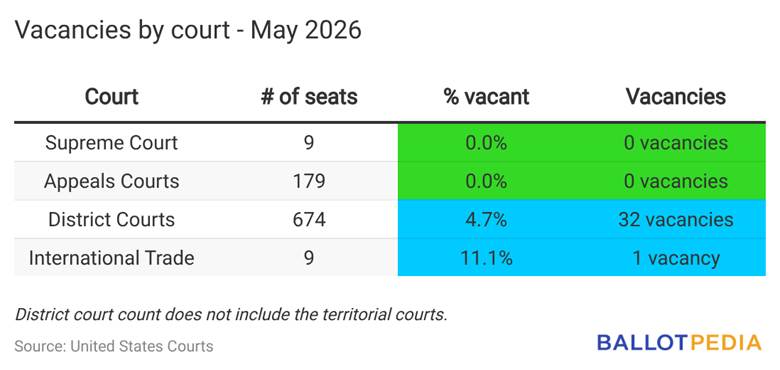
*Though the U.S. territorial courts are named as district courts, they are not Article III courts. They are created in accordance with the power granted under Article IV of the U.S. Constitution. Click here for more information.
New vacancies
No judges left active status since the previous vacancy count. The president nominates individuals to fill Article III judicial position vacancies. Nominations are subject to U.S. Senate confirmation.
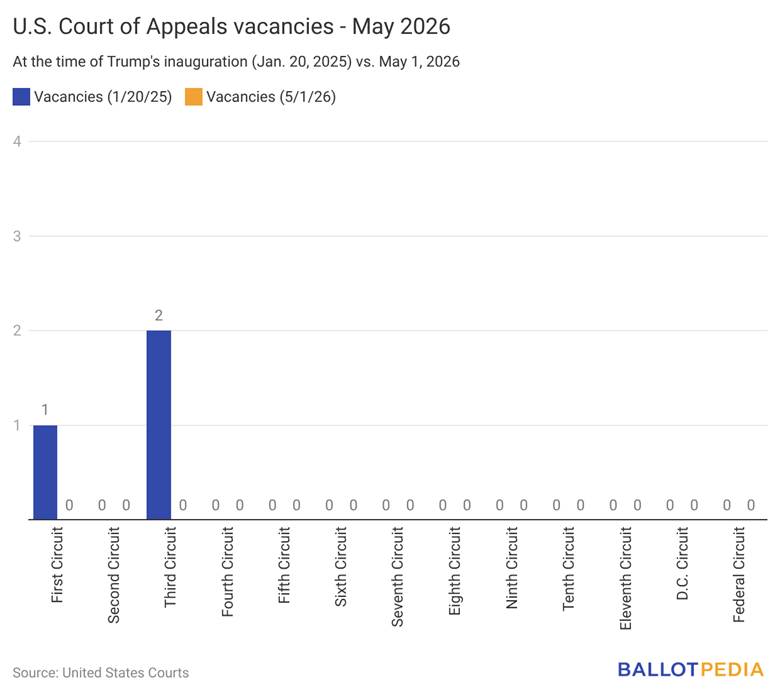
The following chart tracks the number of vacancies in the U.S. Courts of Appeals from President Donald Trump's (R) inauguration to the date indicated on the chart.
U.S. District Court vacancies
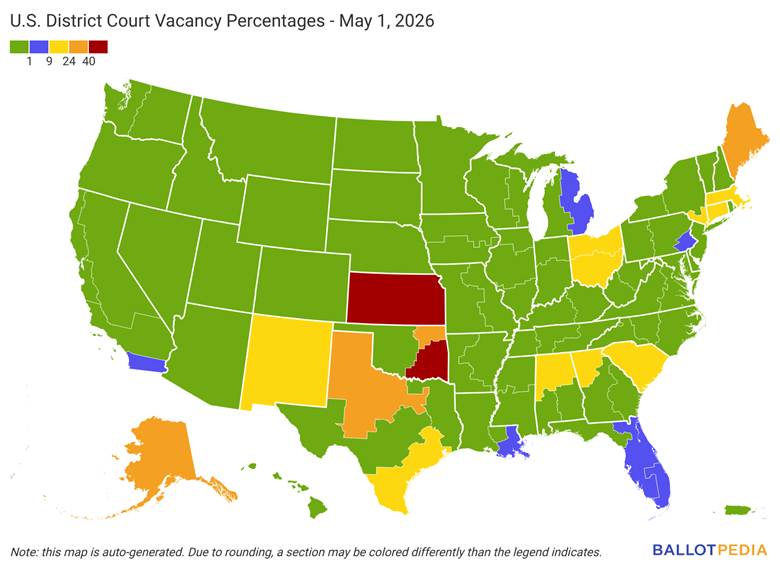
The following map shows the number of vacancies in the U.S. District Courts as of May 1.
New nominations
President Trump announced one new nomination since the April 2026 report:
The president has announced 51 Article III judicial nominations since taking office on Jan. 20, 2025. For more information on the president’s judicial nominees, click here.
New confirmations
As of May 1, the Senate has confirmed 37 of President Trump’s judicial nominees—31 district court judges and six appeals court judges—since January 2025. This is the second-fewest Article III judicial appointments through this point in all presidents’ second terms since President Bill Clinton (D).
- Andrew Davis, to the U.S. District Court for the Western District of Texas
- Chris Wolfe, to the U.S. District Court for the Western District of Texas
- John Shepherd, to the U.S. District Court for the Western District of Arkansas
Comparison of Article III judicial appointments over time by president (1981-Present)
- Presidents have made an average of 50 judicial appointments through May 1 of their second year in office. President Barack Obama (D) had the most appointees confirmed with 73, and President George W. Bush (R) had the fewest confirmations with 33.
- President Bill Clinton (D) made the most appointments through four years with 174. President George W. Bush made the fewest through four years with 122.
- President Obama made the most appointments through two years with 134. President W. Bush made the fewest with 54.
- President Obama made the most appointments through one year in office with 45. President George W. Bush made the fewest with 22.
Need a daily fix of judicial nomination, confirmation, and vacancy information? Click here for continuing updates on the status of all federal judicial nominees.
Or, keep an eye on this list for updates on federal judicial nominations.
Looking ahead
We’ll be back on May 25 with a new edition of Robe & Gavel. Until then, gaveling out!
Contributions
Myj Saintyl compiled and edited this newsletter, with contributions from Sam Post, Ellie Mikus, and Spencer Richardson.