


Welcome to the Wednesday, May 13, 2026, Brew.
By: Briana Ryan
Here’s what’s in store for you as you start your day:
- Louisiana becomes the first state to certify a measure for the 2027 ballot
- A look at the Democratic primary for Maine's 2nd Congressional District — one of 19 Democratic-held districts Donald Trump won in 2024
- Campaigns submit signatures for two California initiatives competing with the proposed billionaire tax measure
Louisiana becomes the first state to certify a measure for the 2027 ballot
On May 6, the Louisiana Legislature approved the Louisiana Supreme Court Jurisdiction for Lawyer Disciplinary Proceedings Amendment, making it the first measure to make the ballot in any state for 2027. This marks the second-earliest that a measure has been certified for an odd-numbered-year ballot since 2010.
The amendment, regarding the Louisiana Supreme Court's authority over disciplinary proceedings against attorneys from other jurisdictions, will appear on the April 17, 2027, statewide primary election ballot.
The earliest certification for an odd-numbered year ballot since 2010 happened on April 15, 2016, when the Maine Legislature certified Maine Question 1. The measure, which issued $50 million in bonds for infrastructure and equipment upgrades in the state's targeted technology sectors and loans to businesses with potential for growth and job creation, appeared on the June 13, 2017, ballot.
On Feb. 19, state Sen. Jay Morris (R) introduced the amendment in Louisiana as Senate Bill 68 (SB 68). The amendment would grant the Court original jurisdiction over disciplinary proceedings not only for members of the state bar, but also for:
- Other lawyers connected to the state, including those specially admitted for a case
- Lawyers who are not licensed in the state but provide legal services in it
- Lawyers who own or operate a law firm in the state
- Lawyers who are not licensed in the state who supervise lawyers licensed in it
Article V, Section 5(B) of the Louisiana Constitution only grants the Court original jurisdiction of disciplinary proceedings against members of the bar within the state.
In Louisiana, a two-thirds (66.67%) vote is required during a single session to put a constitutional amendment on the ballot. That's a minimum of 70 votes in the Louisiana House of Representatives and 26 votes in the Louisiana Senate, assuming there are no vacancies.
On March 24, the state Senate passed it 36-0. On April 28, the state House approved an amended version of the bill 92-0, sending it back to the state Senate. On May 6, the state Senate approved the amended version 37-0.
Louisiana voters rejected a measure related to disciplinary actions from the Court when they decided on Amendment 1 on March 29, 2025. It would have also given the Court original jurisdiction to discipline out-of-state lawyers, and would have authorized the Legislature to establish trial courts with limited or specialized jurisdiction through a two-thirds vote in both chambers. Voters defeated Amendment 1 65% to 35%.
Odd-numbered years typically have fewer measures on statewide ballots than even-numbered years. From 2011 to 2025, an average of 33 statewide measures appeared on odd-numbered-year ballots. From 2010 to 2024, an average of 161 statewide measures appeared on even-numbered-year ballots.
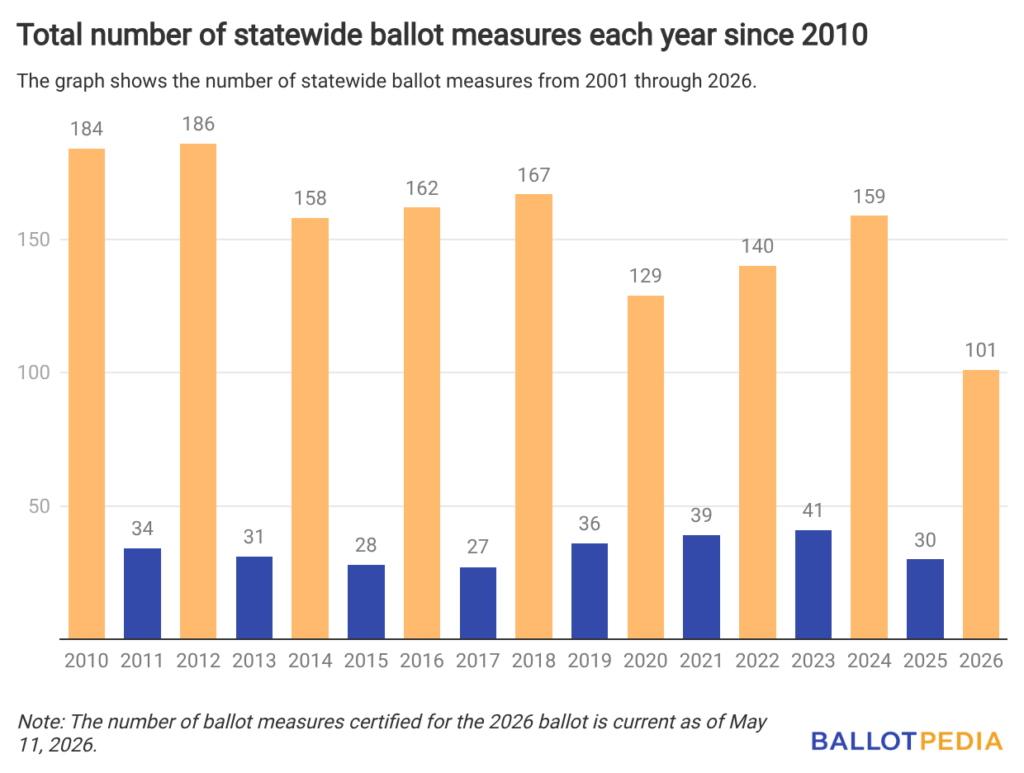
Although the measure in Louisiana is the only one certified in any state for the 2027 ballot so far, it might not remain so for long. Two citizen initiatives have been approved for signature gathering in Maine. Additionally, three legislative referrals — two in Louisiana and one in Wisconsin — are currently pending before their respective state legislatures.
Click here to read more about the Louisiana Supreme Court Jurisdiction for Lawyer Disciplinary Proceedings Amendment, and here to stay up to date on ballot measures for the 2027 ballot.
A look at the Democratic primary for Maine's 2nd Congressional District — one of 19 Democratic-held districts Donald Trump won in 2024
Democrats are competing in a June 9 primary for one of the most Republican-leaning Democratic-held districts in the U.S. House of Representatives — Maine’s 2nd Congressional District, where President Donald Trump (R) won by nine percentage points in 2024 and incumbent Rep. Jared Golden (D) is not running for re-election.
Maine Public's Kevin Miller wrote that "Maine's 2nd District is a perennial battleground between the two national parties. Golden, a centrist Democrat often willing to buck his own party leadership, has held the seat for seven years despite the District's increasingly conservative lean."
In the 2024 presidential election, Trump defeated Kamala Harris (D) in the District 53.5% to 44.5%. Golden defeated Austin Theriault (R) that year 50.3% to 49.7%. Considering redistricting that has happened since the 2024 general elections, Maine’s 2nd Congressional District is one of 19 Democratic-held districts up for election this year that Trump won in 2024.
Among the 19 districts, Trump had the ninth largest margin of victory (MOV) in Maine’s 2nd Congressional District. Golden had the slimmest MOV among the 18 Democrats who ran in those districts with major party opposition. Another Democrat ran in a Trump-won district without major party opposition.
Joe Baldacci (D), Matthew Dunlap (D), Paige Loud (D), and Jordan Wood (D) are running in the primary. The following candidates lead in fundraising, polling, and media attention:
- Baldacci has represented District 9 in the Maine Senate since 2020. He is also a part of the Democratic Congressional Campaign Committee’s (DCCC) Red to Blue program. Baldacci said he is running "because Maine needs a fighter in Washington D.C. — someone who understands what it means when groceries, health care, and housing become unaffordable, and who will actually do something about it."
- Dunlap assumed office as Maine Auditor in 2022. U.S. Rep. Ro Khanna (D-Calif.) and Our Revolution endorsed Dunlap. Dunlap said he is running "because Mainers deserve a fighter who won’t cave to Donald Trump ... When I’m in Congress, I’ll stand up for Maine, and I’ll fight for affordable healthcare, a lower cost of living, and higher wages for hardworking people."
- Wood was the executive director of the political action committee (PAC) democracyFIRST. U.S. Rep. Robert Garcia (D-Calif.) and U.S. Rep. Raul Ruiz (D-Calif.) endorsed Wood. Wood is campaigning on campaign finance and electoral reforms, saying voter trust in elections "has been shaken by dark money, gerrymandering, and attacks on voting rights. We need big reforms to restore faith in our system."
Click here to read more about the June 9 Democratic primary for Maine's 2nd Congressional District. Also, if you're a Maine voter, check out our Sample Ballot Lookup here to prepare for Election Day.
Campaigns submit signatures for two California initiatives competing with the proposed billionaire tax measure
On May 4, campaigns behind two ballot initiatives in California that would challenge provisions of the billionaires' tax initiative submitted signatures for verification:
- The California Prohibit Taxes on Retirement Holdings and Personal Savings Amendment would prohibit the enactment of new taxes after Jan. 1, 2026, on ownership or accumulation of retirement holdings, individually-owned assets, and other forms of personal savings.
- The California Revenue Use Requirements for New Special Taxes Amendment would require state laws or ballot initiatives levying a new special tax, which is any tax imposed for specific purposes, enacted after Jan. 1, 2026, to undergo state audits to determine program effectiveness and cost-saving measures.
The political action committee (PAC) Building a Better California is sponsoring the committee Californians to Protect Retirement and Life Savings. That committee is leading the Yes to Protect Retirement and Life Savings campaign in support of the first initiative. It reported submitting more than 1.4 million signatures. As of March 30, the campaign has reported raising more than $27.7 million. All of the contributions were from Building a Better California, which has received more than half of its total contributions ($102 million) from Google co-founder Sergey Brin ($66 million). The next three highest donors are L. John Doerr III ($10 million), Michael Moritz ($7.5 million), and Patrick Collison ($7 million).
Building a Better California is also sponsoring Californians for a More Transparent and Effective Government, the committee leading the campaign in support of the second initiative. The committee reported raising more than $28.7 million, with Building a Better California contributing all of it.
Signatures for the billionaire tax initiative, or the California One-Time Wealth Tax for State-Funded Health Care Programs Initiative, are also pending verification. The initiative would levy a 5% tax on billionaires' accumulated wealth in the state. Revenue from the tax would be dedicated to state-funded health care programs, such as Medi-Cal, state food assistance, and public education. The initiative is a combined constitutional amendment and state statute.
The Service Employees International Union-United Healthcare Workers West (SEIU-UHW West) is sponsoring Save California Health Care and Public Education, the committee leading the campaign in support of the tax. The campaign submitted 1.5 million signatures on April 27.
Both initiatives challenging the billionaires' tax contain a competing measures provision. The California Prohibit Taxes on Retirement Holdings and Personal Savings Amendment states that if it receives more votes than a competing measure, it would prevail in its entirety over any other measures on the ballot related to taxing personal assets.
The California Revenue Use Requirements for New Special Taxes Amendment states that measures appearing on the same ballot that either impose different audit rules or a state tax exemption from the state spending limit would be deemed in conflict with this initiative. If voters approve this initiative and it receives more affirmative votes than the competing measure, it prevails over the other measure in its entirety. If voters approve both measures and the competing measure receives more affirmative votes but is later ruled invalid, this initiative would take effect.
To qualify an initiated constitutional amendment or a combined constitutional amendment and state statute in California, proponents must submit 874,641 valid signatures, which is equal to 8% of the votes cast at the previous gubernatorial election. The deadline to qualify for the ballot or withdraw an initiative is June 25 (131 days before the election).
Currently, six statewide measures have made the ballot in California this year. From 2010 to 2024, an average of 12 statewide measures appeared on even-numbered-year ballots.
Currently, there are 12 initiatives that have submitted signatures that are pending verification. Click here for a full list of the measures that have made the ballot or are awaiting signature verification in California this year.