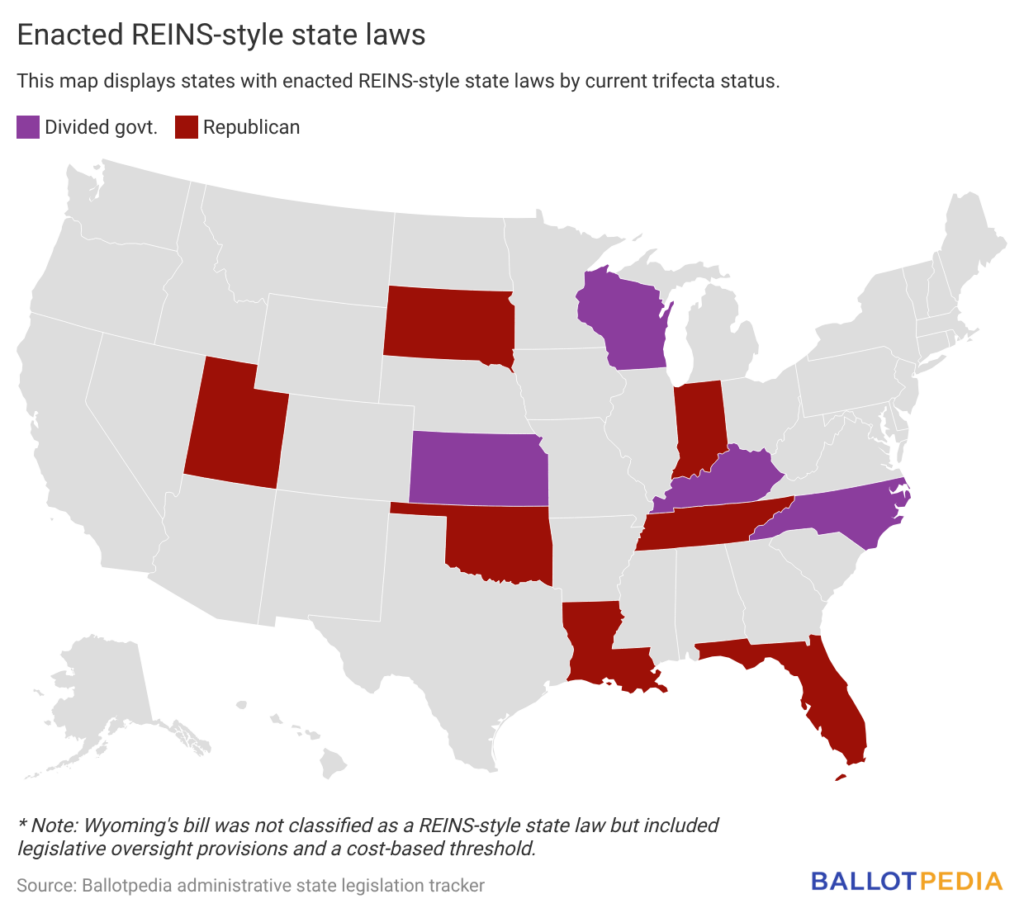
On May 19, Tennessee Gov. Bill Lee (R) signed HB 1913 into law. The bill introduces a REINS-style requirement for agency rulemaking, under which the legislature must approve of proposed rules exceeding a cost threshold. The bill also requires rulemaking agencies to seek feedback from trade organizations that would be affected by a proposed rule, and to include this feedback in a required fiscal impact statement. Tennessee is the second state to enact a REINS-style law in 2026 (after South Dakota), and the 11th state to do so since 2010.
The bill was introduced in the Tennessee House of Representatives on Jan. 22. It passed the House 76-16 on April 13, with four Democrats joining 72 Republicans in voting yes, and 16 Democrats voting no. It passed the Tennessee Senate 24-4 on April 16, with 24 Republicans voting yes and one Republican joining three Democrats in voting no. The bill was delivered to Gov. Lee for signature on May 7.
What does the law do?
HB 1913 is a REINS-style law, requiring that proposed agency rules that are expected to cost $1 million or more over a five-year period receive approval from the legislature before they can go into effect. A proposed emergency rule expected to cost $1 million or more annually must also receive legislative approval. An emergency rule costing this much will expire in 180 days, with the adjournment of the next special session of the legislature, or on the 14th day of the next legislative session (whichever comes first).
HB 1913 also establishes specific requirements for an agency-generated fiscal impact statement for a proposed rule (which is used to determine whether a rule exceeds the $1 million cost threshold). Rulemaking agencies must “make a good faith effort to notify each trade association or organization” affected by a proposed rule, and to incorporate responses to feedback received from these organizations in the fiscal impact statement. The bill also requires rulemaking agencies to provide notice of rules expected to exceed the $1 million cost threshold to the Governor, speakers of the Senate and House of Representatives, and the chairs of the Joint Government Operations Committee. This notice must include a copy of the fiscal impact statement.
The bill also requires agencies to compile an annual report on rulemaking costs from that year’s fiscal impact statements, and to submit this report to the Secretary of State, speakers of the Senate and House of Representatives, and the chairs of the Joint Government Operations Committee. In addition, the bill allows the Joint Government Operations Committee to submit a proposed rule expected to cost $750,000 or more over a five year period (or an emergency rule costing $750,000 or more annually) to the legislative director of the Fiscal Review Committee for independent fiscal analysis.