


Welcome to the Wednesday, May 27, 2026, Brew.
By: Briana Ryan
Here’s what’s in store for you as you start your day:
- Mississippi — one of nine states with supreme court districts — could redraw the districts in the next year
- Virginia Gov. Abigail Spanberger vetoes bills, issues executive order on immigration enforcement at polling places
- Los Angeles mayoral candidates Bass and Raman discuss homelessness, housing affordability, and the environment in our Candidate Connection survey
Mississippi — one of nine states with supreme court districts — could redraw the districts in the next year
While congressional and state legislative districts are supposed to be redrawn every 10 years, this is not always the case with state supreme court districts. In fact, Mississippi was set to redraw its districts for the first time since 1987, but the U.S. Supreme Court’s ruling in Louisiana v. Callais led to the cancellation of a court order for the state to do so.
On May 11, after the ruling in Louisiana v. Callais, the 5th U.S. Circuit Court of Appeals canceled a U.S. District Court judge’s 2025 order that the Mississippi Legislature redraw its districts to include a majority-Black district to be in accordance with the Voting Rights Act. Subsequently, Gov. Tate Reeves (R) canceled a special session to redraw the districts, though he said the Legislature will likely redraw the judicial, legislative, and congressional maps in the future.
Two states that have recently redrawn their districts are Illinois and Louisiana. The Illinois Legislature redrew the state’s districts in 2021, the first time since 1964. The Louisiana Legislature redrew the state’s districts in 2024 for the first time since 1997 to create a second Black-majority district.
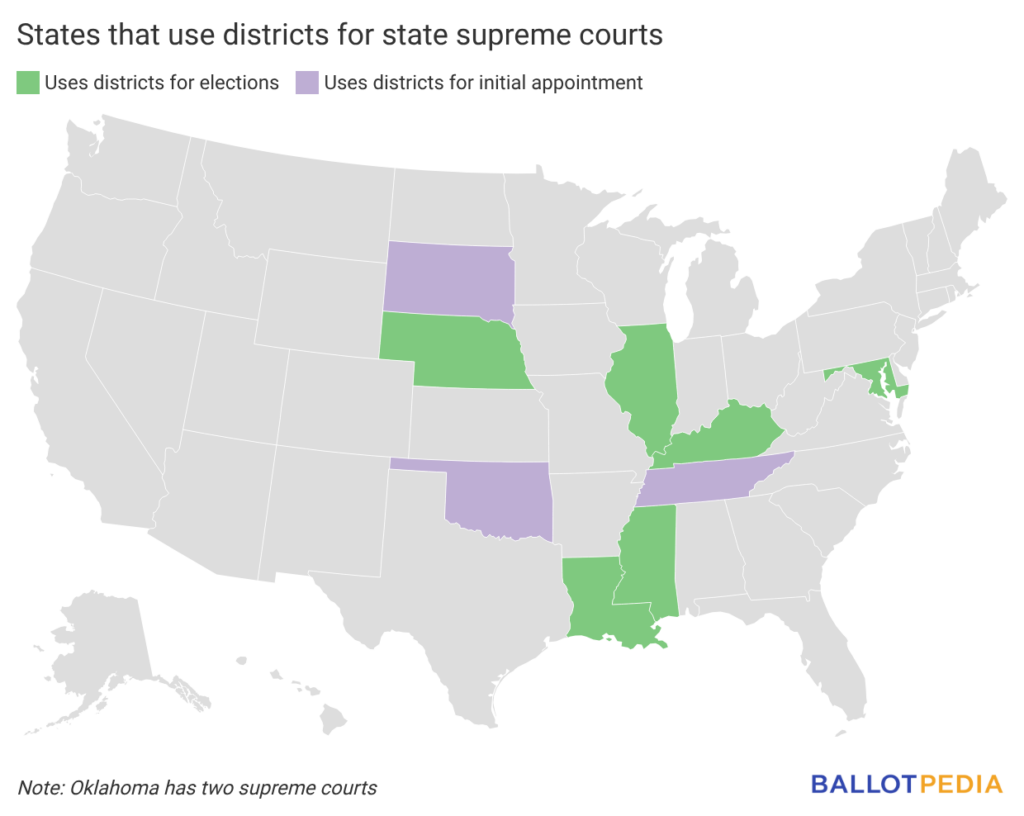
States use supreme court districts in one of two ways — for all elections to the court or for initial appointment after which all justices must run in statewide retention elections.
Mississippi is one of six states that use districts for supreme court elections, along with Illinois, Kentucky, Louisiana, Maryland, and Nebraska. Illinois and Louisiana use partisan elections, while Kentucky and Mississippi use nonpartisan elections, and Maryland and Nebraska use retention elections.
South Dakota, Tennessee, and Oklahoma use districts for initial appointment after which all justices must run in statewide retention elections. Oklahoma uses districts for both its Supreme Court and Court of Criminal Appeals. Oklahoma is one of two states nationwide that have two courts of last resort, one for civil appeals and one for criminal appeals.
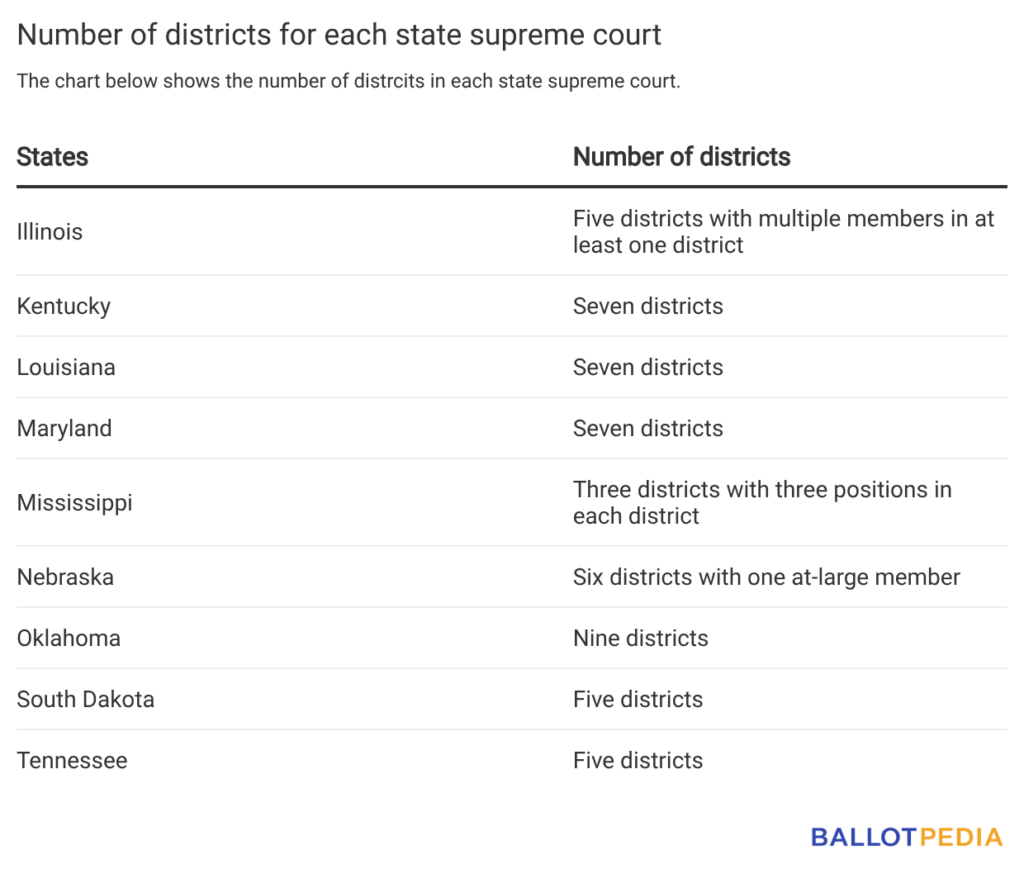
The number of districts varies by state, ranging from three to nine. Some courts have multiple members serving in a district, such as Illinois, where District 1, based in Cook County, has three justices, while the other districts have only one. In Mississippi, there are three districts, each with three positions. In Nebraska, six of the justices are elected from districts, while the chief justice is an at-large position.
Although the states named above use districts for elections or appointments, they hear cases as one court.
Thirty-two states are holding supreme court elections this year, including Kentucky, Louisiana, and Maryland. Click here to read more about state supreme court elections this year.
Virginia Gov. Abigail Spanberger vetoes bills, issues executive order on immigration enforcement at polling places
Virginia Gov. Abigail Spanberger (D) vetoed legislation on May 20 that would have prohibited immigration enforcement near election sites. On the same day, she issued an executive order requiring state election officials to develop guidance on the issue.
Spanberger’s victory in November gave Democrats a trifecta in Virginia for the first time since 2021. As of May 26, Virginia has enacted more election-related bills than any other state in the country.
HB 650 and SB 351 would have prohibited immigration enforcement within 40 feet of a polling place, recount location, or electoral board meeting place, and would also have restricted immigration enforcement at other non-election sites.
In her veto message, Spanberger said the bills "would effectively require security guards and, in some cases, local law enforcement be placed in the untenable position of choosing between violating state law or federal law, rendering this proposal unworkable."
SB 351 sponsor Sen. Saddam Salim (D) said, "We strongly disagree with Governor Spanberger's veto of SB 351. This is a disappointing choice that undermines public safety and accountability in Virginia. This bill is a common-sense measure that would have protected Virginians and strengthened trust in our institutions."
Also on May 20, Spanberger signed an executive order requiring the state Department of Elections to issue guidance for election workers on engaging with federal immigration officers at polling places, among other directives.
There is no timeline for when the agency must issue the guidelines, but the order requires the department to obtain input from relevant stakeholders before doing so.
The order requires the state Department of Elections to develop guidance on engaging with "persons with the lawful authority to perform civil arrests who conduct or attempt to conduct a federal civil immigration arrest at a polling place when the polls are open and ballots are being counted, or within one hour of polls opening or after closing."
A month before issuing the executive order and vetoing HB 650 and SB 351, Spanberger signed four bills related to law enforcement presence at polling places and election sites.
HB 1441 and SB 783 prohibit federal agents from conducting any immigration enforcement activity within 500 yards of any polling place during the times the polls are open, and ballots are being counted, or within one hour before the polls open and one hour after they close. HB 1441 and SB 783 are the only bills enacted so far this year in any state that specifically restrict immigration activities near polling places.
HB 286 and SB 337 prohibit the governor from calling the National Guard to intimidate or threaten any person from voting in a certain way, or to deter them from voting. Spanberger signed all four bills on April 22.
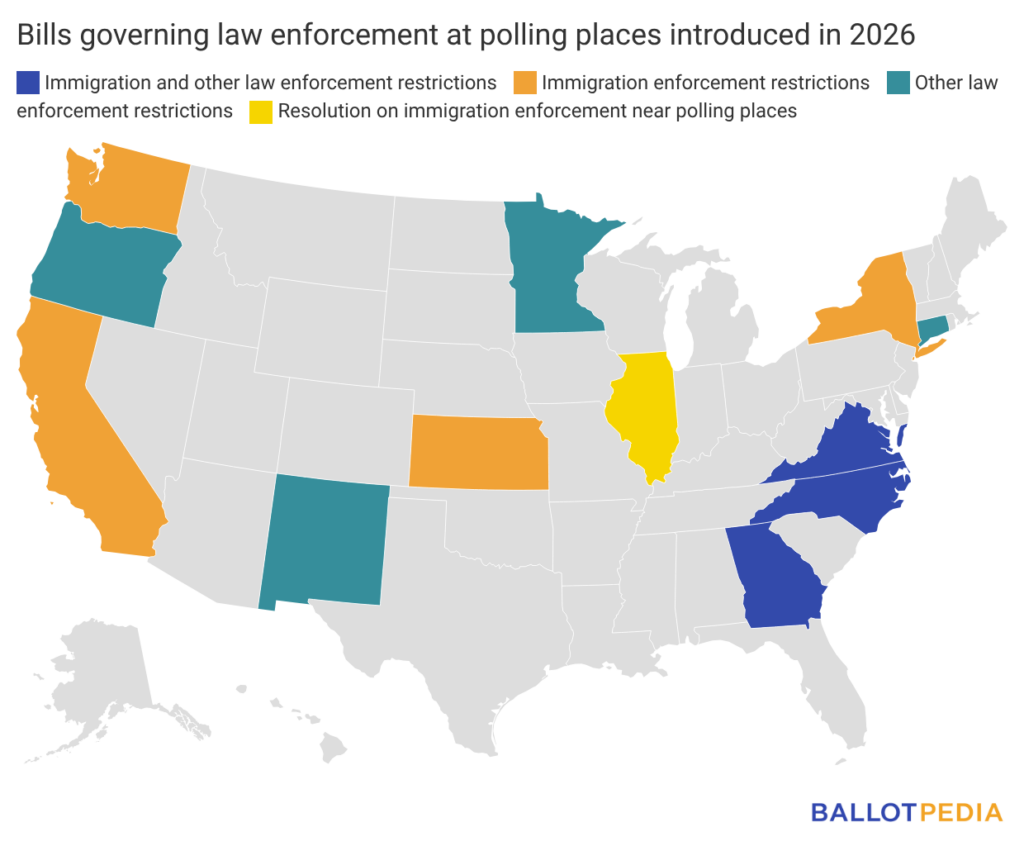
Three other states have also enacted bills regarding law enforcement at election sites so far this year.
Connecticut HB 5001, which Gov. Ned Lamont (D) signed on May 15, prohibits a federal or state law enforcement officer from being within 250 feet of an election site to search, detain, or arrest individuals unless they have proper authority to be there.
Legislation enacted in New Mexico prohibits troops or armed agents from being within 50 feet of a polling site or ballot drop box. In Oregon, HB 4138 prohibits law enforcement from wearing face coverings within 250 feet of a ballot deposit site or voting location. New Mexico Gov. Michelle Lujan Grisham (D) and Oregon Gov. Tina Kotek (D) signed the bills in March.
Nationally, 12 states have introduced 26 bills or resolutions related to law enforcement presence at polling places so far this year. Seven of those states introduced legislation specifically restricting immigration enforcement near election sites.
Click here for more information about the Virginia bills mentioned above.
Los Angeles mayoral candidates Bass and Raman discuss homelessness, housing affordability, and the environment in our Candidate Connection survey
Twelve of the 16 candidates running in the nonpartisan primary election for mayor of Los Angeles on June 2 have completed our Candidate Connection Survey, including two of the three candidates who lead in polling and media attention — incumbent Mayor Karen Bass and Nithya Raman.
These survey responses allow voters to hear directly from candidates about what motivates them to run for office. Bass and Raman both reference addressing homelessness, housing affordability, and the environment in the city in their surveys.
In Bass' responses, she defended her record, writing, "Through initiatives like Inside Safe, we are moving people indoors and treating this as a humanitarian crisis. I am also dedicated to environmental justice, having worked to phase out urban oil drilling and transition Los Angeles to a clean energy future while protecting our most vulnerable communities."
However, Raman wrote in her responses, "What we're doing isn't working. We've spent billions of dollars without seeing the results people deserve, and that has to change." Additionally, she wrote that "Our region has the fewest homes per adult in the country, and as a result we have the most overcrowding, the highest number of rent-burdened households, and the largest unsheltered homeless population of any city."
Although Los Angeles mayoral elections are officially nonpartisan, Bass is a Democrat, and Raman is a Democrat who has received support from the Democratic Socialists of America in past elections. The third noteworthy candidate running in the primary, Spencer Pratt, is a Republican.
The Los Angeles Times' Steve Lopez writes, "Raman is to the left of Bass and the traditional left in Los Angeles. ... Raman's candidacy — along with DSA candidates for other city offices — makes the election something of a referendum on the evolving center of political clout in L.A." Pratt is running to the right of Bass, focusing on public safety and crime reduction.
Los Angeles' chapter of the Democratic Socialists of America did not endorse a candidate for the primary election. Endorsements for Bass include both business and labor organizations and the Los Angeles County Democratic Party. Senator Rick Scott (R-Fla.) and Donald Trump's (R) presidential envoy for special missions Richard Grenell endorsed Pratt. Abundant Housing LA and the Future Urbanist Club endorsed Raman.
Click here for more information about our Candidate Connection Survey. You can also check out Bass' and Raman's full responses here and here.