


Welcome to Ballot Bulletin: Ballotpedia's Weekly Election Policy Digest. Every Tuesday, we deliver the latest updates on election policy around the country, including nationwide trends and recent legislative activity.
In this week’s edition, we cover 143 bills state legislatures acted on last week and look at legal developments affecting New Hampshire’s documentary proof of citizenship law.
The state of election legislation in the U.S.
Note: The legislative activity covered in this edition of Ballot Bulletin has been adjusted due to last week’s Memorial Day holiday. Today's newsletter covers legislative activity from May 22 to May 31.
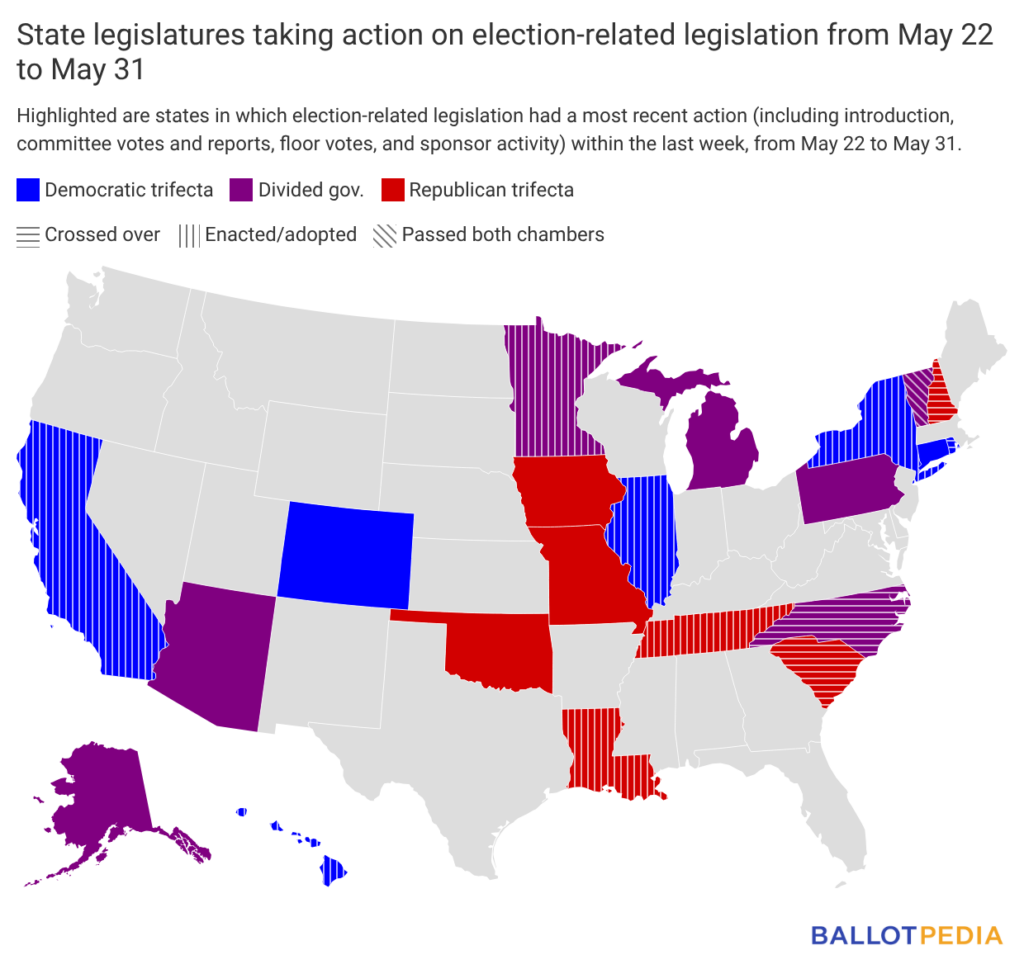
Lawmakers in 21 states acted on 143 election-related bills last week. Seventeen state legislatures are in regular or special sessions. Last week, nine bills were enacted, six bills passed both chambers of a state legislature, and one bill was vetoed.
Of the bills acted on last week, 93 (65%) are in states with Democratic trifectas, 39 (27.3%) are in states with Republican trifectas, and 11 (7.7%) are in states with divided government. The most active bill categories last week were voter registration and list maintenance (20), election types and stages (19), ballots and voting materials (19), and Election Day voting (18).
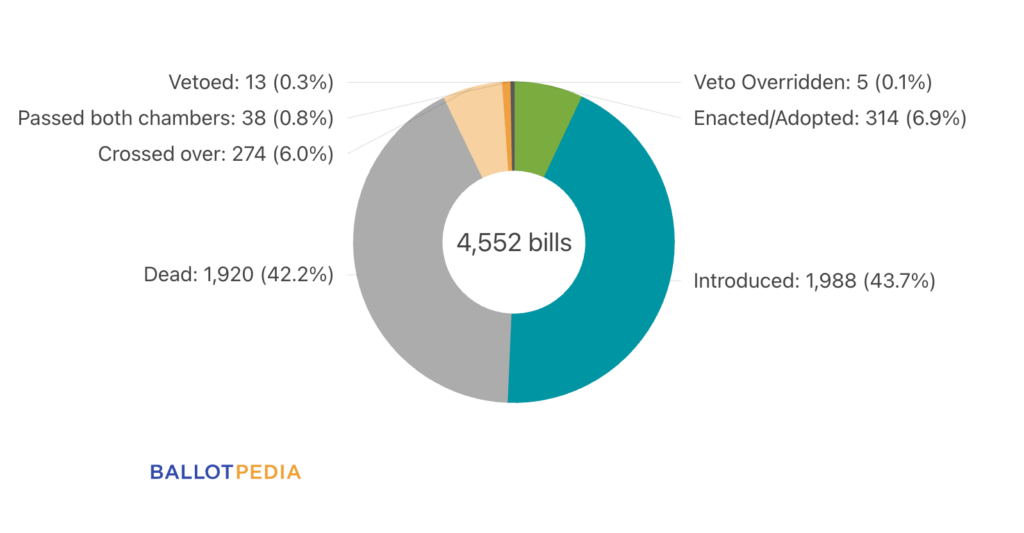
We are currently tracking 4,552 election-related bills across the country. The chart below breaks down the status of those bills by where they stand in the legislative process:
Enacted bills
On May 27, California Gov. Gavin Newsom (D) signed SB 73 into law. The bill prohibits individuals from providing unauthorized access to law enforcement personnel seeking voter lists or equipment, prohibits peace officers from interfering with the administration of elections or with election workers performing their duties, and creates criminal penalties for knowingly seizing ballots from election officials. It also requires the California Department of Justice to provide guidance to county election officials on how to respond to law enforcement requests for access to ballots.
On May 29, Hawaii Gov. Joshua Green (D) signed SB 2239 into law. It requires individuals applying for a driver’s license or ID to be automatically registered to vote, provided they do not affirmatively decline. The bill also requires the name and address of individuals applying for these IDs who are registered to vote to be automatically updated in their voter registration records, also providing they do not affirmatively decline.
On May 29, Louisiana Gov. Jeff Landry (R) signed SB 121 into law, adopting new congressional maps for the state. Read more about this bill and other mid-decade redistricting efforts below.
Six other bills were enacted or adopted last week:
- Hawaii (Democratic trifecta)
- Illinois (Democratic trifecta)
- Minnesota (Divided government)
- New York (Democratic trifecta)
- Tennessee (Republican trifecta)
Bills passing both chambers
Six bills passed both chambers last week:
- Illinois (Democratic trifecta)
- Louisiana (Republican trifecta)
- Vermont (Divided government)
To see a full list of bills awaiting gubernatorial action, click here.
Vetoed bills
One bill was vetoed this week:
- Arizona (Divided government):
To see a list of all bills vetoed this session, click here.
All bills
The chart below shows all bills Ballotpedia is currently tracking, broken down by partisan sponsor
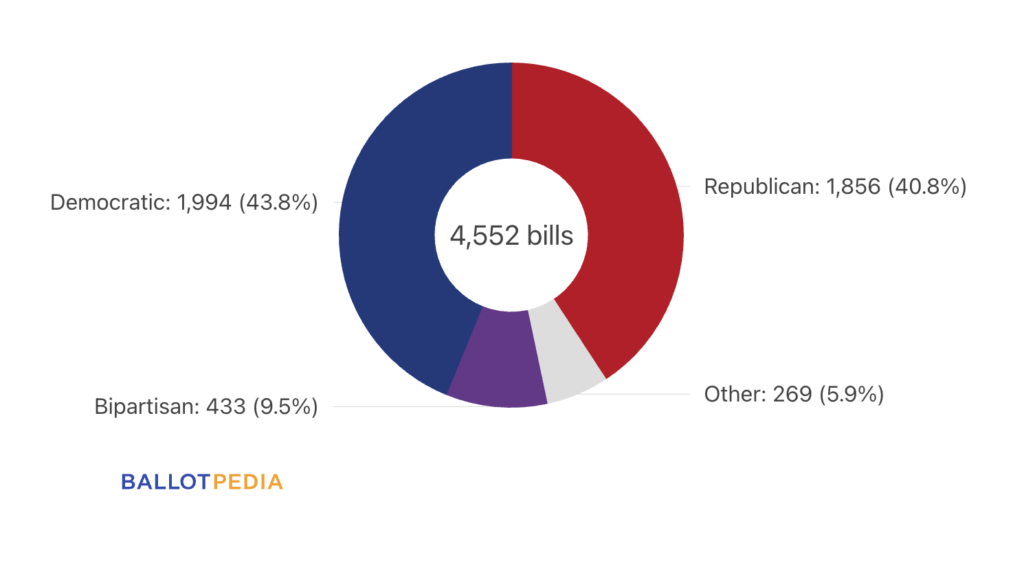
We are currently following 4,552 election-related bills, including bills carried over from the previous year.
- Trifecta status
- Democratic: 1,940 (42.6%)
- Republican: 1,650 (36.2%)
- Divided: 962 (21.1%)
- Partisan sponsorship
- Democratic: 1,994 (43.8%)
- Republican: 1,856 (40.8%)
- Bipartisan: 433 (9.5%)
- Other: 269 (5.9%)
In the news
On May 29, Louisiana Gov. Jeff Landry (R) signed SB 121 into law, adopting new congressional maps for the Republican-trifecta state. Lawmakers aimed with the new maps to shift one of the state’s two Democratic districts toward Republicans. As covered in the May 19 edition of Ballot Bulletin, Landry signed HB 842 on May 14, moving Louisiana’s 2026 U.S. House races from the state’s semi-closed party primary on May 16, to the state's majority-vote system election, with the first round on Nov. 3. The governor previously issued an executive order on April 30 suspending the U.S. House primary elections so that the legislature could draw new maps. A panel of three federal judges is scheduled to meet later this month to determine whether the new maps comply with the Callais decision.
On May 26, the South Carolina State Senate voted 26-18 against continuing debate on H 5683, which would have redrawn the state’s congressional districts. The Senate also adjourned until June 10, the day after the state’s congressional primary elections. South Carolina Gov. Henry McMaster (R) previously called a special session of the legislature starting May 15 to consider redistricting. On May 27, the governor issued a statement confirming that no new congressional map would be approved this election cycle.
On May 26, the U.S. District Court for the Northern District of Alabama issued an injunction against the state’s 2023 congressional districts, saying elections using the maps would be “tainted by intentional race-based discrimination.” On May 27, Attorney General of Alabama Steve Marshall (R) filed an emergency appeal with the U.S. Supreme Court for a stay of the district court’s ruling. Following Louisiana’s enactment of its new congressional maps, mid-decade redistricting efforts would net 10 congressional districts for Republicans if Alabama's previously invalidated maps are allowed to take effect.
Here are other news stories from across the country:
- On May 28, the U.S. District Court for the District of Columbia issued a ruling declining to block President Donald Trump’s (R) March 31 executive order regarding absentee/mail-in ballots. The order requires the U.S. Postal Service to mail such ballots only to voters on an approved list, among other provisions. On May 29, the Postal Service filed a proposed rule to implement the executive order.
- On May 26, the Circuit Court of the Second Judicial Circuit of Florida issued a ruling declining to strike down the state’s new congressional maps, which Gov. Ron DeSantis (R) signed into law on May 4. As covered in the May 5 edition of Ballot Bulletin, the Equal Ground Education Fund and a group of Florida voters sued to block the maps, saying that the redistricting plans violate the state constitution’s prohibition on partisan gerrymandering (known as the Fair Districts Amendment). In his opinion, Judge Joshua Hawkes said the 2022 maps could not be upheld in favor of the new maps because the plaintiffs’ evidence “does not sufficiently challenge the political branches’ finding that CD-20 in the 2022 map was drawn with impermissible racial intent.”
- On June 1, the U.S. Supreme Court declined to hear Rose v. Raffensperger, a case concerning Georgia’s at-large system for electing members of the Georgia Public Service Commission. In 2022, a group of voters sued the state, saying that the statewide, at-large election of public service commissioners diluted Black voting power in violation of Sec. 2 of the Voting Rights Act. The U.S. District Court for the Northern District of Georgia ruled in favor of the voters, but in Nov. 2023, the U.S. Court of Appeals for the Eleventh Circuit overturned the district court’s decision.
Policy spotlight: Federal judge strikes down part of New Hampshire's documentary proof of citizenship law
The story below is adapted from a recent Ballotpedia News story by Andrew Bahl.
On May 28, a federal judge ruled that parts of a New Hampshire law requiring individuals to provide documentary proof of citizenship to register to vote were unconstitutional.
U.S. District Court Judge Samantha Elliott's ruling did not invalidate the proof-of-citizenship requirement.
Instead, it reinstated the option for people to register to vote by signing an affidavit attesting to their citizenship under penalty of perjury, rather than presenting another document, such as a birth certificate, passport, or naturalization papers, to register.
HB 1569, which Gov. Chris Sununu (R) signed in September 2024, eliminated the option for prospective voters to sign a qualified voter affidavit as proof of citizenship. It also removed voters' ability to sign a separate affidavit in response to having their eligibility to vote challenged on Election Day.
The New Hampshire Youth Movement and the Coalition for Open Democracy, the League of Women Voters, the Forward Foundation, and multiple prospective voters filed two lawsuits later that same month, alleging that eliminating the two affidavits unduly burdened the right to vote and violated the U.S. Constitution. The lawsuits were later consolidated into one case.
The New Hampshire Attorney General's office argued that the new requirements were necessary to reduce the risk of voter fraud and increase voter confidence in elections. It also argued that changes to the law in 2025, including allowing election officials to use an online database to help verify a person’s citizenship, mitigated the burden on voters.
In her ruling, Elliott held that removing the affidavit option had led to eligible voters being turned away from polling places when trying to register on election day. She said that the 2024 law did not adequately further the state’s interests.
“It may be tempting for some to describe the Qualified Voter Affidavit as an exception to the proof-of-citizenship requirement, but it is not,” Elliott wrote. “A sworn affidavit capable of exposing an affiant to criminal prosecution is a method of proving citizenship and not an exception to that requirement. Moreover, the evidence shows that it is the only method of proof available to a significant number of New Hampshire voters.”
The ruling prevents the state from enforcing the prohibition on using the two affidavits, reinstating their use ahead of New Hampshire’s September 8 primary election.
In a statement, League of Women Voters chief of activation and justice Marcia Johnson said, "This decision sends a clear message that constitutional rights do not end when voting begins. Eligible voters should not be denied access to voting because of burdensome and unnecessary requirements."
A spokesperson for the New Hampshire Attorney General's office said they would appeal the decision.
“We are disappointed with the court’s decision and are carefully reviewing the order at this time,” spokesperson Michael Garrity said. “HB 1569 represents a common-sense approach to voter registration and election administration designed to protect the integrity of our elections.”
HB 365, which Gov. Kelly Ayotte (R) signed into law on May 18, will also be in effect for the primary election. The measure requires clerks to confirm the citizenship status of individuals without documentary proof of citizenship through the New Hampshire Secretary of State's office. If a check of "relevant and available in-state, out-of-state, and federal databases" confirms that a person is a U.S. citizen, the proof of citizenship requirement is considered satisfied.
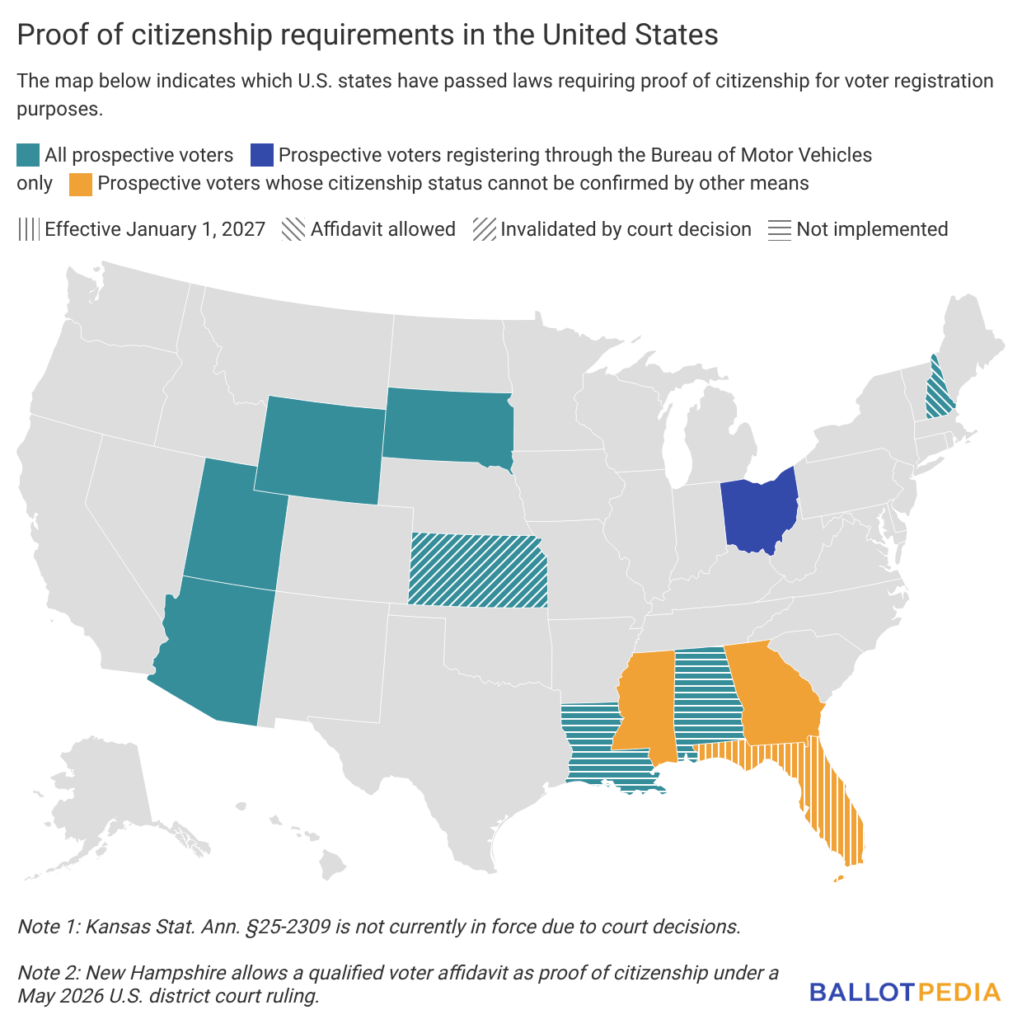
Twelve states, including New Hampshire, have laws requiring proof of citizenship to register to vote in at least some cases.
As of June 2026, Alabama and Louisiana have not implemented their proof-of-citizenship laws. A federal court blocked Kansas' proof-of-citizenship law in 2018.
One state, Ohio, requires proof of citizenship only when registering to vote at a Bureau of Motor Vehicles facility. Three states, Florida, Georgia, and Mississippi, require proof of citizenship at the time of registration if a person's citizenship status cannot be confirmed by other means.
Four states — Florida, Mississippi, South Dakota, and Utah — enacted or expanded documentary proof-of-citizenship laws in 2026. Twenty-three states have introduced 49 bills related to proof of citizenship this year.For more information on documentary proof-of-citizenship laws, click here.