


On May 28, a federal judge ruled that parts of a New Hampshire law requiring individuals to provide documentary proof of citizenship to register to vote were unconstitutional.
U.S. District Court Judge Samantha Elliott's ruling did not invalidate the proof-of-citizenship requirement.
Instead, it reinstated the option for people to register to vote by signing an affidavit attesting to their citizenship under penalty of perjury, rather than presenting another document, such as a birth certificate, passport, or naturalization papers, to register.
HB 1569, which Gov. Chris Sununu (R) signed in September 2024, eliminated the option for prospective voters to sign a qualified voter affidavit as proof of citizenship. It also removed voters' ability to sign a separate affidavit in response to having their eligibility to vote challenged on Election Day.
The New Hampshire Youth Movement and the Coalition for Open Democracy, the League of Women Voters, the Forward Foundation, and multiple prospective voters filed two lawsuits later that same month, alleging that eliminating the two affidavits unduly burdened the right to vote and violated the U.S. Constitution. The lawsuits were later consolidated into one case.
The New Hampshire Attorney General's office argued that the new requirements were necessary to reduce the risk of voter fraud and increase voter confidence in elections. It also argued that changes to the law in 2025, including allowing election officials to use an online database to help verify a person’s citizenship, mitigated the burden on voters.
In her ruling, Elliott held that removing the affidavit option had led to eligible voters being turned away from polling places when trying to register on election day. She said that the 2024 law did not adequately further the state’s interests.
“It may be tempting for some to describe the Qualified Voter Affidavit as an exception to the proof-of-citizenship requirement, but it is not,” Elliott wrote. “A sworn affidavit capable of exposing an affiant to criminal prosecution is a method of proving citizenship and not an exception to that requirement. Moreover, the evidence shows that it is the only method of proof available to a significant number of New Hampshire voters.”
The ruling prevents the state from enforcing the prohibition on using the two affidavits, reinstating their use ahead of New Hampshire’s September 8 primary election.
In a statement, League of Women Voters chief of activation and justice Marcia Johnson said, "This decision sends a clear message that constitutional rights do not end when voting begins. Eligible voters should not be denied access to voting because of burdensome and unnecessary requirements."
A spokesperson for the New Hampshire Attorney General's office said they would appeal the decision.
“We are disappointed with the court’s decision and are carefully reviewing the order at this time,” spokesperson Michael Garrity said. “HB 1569 represents a common-sense approach to voter registration and election administration designed to protect the integrity of our elections.”
HB 365, which Gov. Kelly Ayotte (R) signed into law on May 18, will also be in effect for the primary election. The measure requires clerks to confirm the citizenship status of individuals without documentary proof of citizenship through the New Hampshire Secretary of State's office. If a check of "relevant and available in-state, out-of-state, and federal databases" confirms that a person is a U.S. citizen, the proof of citizenship requirement is considered satisfied.
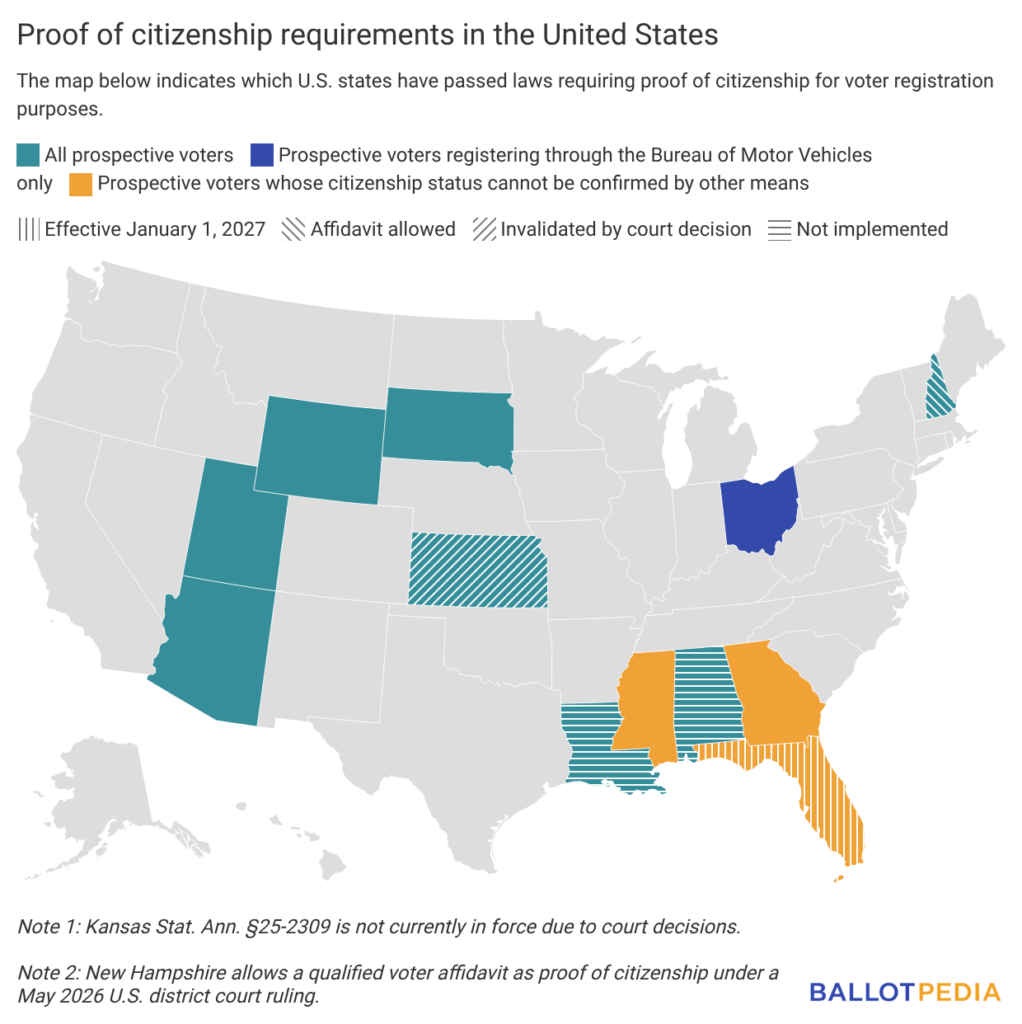
Twelve states, including New Hampshire, have laws requiring proof of citizenship to register to vote in at least some cases.
As of June 2026, Alabama and Louisiana have not implemented their proof-of-citizenship laws. A federal court blocked Kansas' proof-of-citizenship law in 2018.
One state, Ohio, requires proof of citizenship only when registering to vote at a Bureau of Motor Vehicles facility. Three states, Florida, Georgia, and Mississippi, require proof of citizenship at the time of registration if a person's citizenship status cannot be confirmed by other means.
Four states — Florida, Mississippi, South Dakota, and Utah — enacted or expanded documentary proof-of-citizenship laws in 2026. Twenty-three states have introduced 49 bills related to proof of citizenship this year.
For more information on documentary proof-of-citizenship laws, click here.