


Welcome to the Thursday, June 4, 2026, Brew.
By: Briana Ryan
Here’s what’s in store for you as you start your day:
- South Dakota to hold its first primary runoff since adopting the system in 1985
- Eleven candidates are running in the June 9 Republican primary for South Carolina’s 1st Congressional District
- President Donald Trump issued five executive orders in May, matching April for second-fewest in his second term
South Dakota to hold its first primary runoff since adopting the system in 1985
On June 2, voters in California, Iowa, Montana, New Jersey, New Mexico, and South Dakota headed to the polls. Here's a look at some noteworthy elections and where they stand as of June 3 at 4: 00 p.m. EST.
South Dakota
Governor Larry Rhoden and Toby Doeden advanced from the four-candidate Republican primary to the July 28 runoff — the state's first since adopting runoffs in 1985. The law states that a congressional or gubernatorial candidate must win at least 35% of the vote to avoid a runoff between the top two vote-getters. Doeden won 30.6% of the vote, and Rhoden won 25.2%.
California
California uses a top-two primary system. In a top-two primary system, all candidates appear on the same ballot. The top two vote-getters, regardless of their partisan affiliations, advance to the general election.
The 61-candidate primary for the open governor's office remains uncalled. So far, Steve Hilton (R) is in the lead with 27.8% of the vote, Xavier Becerra (D) is in second with 25.4%, and Tom Steyer (D) is in third with 19.6%. CalMatters' Ben Christopher wrote that one thing we do know is that preliminary results show there is no longer any possibility that two Republicans could advance to the general election, an outcome Democratic Party leaders worried about because of the large number of Democrats who ran compared to Republicans.
Connie Chan (D), a progressive, and Scott Wiener (D), a moderate, advanced from the 12-candidate primary to the general election in the race to succeed Rep. Nancy Pelosi (D) in representing the 11th Congressional District. Wiener won 41.3% of the vote, and Chan won 28.6%.
Representative Mike Thompson (D) advanced from the nine-candidate primary to the general election for the 4th Congressional District with 37.4% of the vote. Still, it's unclear who will join him on the ballot. Raymond Riehle (R) is in second with 23.9% of the vote, and Eric Jones (D), who outraised both candidates, is in third with 21%.
Representative David Valadao (R) advanced from the three-candidate primary to the general election for the 22nd Congressional District with 44.5% of the vote. Still, it's unclear who will join him on the ballot — the progressive Randy Villegas (D), who's in second with 29.8% of the vote, or moderate Jasmeet Bains (D), who's in third with 25.7%.
If the current vote totals hold, the incumbent-versus-incumbent race in the 40th Congressional District will continue into the general election. Redistricting drew Reps. Ken Calvert (R) and Young Kim (R) into the same district. Calvert advanced from the eight-candidate primary with 36.2% of the vote. Kim is in second with 21.6% of the vote, and Esther Kim Varet (D) is in third with 15.5%.
The rematch between Rep. Linda Sánchez (D) and Hector De La Torre (D) in the 41st Congressional District ended with Sánchez and Mitch Clemmons (R) advancing from the four-candidate primary to the general election. Clemmons won 40.8% of the vote, and Sánchez won 35.8%.
It's unclear who will advance from the 11-candidate primary for the open insurance commissioner's office, with Jane Kim (D) in the lead with 23.7% of the vote, Ben Allen (D) in second with 19.2%, and Stacy Korsgaden (R) in third with 17.5%. This race is taking place against the backdrop of wildfires across the state that have affected insurance policies in recent years.
Mayor Karen Bass, who won 34.8% of the vote, advanced from the 16-candidate primary to the general election for mayor of Los Angeles after no candidate won at least 50% of the vote. Still, it's unclear who will join her on the ballot — Spencer Pratt, who's in second with 30.4% of the vote, or Nithya Raman, who's in third with 22.3%. Although the race is nonpartisan, Bass and Raman are Democrats. According to the Los Angeles Times' Steve Lopez, Raman ran to the left of Bass. Pratt is a Republican.
Here are some notable local ballot measure results:
- Los Angeles, California, Measure TC would expand the list of fees and charges subject to the city's existing 14% transient occupancy tax to include service, booking, processing, and transaction fees, as well as charges for hotel amenities such as spas and fitness centers, and rental and reservation deposits. Currently, 54.4% of voters have approved the measure.
- Los Angeles, California, Measure TT would increase the transient occupancy tax rate from 14% to 16% through Dec. 31, 2028, then reduce it to 15% beginning Jan. 1, 2029. Currently, 55.6% of voters have defeated the measure.
- Los Angeles County, California, Measure ER would increase the county sales tax from 9.75% to 10.25% for five years to fund county health departments and services. Currently, 53.1% of voters have defeated the measure.
- San Diego, California, Measure A would levy a flat annual tax on residential properties that are vacant for more than 182 days in a calendar year and are not the owner's primary residence. Currently, 57.7% of voters have defeated the measure.
- San Francisco, California, Measure B would establish lifetime term limits of two four-year terms for the mayor and each member of the Board of Supervisors. Currently, 55% of voters have approved the measure.
- Monterey Park, California, Measure NDC amends the city's general plan to prohibit data centers citywide. Voters approved the measure 86.3% to 13.7%.
- Shasta County, California, Measure B would amend the county charter to require in-person voting on a single election day, limit absentee voting to voters who are infirm, military, or U.S. citizens living overseas, and require voters to present a government-issued photo ID before casting a ballot. Currently, 55.6% of voters have approved the measure.
Iowa
Josh Turek, a moderate, defeated Zach Wahls, a progressive, in the Democratic primary for the U.S. Senate in Iowa with 62.7% of the vote. Turek will now face Ashley Hinson (R) in the general election to succeed retiring Sen. Joni Ernst (R). According to The Cook Political Report's Jessica Taylor, "Even though Hinson is a strong candidate who has amassed a formidable war chest, the overall environment in the Hawkeye State is an increasingly favorable one for Democrats given backlash to tariffs and rising fuel and fertilizer prices as a result of the Iran War."
Montana
Shelley Vance — one of the nine Montana state senators whom the state's Republican Party censured in April 2025 — lost re-election to Caleb Hinkle 74% to 26% in the District 34 Republican primary. Of the five censured members who were up for re-election this year, Vance was the only one who sought re-election. Two others retired from public office, and two — Jason Ellsworth and Bruce Gillespie — ran for the Montana House of Representatives. Ellsworth lost, while Gillespie ran unopposed. So far, Vance is one of two Montana state senators who lost re-election.
New Jersey
Rebecca Bennett, a moderate, defeated three other candidates in the Democratic primary for the 7th Congressional District with 45.5% of the vote. Bennett will now face Rep. Tom Kean Jr. (R) in a general election that three independent race forecasters have rated as a toss-up. In 2024, Kean and President Donald Trump (R) won the district. However, Gov. Mikie Sherrill (D) won the district in the 2025 gubernatorial election.
Adam Hamawy, a progressive, defeated 12 other candidates in the Democratic primary for the 12th Congressional District with 28.1% of the vote. Rider University's Micah Rasmussen said the retirement of the district's incumbent and the historical precedent that the incumbent president's party typically loses seats in the U.S. House in midterm elections led to a large number of candidates in the primary.
Click here to check out all the election results from June 2.
Eleven candidates are running in the June 9 Republican primary for South Carolina’s 1st Congressional District
Looking ahead to next week's primary elections, 11 candidates are running in the June 9 Republican primary for South Carolina's 1st Congressional District — the most candidates running in a U.S. House primary in South Carolina this year.
The district is open for the first time since 2013, which is one factor driving the high number of candidates. Incumbent Rep. Nancy Mace (R) is running for governor of South Carolina rather than seeking re-election.
Here's a look at the five candidates who lead in fundraising and media attention:
Jay Byars (R) is a small business founder and Dorchester County Councilmember. He is running on his professional and volunteer experience with his campaign website stating he is "a man in the arena, guided by his faith, grounded in service, and unafraid to speak hard truths. A lifelong servant of God, family, community, and country, Jay brings a rare blend of grit, integrity, and real-world leadership to every role he takes on."
Jenny Honeycutt (R) is an attorney and Charleston County Councilmember. She is running on her connections to the area, with her campaign website stating she is "running for Congress because she believes the Lowcountry deserves leadership rooted in integrity, principle, and a genuine commitment to serve because our home and our values must be protected."
Sam McCown (R) is a physician and medical administrator focused on women's cancer treatment. He is running on his personal and professional experience, saying in a campaign advertisement, "I'm not running to be another voice in the choir. I'm running to get results. I'm an engineer, a doctor, an entrepreneur that has spent my life solving tough problems in the real world."
Alex Pelbath (R) is a retired U.S. Air Force colonel. He is running on his military experience, including having commanded the last flight out during the evacuation of Kabul, Afghanistan, in 2021, saying in a campaign advertisement, "I was the commander of the final air mission out of Afghanistan. I never planned to run for Congress, but I've witnessed the devastation caused by career politicians' weak leadership. We can't let that happen anymore. ... I led the last mission out, but the fight's not over."
Mark Smith (R) is a member of the South Carolina House of Representatives and the president and chief executive officer of McAlister-Smith Funeral Homes, Inc. He is running on his political experience, with a campaign advertisement stating, "This man isn't a slick politician. He's a man that gets things done. ... From town council to the state house, a conservative record. Voted for the biggest tax cut in South Carolina history, helped establish South Carolina's illegal immigration task force, and has worked to preserve Lowcountry values."
Also running in the primary are Dan Brown (R), Logan Cunningham (R), Tyler Dykes (R), Kendal Ludden (R), and Cindy Riley (R). Former Gov. and U.S. Rep. Mark Sanford (R) withdrew after the filing deadline, but his name will still be on the ballot.
Click here to read more about the Republican primary. Also, if you're a South Carolina voter, check out our Sample Ballot Lookup here to prepare for Election Day.
President Donald Trump issued five executive orders in May, matching April for second-fewest in his second term
President Donald Trump (R) issued five executive orders in May. That number ties with April's total for the second-fewest executive orders issued in any month so far in his second term.
The May orders concerned sanctions, financial systems, federal lands, and vaccines. Click here to read more about each order.
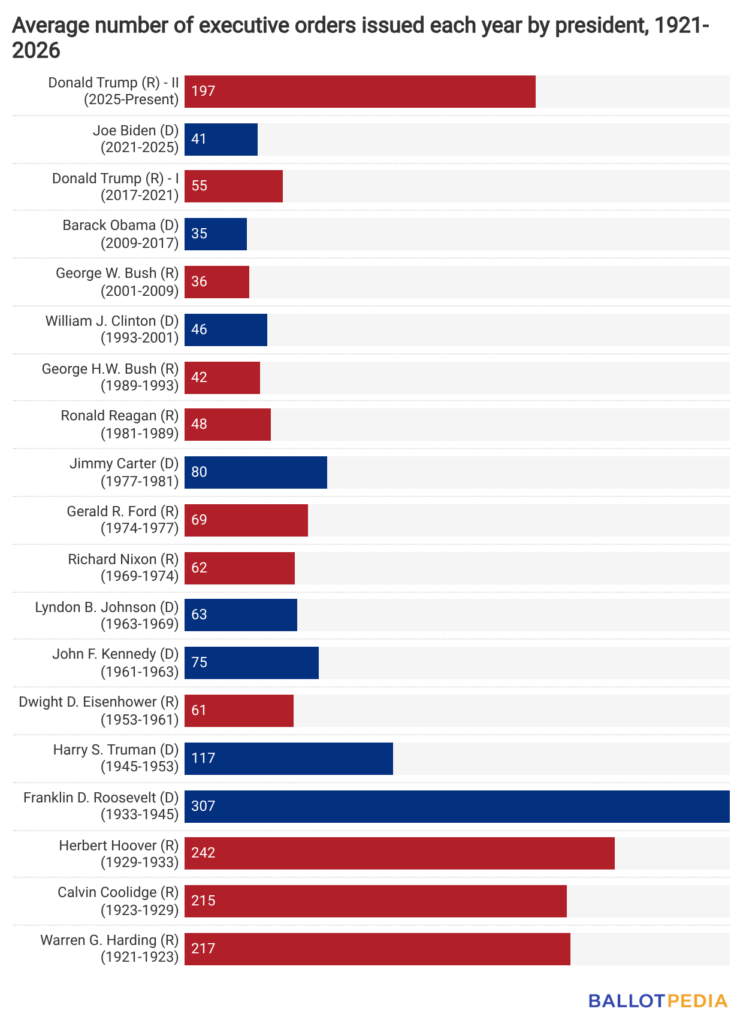
As of June 1, Trump has issued 263 executive orders in his second term. Trump has issued executive orders at an average rate of 197 per year in his second term — the highest average among the seven presidents who have held office since 1981. In his first term, Trump averaged 55 executive orders per year, the second-highest in that time. Joe Biden (D) averaged 41 per year, the third-fewest in that time. Franklin D. Roosevelt (D) issued an average of 307 executive orders per year, the most of any U.S. president.
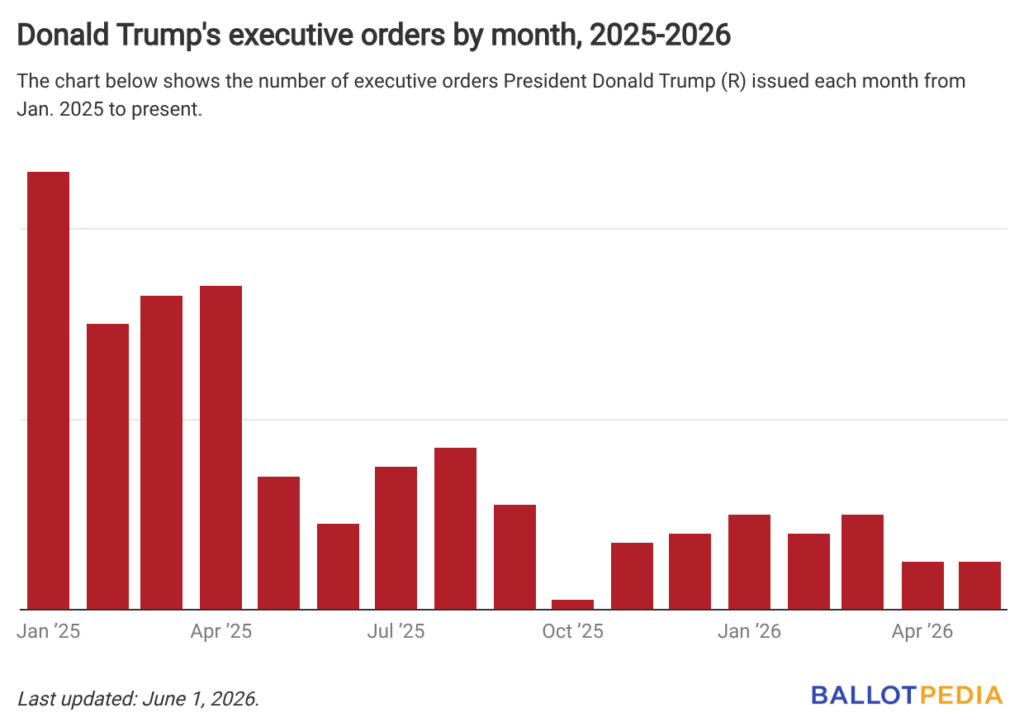
Trump issued 46 executive orders in January 2025, more than in any other month of his second term so far. Trump issued the fewest executive orders in his second term in October 2025, when he issued one.
Among all U.S. presidents, Trump has issued the 10th-most executive orders, with 483 orders across his two terms in office as of June 1. Franklin D. Roosevelt (D) issued the most executive orders of all U.S. presidents, totaling 3,721 during his time in office. William Henry Harrison (Whig) issued the fewest, having issued none during his one month in office. Three presidents issued only one executive order each: James Madison (Democratic-Republican), James Monroe(Democratic-Republican), and John Adams (Federalist).
Click here for a full list of Trump’s executive orders and actions.