


Welcome to Ballot Bulletin: Ballotpedia's Weekly Election Policy Digest. Every Tuesday, we deliver the latest updates on election policy around the country, including nationwide trends and recent legislative activity.
In this week’s edition, we cover 83 bills state legislatures acted on last week and look at voter ID measures on the ballot this year in Ohio and other states.
The state of election legislation in the U.S.
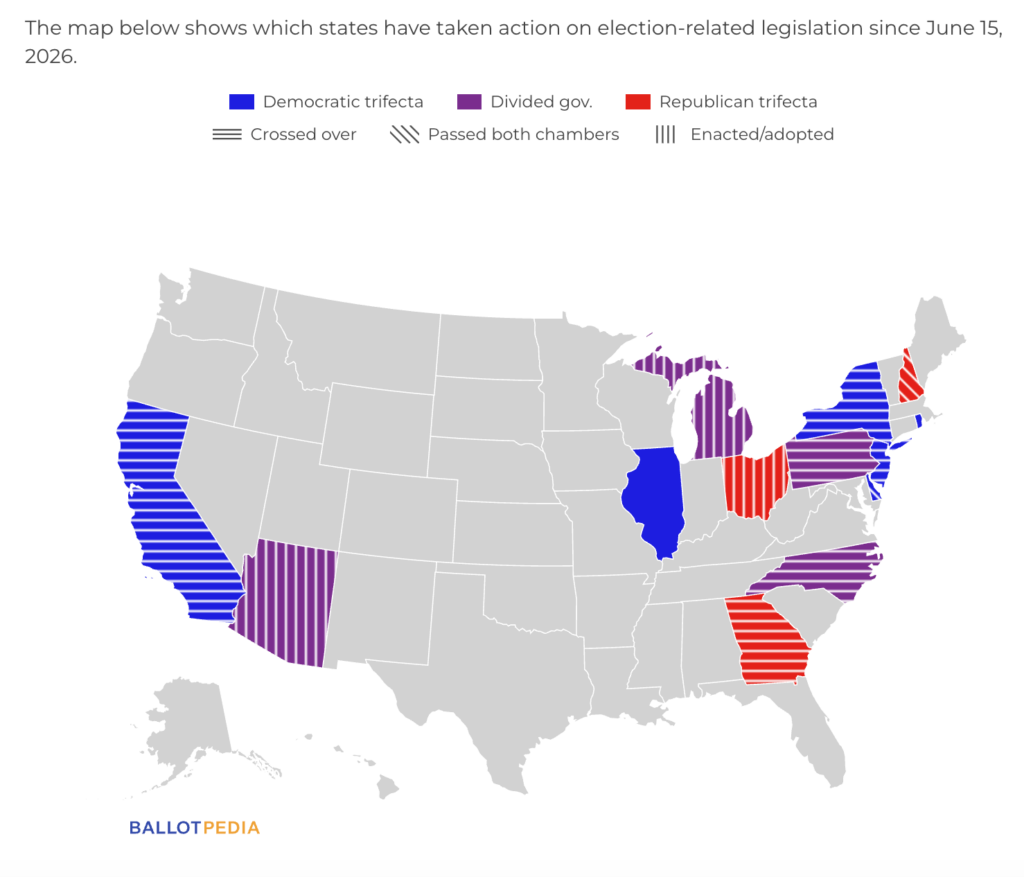
Lawmakers in 12 states acted on 83 election-related bills last week. Ten state legislatures are in regular or special sessions. Last week, eight bills were enacted, six bills passed both chambers of a state legislature, and no bills were vetoed.
Of the bills acted on last week, 57 (68.7%) are in states with Democratic trifectas, six (7.2%) are in states with Republican trifectas, and 20 (24.1%) are in states with divided government. The most active bill categories last week were campaign finance (33), election types and stages (20), and voter registration and list maintenance (15).
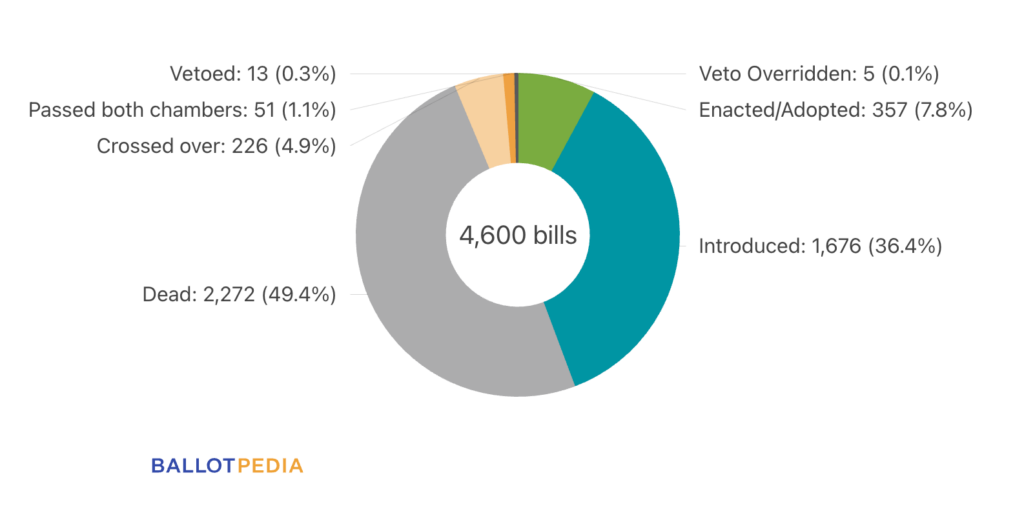
We are currently tracking 4,600 election-related bills across the country. The chart below breaks down the status of those bills by where they stand in the legislative process:
Enacted bills
On June 18, Rhode Island Gov. Daniel McKee (D) signed H 7090 into law. The bill requires the primary election for delegates to the national convention for each political party to be held on the first Tuesday in March 2028 and every fourth year afterwards (rather than the fourth Tuesday in April).
Seven other bills were enacted or adopted last week:
Bills passing both chambers
Six bills passed both chambers last week:
- Delaware (Democratic trifecta)
- Michigan (Divided government)
- New Hampshire (Republican trifecta)
To see a full list of bills awaiting gubernatorial action, click here.
Vetoed bills
No bills were vetoed this week.
To see a list of all bills vetoed this session, click here.
All bills
The chart below shows all bills Ballotpedia is currently tracking, broken down by partisan sponsor
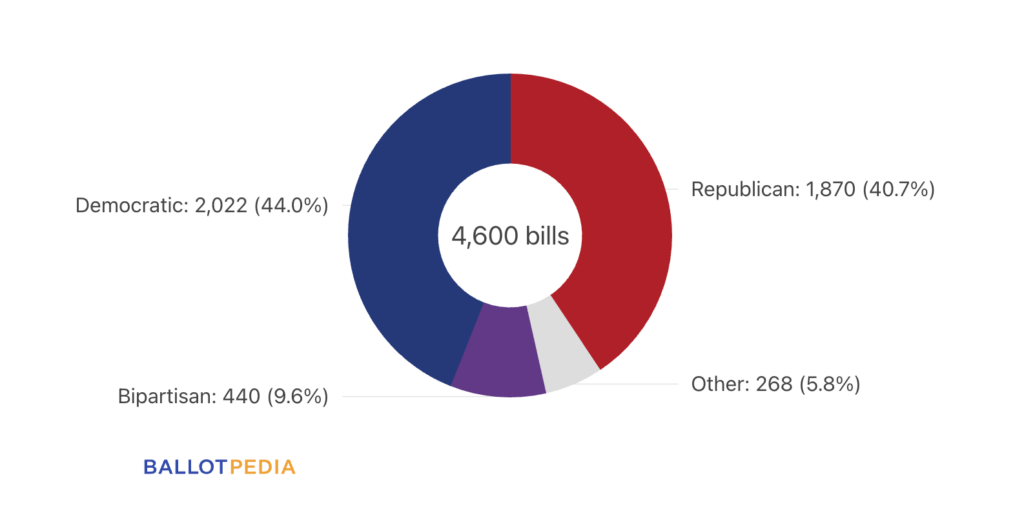
We are currently following 4,600 election-related bills, including bills carried over from the previous year.
- Trifecta status
- Democratic: 1,970 (42.8%)
- Republican: 1,656 (36%)
- Divided: 974 (21.2%)
- Partisan sponsorship
- Democratic: 2,022 (44%)
- Republican: 1,870 (40.7%)
- Bipartisan: 440 (9.6%)
- Other: 268 (5.8%)
In the news
On June 17, Speaker of the Georgia House of Representatives Jon Burns (R) sent a letter to Gov. Brian Kemp (R) saying that the Georgia General Assembly would not consider changes to the state’s 14 congressional districts in the ongoing special session. On May 13, Kemp called the special session to consider redistricting for 2028 and ballot QR codes, as covered in the May 19 edition of Ballot Bulletin. Kemp said that the U.S. Supreme Court’s decision in Louisiana v. Callais requires Georgia to change its congressional maps, but acknowledged the discretion of the General Assembly to defer consideration of redistricting.
The South Carolina Legislature similarly declined to pass new congressional maps following a special session Gov. Henry McMaster (R) called starting May 15, as covered in the June 2 edition of Ballot Bulletin.
Here are other news stories from across the country:
- On June 16, the Public Interest Legal Foundation (PILF) filed a complaint against Oklahoma State Election Board Secretary Paul Ziriax in the U.S. District Court for the Western District of Oklahoma. PILF, which describes itself as a “public interest law firm dedicated to election integrity,” said Ziriax violated Sec. 8 of the National Voter Registration Act (NVRA) and Fourteenth Amendment by refusing to provide the foundation full access to the state voter registration list. On May 8, Ziriax denied PILF’s request, saying that the state voter list did not constitute “records concerning the implementation of programs and activities conducted for the purpose of ensuring the accuracy and currency of official lists of eligible voters” under the NVRA.
- On June 18, Judge Indira Talwani of the U.S. District Court for the District of Massachusetts allowed lawsuits against President Donald Trump’s (R) March 31 Executive Order 14399 concerning mail-in ballots to continue. The order requires the U.S. Postal Service to mail such ballots only to voters on an approved list, among other provisions. Talwani wrote that the order’s legality is ripe for review, given “an ever-narrowing window of time in which review is appropriate and practicable” before the November 3, 2026, general election. On May 29, the U.S. Postal Service submitted a proposed rule to implement the executive order.
- On June 16, Judge Solomon Oliver of the Eastern Division of the U.S. District Court for the Northern District of Ohio denied the Department of Justice’s statement of interest in Red Wine & Blue v. LaRose, blocking the federal government’s attempt to defend a 2025 Ohio law requiring proof of citizenship during voter registration at the Bureau of Motor Vehicles. Oliver wrote that “the filings largely reiterate the arguments already presented by the Defendants and the previously accepted amicus brief.” Oral arguments on the preliminary injunction motion are scheduled for June 25.
Policy spotlight: Ohio will be one of six states with a voter ID measure on the ballot this year
The story below is adapted from a recent Daily Brew story by Briana Ryan.
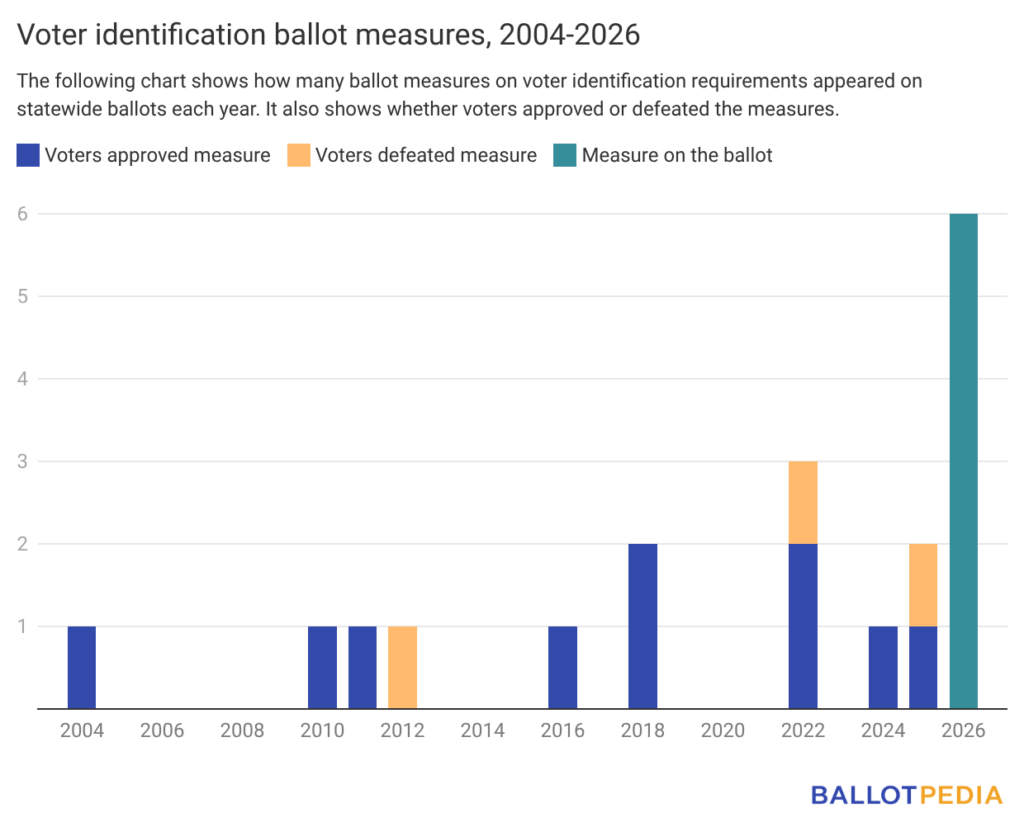
Ohio will be one of six states to decide on a ballot measure on voter identification requirements this year. Other voter ID measures are set to appear on the ballot in Arizona, California, Nevada, North Carolina, and Oklahoma. Two other voter ID measures could also appear on statewide ballots this year.
This year marks the most voter ID measures to appear on statewide ballots in a single year. From 2004 to 2025, 13 voter ID measures appeared on statewide ballots. Voters approved 10 of those measures and defeated three. All 13 measures either established or expanded voter ID requirements. Four measures were state statutes, and nine were constitutional amendments.
The Ohio Require Voter Identification Amendment would require individuals to present photo identification to vote in person, and absentee voters to provide a photo ID, or a signature plus one other unique identifier authorized by law. It would also allow the Legislature to establish an alternative identity-verification process for voters with a sincere religious objection to being photographed.
Current law requires voters to present one of the following unexpired documents in order to vote:
- An Ohio driver’s license, state identification card, or interim identification form.
- A U.S. passport or passport card.
- A U.S. military identification card, an Ohio National Guard identification card, or a U.S. Department of Veterans Affairs identification card.
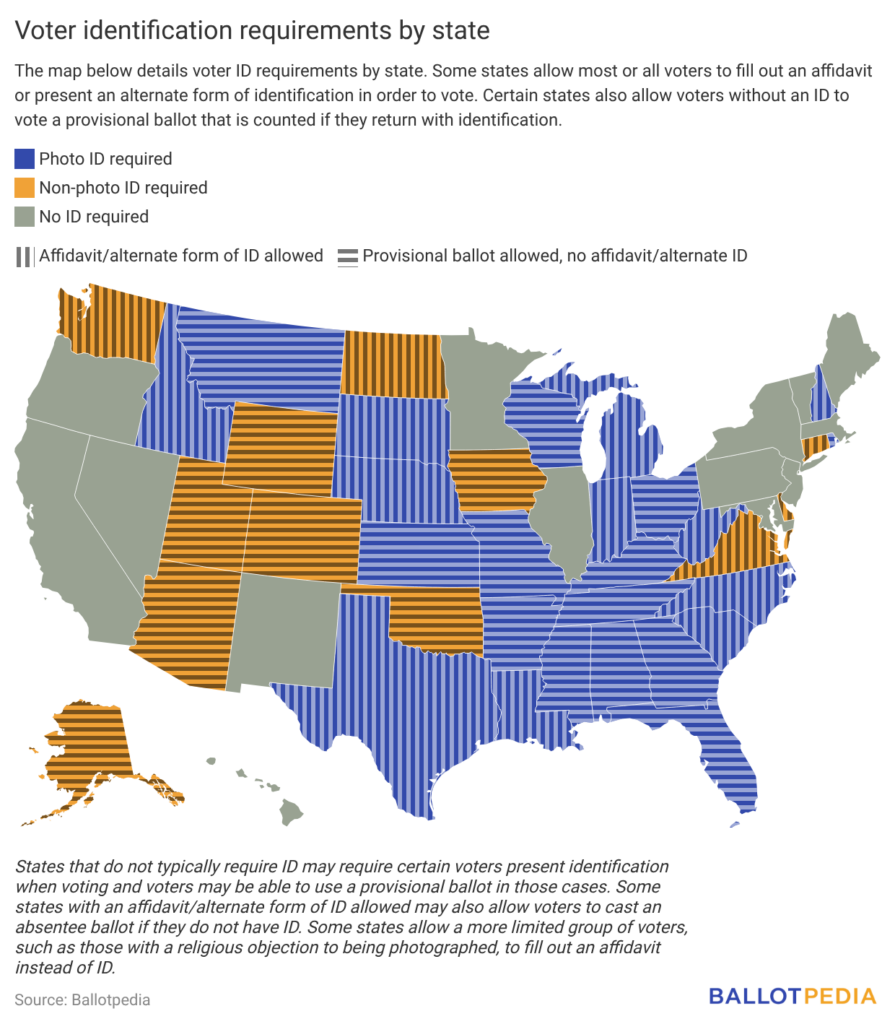
Individuals who do not have or are unable to provide photo identification are allowed to cast a provisional ballot. For the provisional ballot to count, the voter must go to the board of elections office and present their photo ID within four days after Election Day. If a person has a religious objection to being photographed, they must instead complete an affidavit.
Ohio is one of 40 states that allow voters to cast a provisional ballot if they are unable to provide identification at the polls. It is also one of eight states that specifically allow voters with a religious objection to being photographed to sign an affidavit instead of providing identification, or that exempt them from the ID requirement altogether.
Ohio also requires voters to provide either a copy of their ID or driver's license, or their driver’s license number, ID card number, or the last four digits of their Social Security number when applying for and returning an absentee ballot. Georgia is the only other state to require an ID or ID number when both applying for and returning an absentee ballot.
State Sens. Jane Timken (R-29) and Theresa Gavarone (R-2) introduced the amendment as Senate Joint Resolution 10 (SJR 10). On June 3, the Ohio Senate passed the bill 22-9. Twenty-two Republicans voted for the bill, and eight Democrats and one Republican voted against it. On June 10, the Ohio House of Representatives passed the bill 62-30. Sixty-two Republicans voted for the bill, and 30 Democrats voted against it.
Thirty-six states require voters to present identification to vote. Of these states, 24 require voters to present a photo ID, while 12 do not explicitly require it.
Six states — Arkansas, Mississippi, Missouri, Nebraska, North Carolina, and Wisconsin — have voter identification requirements in their state constitutions. Voters approved each of the six amendments with between 55% and 79% of the vote.
So far, this measure is the only one Ohio voters will decide on Nov. 3. However, seven potential amendments could also make the Nov. 3 ballot.
Click here to read more about the Ohio Require Voter Identification Amendment.