


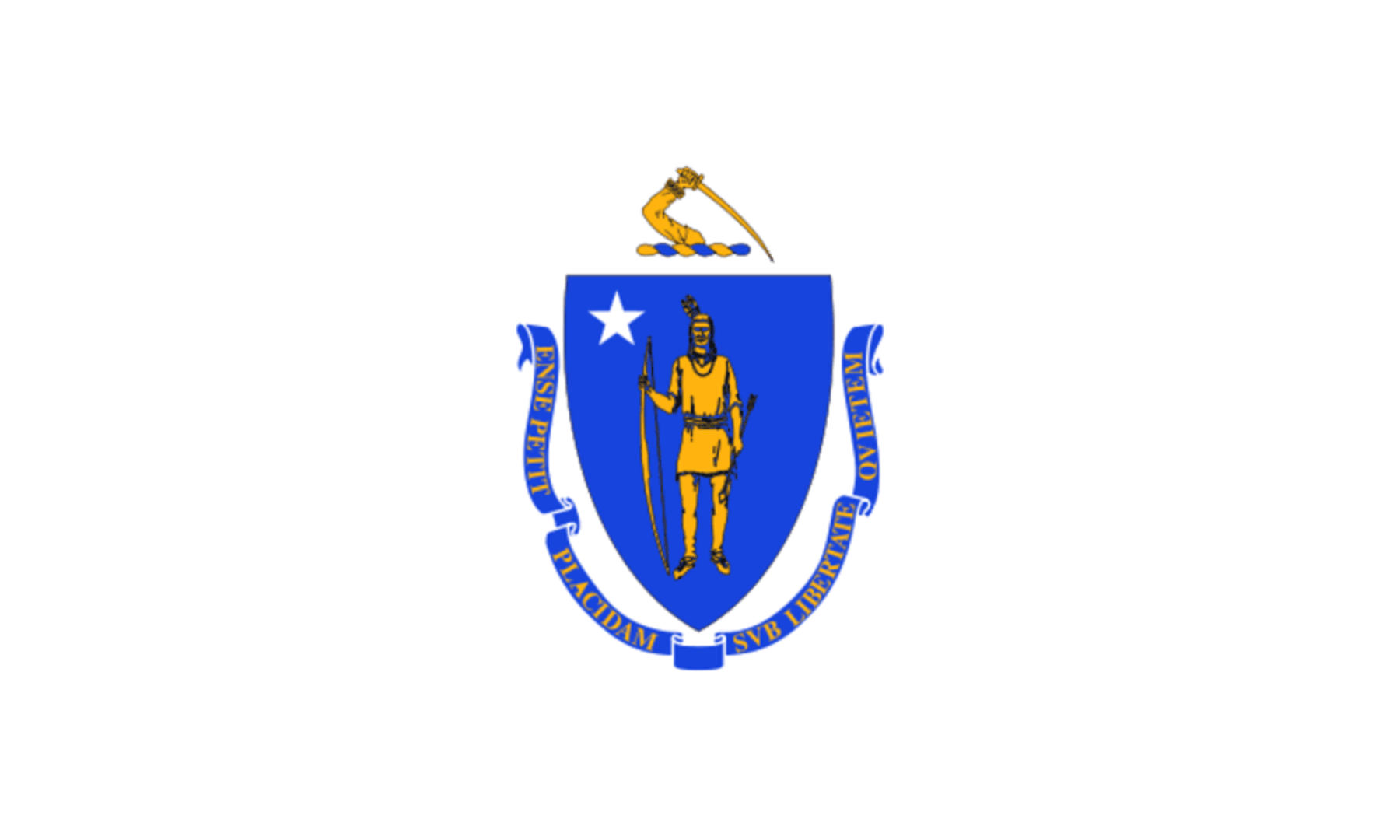
Judges in the U.S. District Court for the District of Massachusetts have blocked two of President Donald Trump’s (R) executive orders related to elections and voting in the past week.
On June 25, Judge Indira Talwani blocked the federal government from implementing Trump’s March 31, 2026, executive order, titled Ensuring Citizenship Verification and Integrity in Federal Elections, in the November general election in 23 states and Washington, D.C.
Democratic officials from those 23 states and D.C. filed a lawsuit in the District of Massachusetts on April 3, 2026, challenging Sections 2, 3, and 5 of the executive order.
The challenged sections require the U.S. secretary of Homeland Security to compile and send a list of all U.S. citizens over the age of 18 who are residents of the state to the state’s chief election official, require the U.S. postmaster general to initiate rulemaking to implement certain requirements for the U.S. Postal Service in delivering ballots by mail in federal elections, and require the U.S. attorney general and executive department heads to withhold funds from noncompliant states.
In their complaint, the states alleged that those sections of the executive order “[transgressed the states’] constitutional power to prescribe the time, place, and manner of federal elections,” “[sought to] amend and dictate election law by fiat based on the President’s whims,” and “[harmed their] authority to administer elections and secure the voting rights of their citizens, and particularly the States’ authority to determine which voters are entitled to vote by mail.”
In her June 25 order, Talwani wrote of Section 2 that “the creation of the Confirmed Citizen Lists is ultra vires because the President lacks any authority to compile voter lists for each State,” and of Section 3 that “USPS lacks authority to promulgate regulations on voting and the EO’s directive that USPS do so constitutes ultra vires executive action.” She cited another case to define ultra vires: “To act ultra vires a government official is either acting in a way that is impermissible under the Constitution or acting outside of the confines of his statutory authority.”
Talwani concluded that “Sections 2 and 3 of the EO are legally void as they are ultra vires and unconstitutionally violate the separation of powers, and that Section 5 of the EO is merely precatory.” She blocked the federal government from “implementing or giving effect to Sections 2 and 3 of the EO with respect to the November 3, 2026 or any earlier federal election in the Plaintiff States[.]”
White House representative Abigail Jackson said that the March 2026 executive order “lawfully protects our elections, and we are confident that we will ultimately prevail in its implementation.”
On June 24, the day before Talwani’s ruling, U.S. Sen. Gary Peters (D-Mich.) asked Postmaster General David Steiner at a Senate hearing whether USPS would deliver ballots in a state that did not comply with the executive order. Steiner replied, “Under our proposed regulation, no.”
In a separate lawsuit, U.S. District Judge Denise Casper on June 24 permanently blocked the federal government from enforcing multiple provisions of Trump’s March 25, 2025, executive order, titled Preserving and Protecting the Integrity of American Elections.
The order instructed the U.S. Election Assistance Commission (EAC) to require prospective voters to provide documentary proof of citizenship to register to vote using the national mail voter registration form and required absentee/mail-in ballots to be received by election day, among other requirements.
Democratic attorneys general in 19 states filed a lawsuit in the District of Massachusetts on April 3, 2025, challenging multiple sections of the executive order as violating the separation of powers.
Casper permanently blocked five sections of the executive order, writing that those sections were “unconstitutional and void because they are ultra vires and violate the separation of powers under the United States Constitution.” Those sections included the requirement for documentary proof of citizenship when registering to vote with the national mail voter registration form, as well as the requirement for the U.S. attorney general to enforce election day as the deadline for receiving ballots.
Challenges to the March 2025 executive order are pending in multiple federal courts, including the U.S. Court of Appeals for the First Circuit, where the Trump administration is appealing Casper’s previous rulings that temporarily blocked sections of the order. Oral argument in that case is set for Dec. 9. Read more about those lawsuits here.
Click here to read about the March 2026 executive order, and here to read about proposed rulemaking from USPS. Click here for more information about other lawsuits challenging this executive order.