



On June 29, the U.S. Supreme Court ruled 5-4 that a Mississippi law allowing absentee ballots to be received up to five business days after the election was not preempted by federal statutes and could remain in place.
Mississippi is one of 14 states that allow absentee/mail-in ballots postmarked by Election Day to be counted if they arrive within a set period of time after the election. The state passed a law allowing for a five-day grace period in 2020. Most states, including Mississippi, also allow at least some absentee/mail-in ballots from military or overseas voters to be counted if they arrive after Election Day. The ruling means those laws will remain in effect.
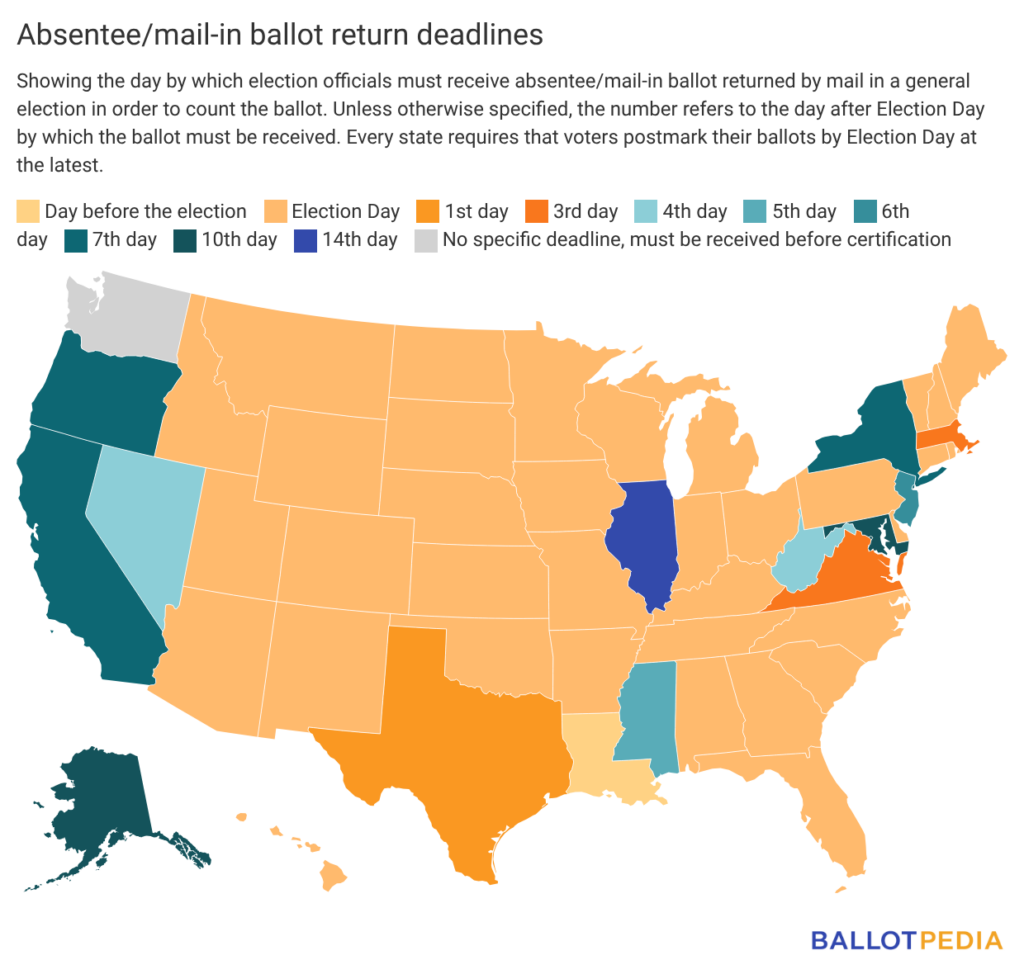
In two 2024 lawsuits, the Republican National Committee and the state Republican and Libertarian parties challenged the law, alleging that because federal law establishes a uniform, national Election Day for congressional and presidential elections, ballots received after that date were invalid.
The U.S. District Court for the Southern District of Mississippi ruled in favor of the state in July 2024. Plaintiffs appealed to the U.S. Court of Appeals for the Fifth Circuit, where a three-judge panel in October 2024 held that Mississippi's statute was unlawful and ordered the case to be sent back to the district court. Mississippi then appealed to the U.S. Supreme Court, which agreed to hear the case last year. Oral arguments took place in March.
In the majority opinion, Justice Amy Coney Barrett wrote that federal law requires voters to cast their ballots by Election Day but does not dictate that the ballots must be received by that date. Barrett was joined in her opinion by Chief Justice John Roberts and Justices Elena Kagan, Sonia Sotomayor, and Ketanji Brown Jackson.
"In sum, the election-day statutes require the electorate’s choice to be made on election day. That occurs so long as election day is the deadline for individuals to vote—as it is in Mississippi," Barrett wrote. "But the election-day statutes do not set a deadline for ballot receipt, so they do not prevent Mississippi from counting ballots postmarked before election day yet received afterward." She also wrote, "Carried to its logical conclusion, this theory would call into question the way modern elections work."
Barrett concluded, "The election-day statutes say nothing about ballot receipt, and we cannot add to the words Congress chose."
In the dissenting opinion, Justice Samuel Alito wrote that federal law requires ballots to be collected on the day of the election: "The acceptance of these late-arriving ballots effectively postpones the date on which the electorate’s choice is made, and federal law precludes that postponement." Alito was joined in the dissent by Justices Neil Gorsuch and Clarence Thomas. Justice Brett Kavanaugh joined part of the dissent.
"Today, not all voting occurs in person on election day. Both voting by mail and early voting have become popular, and respondents do not dispute the lawfulness of these modern practices. Nor do I," Alito wrote. "But acceptance of these practices cannot change the fact that under federal law, the electorate’s collective choice must still be authoritatively expressed on election day."
Watson v. RNC is one of three election law-related cases the court heard during the 2025-2026 term.