


Welcome to Ballot Bulletin: Ballotpedia's Weekly Election Policy Digest. Every Tuesday, we deliver the latest updates on election policy around the country, including nationwide trends and recent legislative activity.
In this week’s edition, we cover 61 bills state legislatures acted on last week and look at the U.S. Supreme Court’s decision in Watson v. Republican National Committee concerning the receipt of mail-in ballots after Election Day.
The state of election legislation in the U.S.
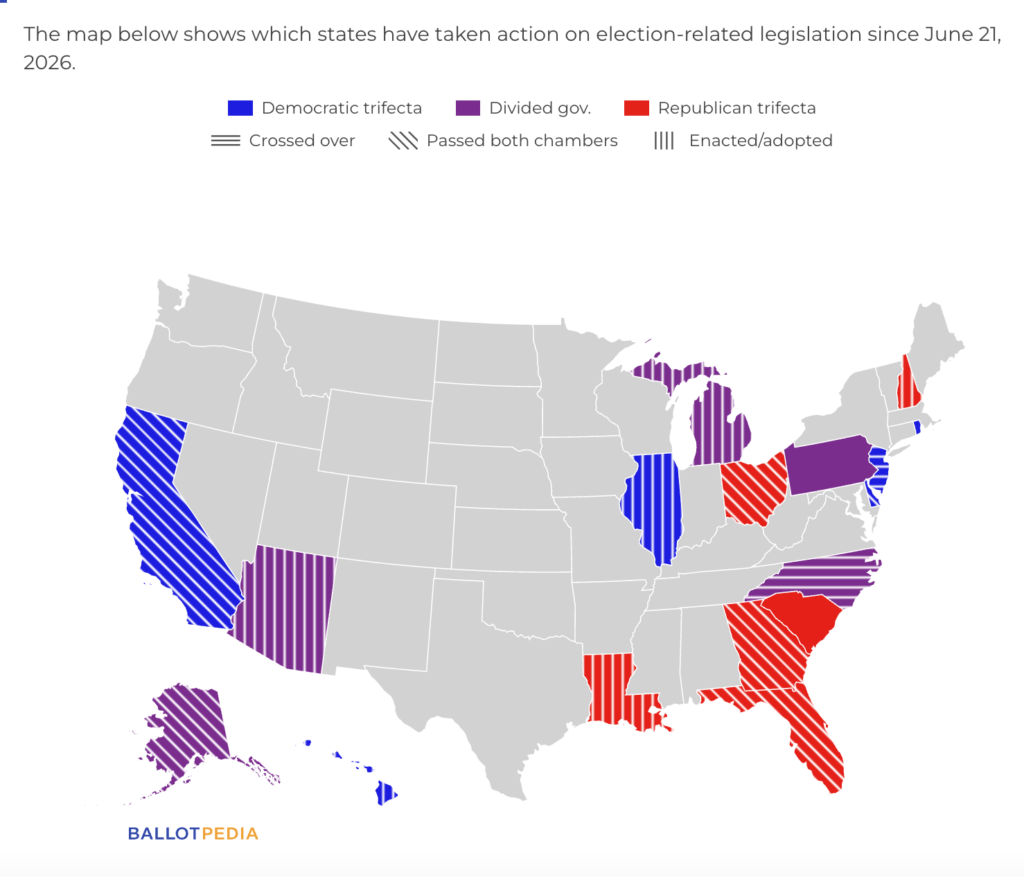
Lawmakers in 17 states acted on 61 election-related bills last week. Eleven state legislatures are in regular or special sessions. Last week, 12 bills were enacted, nine bills passed both chambers of a state legislature, and one bill was vetoed.
Of the bills acted on last week, 31 (50.8%) are in states with Democratic trifectas, 16 (26.2%) are in states with Republican trifectas, and 14 (23%) are in states with divided government. The most active bill categories last week were campaign finance (22), ballot measures (14), and counting and certification (9).
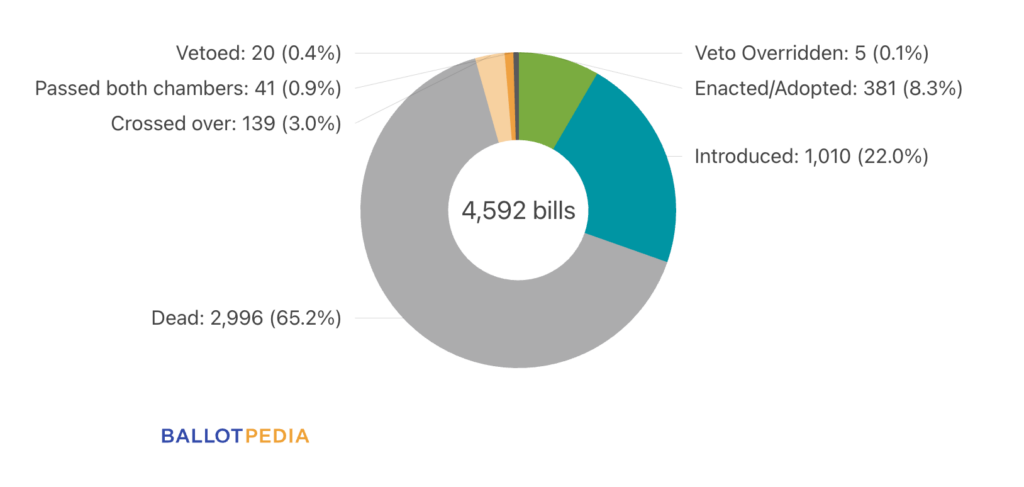
We are currently tracking 4,592 election-related bills across the country. The chart below breaks down the status of those bills based on where they stand in the legislative process:
Enacted bills
On June 25, Georgia Gov. Brian Kemp (R) signed SB 3 into law. See the In the news section below for more information on this bill.
On June 21, Louisiana SB 25 went into effect without the signature of Gov. Jeff Landry (R). It establishes new boundaries for Louisiana Senate Districts 33, 34, and 35.
On June 22, Rhode Island Gov. Daniel McKee (D) signed H 7434 and S 3339 into law. The bills prohibit U.S. Immigration and Customs Enforcement (ICE) employees, agents, or officials from entering or remaining within 200 feet of any polling place, including for both early voting and on Election Day, except when they are present to vote in compliance with the law.
Eight other bills were enacted or adopted last week:
- Arizona (Divided government)
- Florida (Republican trifecta)
- Hawaii (Democratic trifecta)
- Illinois (Democratic trifecta)
- Rhode Island (Democratic trifecta)
Bills passing both chambers
Nine bills passed both chambers last week:
- California (Democratic trifecta)
- Delaware (Democratic trifecta)
- New Hampshire (Republican trifecta)
- Ohio (Republican trifecta)
To see a full list of bills awaiting gubernatorial action, click here.
Vetoed bills
One bill was vetoed this week. On June 24, Ohio Gov. Mike DeWine vetoed HB 472. It would have required individuals voting by mail to submit a photocopy of their photo identification through an online portal or the mail when requesting or voting an absentee ballot.
To see a list of all bills vetoed this session, click here.
All bills
The chart below shows all bills Ballotpedia is currently tracking, broken down by partisan sponsor
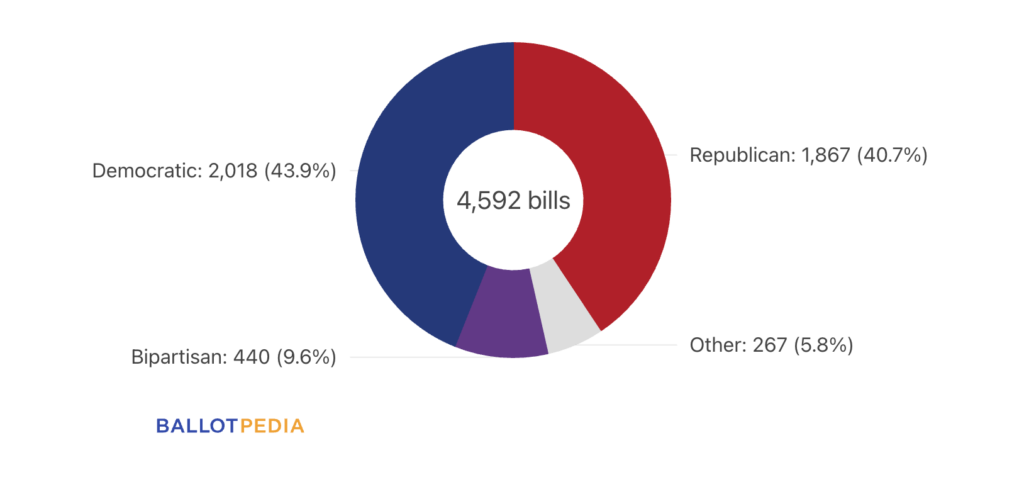
We are currently following 4,592 election-related bills, including bills carried over from the previous year.
- Trifecta status
- Democratic: 1,972 (42.9%)
- Republican: 1,649 (35.9%)
- Divided: 971 (21.1%)
- Partisan sponsorship
- Democratic: 2,018 (43.9%)
- Republican: 1,867 (40.7%)
- Bipartisan: 440 (9.6%)
- Other: 267 (5.8%)
In the news
On June 25, Georgia Gov. Brian Kemp (R) signed Senate Bill 3EX, delaying the implementation of a state law banning the use of QR codes and other machine coding in ballot tabulation. The bill set a 2028 deadline to eliminate the use of QR codes for ballot tabulation and requires a committee to recommend standards for new election equipment. It also requires automatic hand recounts in any statewide executive races listed first or second on the ballot that are decided by less than 0.5% of the vote.
In 2024, lawmakers enacted SB 189 prohibiting the use of QR codes, bar codes, or other machine coding in ballot tabulation, starting on July 1, 2026. Currently, Georgia uses voting machines that print QR codes on ballots to count votes. Those machines were not replaced before the July deadline. Kemp called a special session in May to postpone the implementation of the QR code prohibition and consider congressional redistricting. Legislators later said they would not take up redistricting during the session, as covered in the June 23 edition of Ballot Bulletin.
Here are other news stories from across the country:
- On June 25, Judge Indira Talwani of the U.S. District Court for the District of Massachusetts blocked the federal government from implementing parts of President Donald Trump’s (R) March 31, 2026, executive order titled Ensuring Citizenship Verification and Integrity in Federal Elections in the November general election in 23 states and Washington, D.C. Democratic officials from those states and D.C. filed a lawsuit in the District of Massachusetts on April 3, 2026, challenging Sections 2, 3, and 5 of the executive order. In the order blocking the implementation of Sections 2 and 3 in those 24 jurisdictions, Talwani wrote that “Sections 2 and 3 of the EO are legally void as they are ultra vires and unconstitutionally violate the separation of powers.”
- On June 24, Judge Denise Casper of the U.S. District Court for the District of Massachusetts permanently blocked the federal government from enforcing multiple provisions of President Donald Trump’s (R) Trump’s March 25, 2025, executive order, titled Preserving and Protecting the Integrity of American Elections. The order instructed the U.S. Election Assistance Commission (EAC) to require prospective voters to provide documentary proof of citizenship to register to vote using the national mail voter registration form. It also required absentee/mail-in ballots to be received by election day, among other requirements. Democratic attorneys general in 19 states filed a lawsuit in the District of Massachusetts on April 3, 2025, challenging multiple sections of the executive order as violating the separation of powers.
- On June 25, the Brennan Center for Justice at New York University School of Law sued the U.S. Department of Justice in the U.S District Court for the Southern District of New York seeking records related to the DOJ’s request for unredacted voter files. Federal judges have blocked these attempts in several states. On June 24, the U.S. Court of Appeals for the Sixth Circuit ruled in United States v. Benson that Michigan Secretary of State Jocelyn Benson (D) was not required to give the state’s unredacted voter list to the federal government.
- On June 29, the Alaska Supreme Court issued an order that the Alaska Division of Elections must allow Dan Sullivan (R), a retired teacher, to run in the top-four primary for the U.S. Senate in Alaska. As a result, Sullivan will be on the same ballot as incumbent U.S. Sen. Daniel S. Sullivan (R-Alaska), whom voters first elected in 2014. In the order, the Court stated that the Division of Elections may decide how Sullivan's name would appear on the ballot.
Policy spotlight: U.S. Supreme Court upholds Mississippi's absentee ballot return law
The story below is adapted from a recent Ballotpedia News story by Andrew Bahl.
On June 29, the U.S. Supreme Court ruled 5-4 in Watson v. Republican National Committee that federal law does not preempt a Mississippi law allowing absentee ballots to be received up to five days after the election.
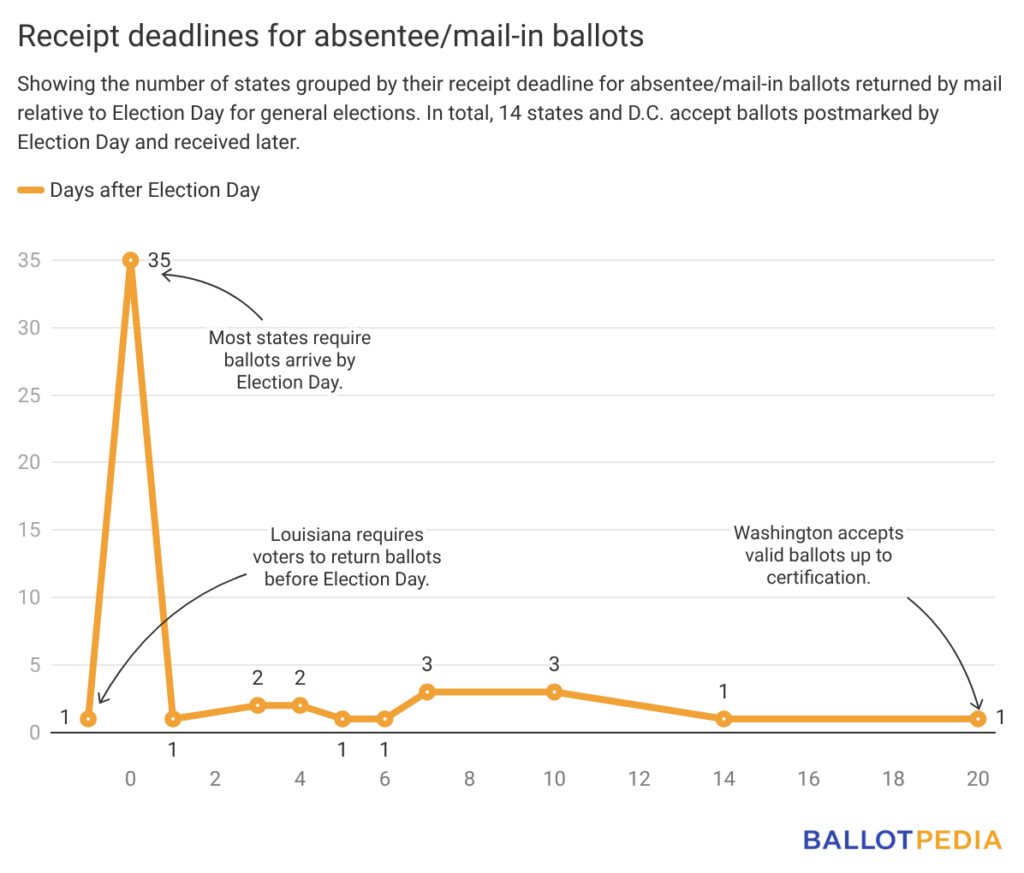
Mississippi is one of 14 states that allow all valid absentee/mail-in ballots postmarked by Election Day to be counted if they arrive within a set period of time after the election. The state passed a law allowing for a five-day grace period in 2020. Most states, including Mississippi, allow at least some military or overseas ballots to be counted if they arrive after Election Day. The ruling means those laws will remain in effect.
In two 2024 lawsuits, the Republican National Committee and the state Republican and Libertarian parties challenged the Mississippi law, alleging that because federal law establishes a uniform, national Election Day for congressional and presidential elections, ballots received after that date were invalid.
The U.S. District Court for the Southern District of Mississippi ruled in favor of the state in July 2024. Plaintiffs appealed to the U.S. Court of Appeals for the Fifth Circuit, where a three-judge panel in October 2024 held that Mississippi's statute was unlawful and ordered the case to be sent back to the district court. Mississippi then appealed to the U.S. Supreme Court, which agreed to hear the case last year. Oral arguments took place on March 23.
On March 19, Mississippi Gov. Tate Reeves (R) signed HB 908, a bill that would have required absentee ballots to be received the day before an election if the Supreme Court had overturned Mississippi’s deadline.
In the majority opinion, Justice Amy Coney Barrett wrote that federal law requires voters to cast their ballots by Election Day but does not dictate that the ballots must be received by that date. Chief Justice John Roberts and Justices Elena Kagan, Sonia Sotomayor, and Ketanji Brown Jackson joined the opinion.
"In sum, the election-day statutes require the electorate’s choice to be made on election day. That occurs so long as election day is the deadline for individuals to vote—as it is in Mississippi," Barrett wrote. "But the election-day statutes do not set a deadline for ballot receipt, so they do not prevent Mississippi from counting ballots postmarked before election day yet received afterward." She also wrote, "Carried to its logical conclusion, this theory would call into question the way modern elections work."
Barrett concluded, "The election-day statutes say nothing about ballot receipt, and we cannot add to the words Congress chose."
In the dissenting opinion, Justice Samuel Alito wrote that federal law requires ballots to be collected on the day of the election: "The acceptance of these late-arriving ballots effectively postpones the date on which the electorate’s choice is made, and federal law precludes that postponement." Alito was joined in the dissent by Justices Neil Gorsuch and Clarence Thomas. Justice Brett Kavanaugh joined part of the dissent.
"Today, not all voting occurs in person on election day. Both voting by mail and early voting have become popular, and respondents do not dispute the lawfulness of these modern practices. Nor do I," Alito wrote. "But acceptance of these practices cannot change the fact that under federal law, the electorate’s collective choice must still be authoritatively expressed on election day."
Watson v. Republican National Committee is one of three election law-related cases the court heard during the 2025-2026 term.