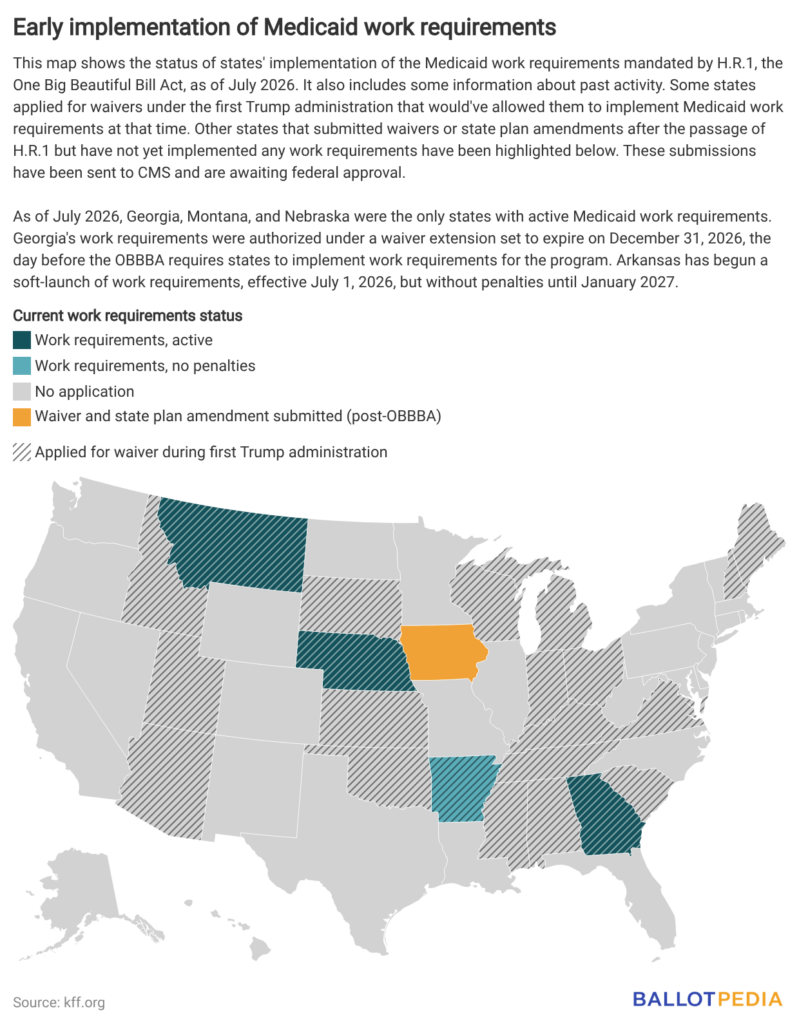
On July 1, Arkansas and Montana began implementing work requirements for Medicaid enrollees, becoming the second and third states to do so after President Donald Trump (R) signed the One Big Beautiful Bill Act (OBBBA) on July 4, 2025. The OBBBA established the first federal work requirements for Medicaid and requires states to adopt these requirements for able-bodied adults ages 19-64 without dependents in the Affordable Care Act’s Medicaid expansion group by January 1, 2027.
These requirements—also known as community engagement requirements—can be met by doing any of the following for 80 hours a month: working, doing community service, participating in a work program, or doing a combination of these activities.
An individual could also meet the requirements by enrolling at least part-time in an educational program or by making a monthly income of at least 80 times the federal hourly minimum wage, which is $580. Failure to comply with the community engagement requirement would result in denial of a Medicaid application or disenrollment from the program.
Some states have implemented these requirements ahead of the January 2027 deadline. Georgia has been enforcing work requirements for the program since July 1, 2023, and Nebraska implemented the OBBBA's requirements on May 1, 2026.
Montana implemented the policy, including penalties for noncompliance, just as Nebraska and Georgia have done. Arkansas, however, began what the state has called a soft launch of the Medicaid work requirements. This means that recipients in the Affordable Care Act expansion group are required to begin proving that they are working, volunteering, or taking classes for a combined total of 80 hours per month on July 1, but penalties for noncompliance do not begin until January 2027. On Jan. 1, 2027, recipients in Arkansas could begin losing benefits for noncompliance.