


Welcome to the Friday, Oct. 23, 2026, Brew.
By: Andrew Bahl
Here’s what’s in store for you as you start your day:
- Eighty-eight of the 99 state legislative chambers are up for election this year
- Democrats are one seat away from a veto-proof supermajority in New York’s Legislature
- In 331 races, both candidates share the same last name
Eighty-eight of the 99 state legislative chambers are up for election this year
On Nov. 3, elections are happening in 46 states for 88 of the 99 state legislative chambers. In total, 6,139 of the country's 7,386 state legislative seats are up for election this year.
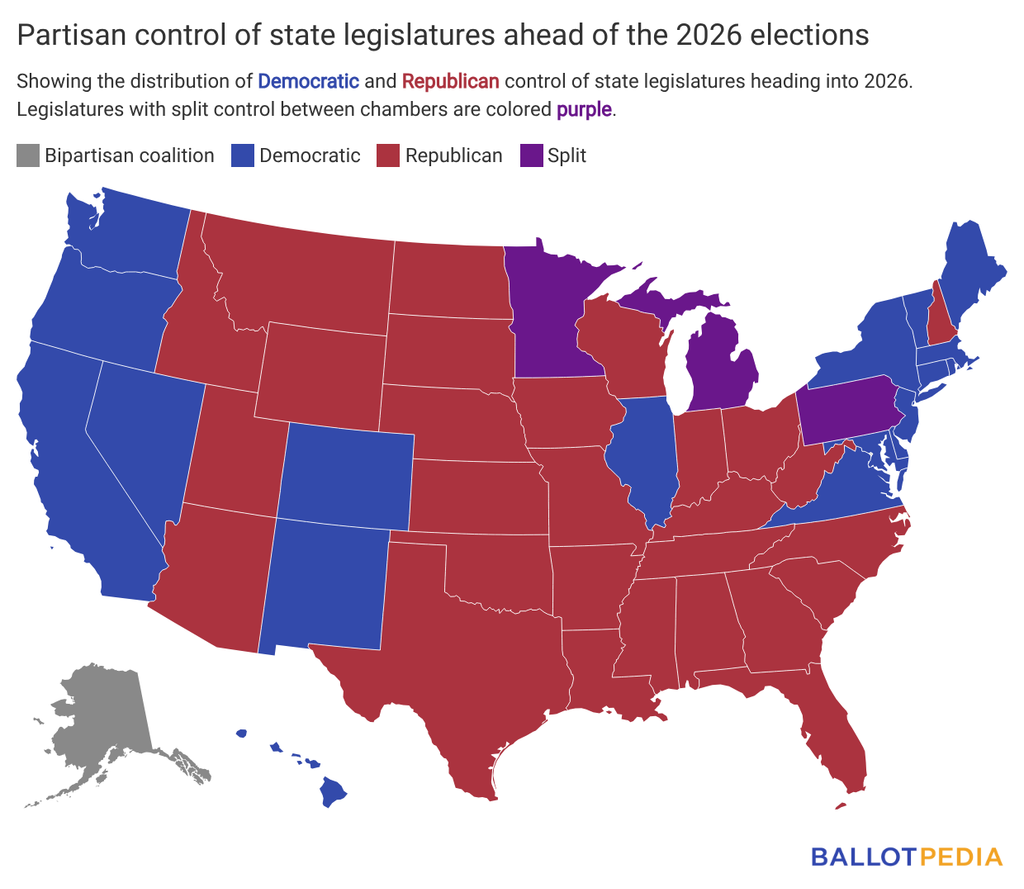
Republicans have majorities in 51 of the state legislative chambers whose members are up for election this year, and Democrats have majorities in 34. Power-sharing coalitions control the Alaska Senate and the Alaska House of Representatives, and the Minnesota House of Representatives is split evenly between the two parties.
Republicans control 3,325 of the state legislative seats up for election this year, and Democrats control 2,741. Third-party and independent legislators control 24 seats, and 49 are vacant.
Overall, Republicans have majorities in 57 state legislative chambers, while Democrats have majorities in 39. Three state legislative chambers either have power-sharing coalitions or are split evenly between the two parties. Republicans control 4,061 state legislative seats, and Democrats control 3,238. Third-party and independent legislators control 28 seats, and 59 are vacant.
Battlegrounds
We have identified elections for 18 state legislative chambers as battlegrounds this year. Republicans control 10 of those chambers, and Democrats control five. Three chambers either have power-sharing coalitions or are split evenly between the two parties.
Key trends to watch
- State government trifectas: State government trifectas occur when one party controls the governorship and both state legislative chambers. In 1992, there were 16 Democratic trifectas, three Republican trifectas, and 31 divided governments. Since then, the number of states with single-party control has increased, while those with divided governments have decreased. Currently, there are 23 Republican trifectas, 16 Democratic trifectas, and 11 divided governments. Ballotpedia identified five states with Republican trifectas — Georgia, Iowa, Montana, New Hampshire, and Texas — and four states with Democratic trifectas — Maine, New Mexico, Oregon, and Washington — that could break this year. Democrats could gain trifectas in Kentucky and North Carolina, and Republicans could gain trifectas in Alaska and Kansas. There are seven states — Arizona, Michigan, Minnesota, Nevada, Pennsylvania, Vermont, and Wisconsin — in which either party could gain a trifecta. This year's elections could show whether or not the trend of increased single-party control continues.
- Supermajorities: Supermajorities occur when one party holds a majority in a state legislature large enough to override a gubernatorial veto without any votes from the minority party. Before the 2022 elections, 16 states had Republican supermajorities and six states had Democratic supermajorities. The number of supermajorities has increased since then. Currently, there are 19 states with Republican supermajorities and eight states with Democratic supermajorities. Ballotpedia identified eight states with Republican supermajorities — Florida, Kansas, Missouri, Nebraska, Ohio, Oklahoma, South Carolina, and Utah — and five states with Democratic supermajorities — California, Connecticut, Delaware, Illinois, and Maryland — as being exposed to breaking this year. Republicans could gain supermajorities in Alaska, Arizona, Georgia, Iowa, Montana, New Hampshire, North Carolina, Texas, and Wisconsin. Democrats could gain supermajorities in Colorado, Maine, Nevada, New York, Oregon, Vermont, and Washington. Ahead of the 2022 elections, there were four states in which the governor belonged to a different political party from the supermajority. That number has decreased over time to two such states — Kentucky and Kansas. Elections are happening this year for at least one chamber in each state legislature, meaning their supermajority status could change as a result. Ballotpedia identified five states — Arizona, Nevada, North Carolina, Vermont, and Wisconsin — that could switch to having a governor of one party and a supermajority of the opposing party as a result of this year's elections.
- Wave elections: In 2018, we published a study on wave elections, examining the results of 50 election cycles between 1918 and 2016. In that study, we defined wave elections as the 20% of elections that produced the largest swing against the president's party. This year, the president's party would need to lose at least 494 state legislative seats to qualify as a wave election. Including both presidential and midterm years, the president's party has lost 494 or more legislative seats in 10 of the 50 election cycles between 1918 and 2024.
- Rematch elections: This year, 383 state legislative general elections are rematches between the same candidates who ran in either 2024 or 2022. Ninety-three of those 383 races were decided by 10 percentage points or fewer the last time the candidates ran against each other.
Recent election history
There were elections for 85 state legislative chambers in 2024, accounting for 5,807 of the 7,386 seats nationwide. Republicans gained control of the Michigan House of Representatives from Democrats, and the Minnesota House ended in a tie.
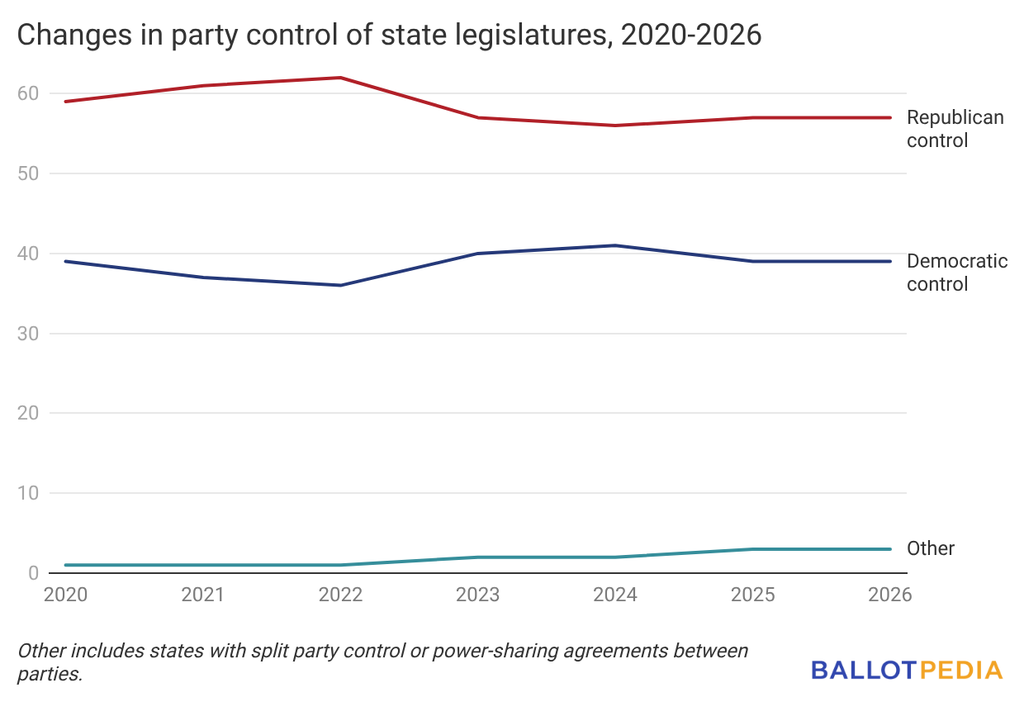
In 2022, the most recent midterm, Democrats gained control of four state legislative chambers: the Michigan Senate, the Michigan House, the Minnesota Senate, and the Pennsylvania House of Representatives.
For more information on this year's state legislative elections, click here.
Democrats are one seat away from a veto-proof supermajority in New York’s Legislature

Welcome to our next installment of our 50 States in 50 Days series, covering New York. To view our archive of past editions, click here.
Democrats would reach a veto-proof supermajority with a net gain of one seat in the New York Senate. Republicans would prevent a supermajority by holding their current 22 seats or gaining seats. Currently, Democrats have a 41-22 majority in the chamber, and New York has a Democratic governor.
Democrats currently have a supermajority in the state Assembly. They can lose no more than three seats to maintain that supermajority. Republicans need to gain at least four seats in the Assembly to break the Democratic supermajority. A total of 100 votes is needed for a supermajority in the New York State Assembly, with Democrats currently holding a 103-47 majority.
Currently, eight states with a Democratic trifecta also have a supermajority in both chambers of their state legislature.
New York is one of seven states Ballotpedia identified as possible Democratic supermajority pickups in 2026. We identified nine states as possible Republican supermajority pickups. Click here to see our full supermajority outlook for the 2026 elections.
Want to see what’s on your ballot this November? Click here to use our Sample Ballot Lookup Tool. Now let’s take a closer look at what’s happening in New York.
Early voting opens Oct. 24 and ends Nov. 1.
Polls open on Election Day at 6:00 a.m. and close at 9:00 p.m.
Voter ID is not required to vote in New York in most cases. The federal Help America Vote Act requires that individuals in all 50 states who register to vote by mail and who have not voted previously in a federal election in their state must provide either their driver's license or a paycheck, bank statement, current utility bill, or government document showing their name and address.
Absentee/mail-in ballots must be requested by Oct. 24 and postmarked by Nov. 3.
Current party control
Democrats represent 19 congressional districts, and Republicans represent seven. Both of New York's U.S. Senators are Democrats.
As mentioned above, Democrats have majorities in both chambers of the New York Legislature. Because the governor is a Democrat, New York is one of 16 states with a Democratic trifecta. New York’s attorney general and secretary of state are also Democrats. As a result, New York is one of 21 states with a Democratic triplex. Democratic governors have appointed all seven members of the New York Court of Appeals, the state’s court of last resort.
Offices on the ballot
Elections are taking place for the U.S. House, four state executive offices, all 63 seats in the state Senate, and all 150 seats in the state Assembly.
The state executive offices up for election include the governor, lieutenant governor, attorney general, and comptroller.
Battleground elections
New York's 3rd Congressional District: Incumbent Rep. Tom Suozzi (D) and Michael LiPetri Jr. (R/Conservative Party) are running. This election is a rematch from 2024, when Suozzi defeated LiPetri 51.7% to 48.1%. This is one of 23 Democratic-held districts that President Donald Trump (R) won in the 2024 presidential election. Trump defeated Kamala Harris (D) 51.4% to 47.1% in the district.
New York's 4th Congressional District: Incumbent Laura Gillen (D) and Jeanine Driscoll (R) are running. In 2024, Gillen defeated then-incumbent Anthony D'Esposito (R) 51.1% to 48.8%. Driscoll is the receiver of taxes for Hempstead, New York.
New York's 17th Congressional District: Incumbent Michael Lawler (R/Conservative Party) and Cait Conley (D/Working Families Party) are running. This is one of eight Republican-held districts that Harris won in the 2024 presidential election. In 2024, Lawler was re-elected 52.1% to 45.8%, and Harris defeated Trump 49.9% to 49.3% in the 17th District.
New York's 19th Congressional District: Incumbent Josh Riley (D/Working Families Party) and Peter Oberacker (R/Conservative Party) are running. In 2024, Riley defeated then-incumbent Marcus Molinaro (R/Conservative Party) 51.1% to 48.8%, and Harris defeated Trump (R) 50.4% to 48.7% in the 19th District.
Three candidates for Congress and 11 candidates running for the New York State Assembly have been endorsed by the Democratic Socialists of America. The 2026 elections nationally have featured several noteworthy races in which a DSA-backed challenger defeated an incumbent or won an open seat in a Democratic primary. That includes New York’s 7th Congressional District, where Claire Valdez (D) won an open primary, and the 13th Congressional District, where challenger Darializa Avila Chevalier (D) defeated incumbent Adriano Espaillat (D). For more information on those races, click here.
Statewide ballot measures
This year, there are no statewide measures on the New York ballot. Between 2000 and 2025, voters decided on 32 statewide measures in New York, or an average of .5 per even-numbered year. Twenty-four were approved, and eight were defeated.
Local ballot measures
Ballotpedia is covering local measures in Albany County, Erie County, and New York City.
Join us next edition when we'll preview elections in Oklahoma, the Sooner State.
Click here to see every edition of 50 States in 50 Days as we publish them, and here to use our Sample Ballot Lookup Tool.
In 331 races, both candidates share the same last name
In 331 races on Nov. 3 across 28 states, 668 candidates share a last name with another candidate running in that race.
This total includes one congressional race, 13 state contests, and 317 local races in Ballotpedia’s coverage scope. Two hundred fifty-six of these races are nonpartisan, and 75 are partisan.
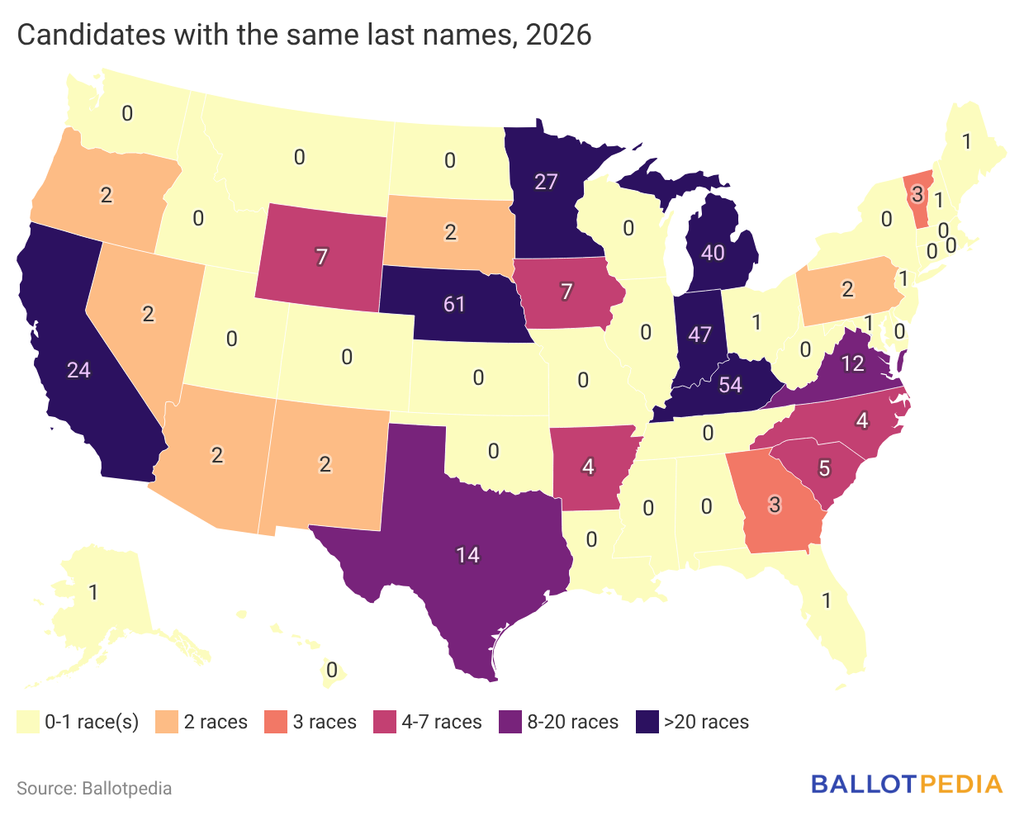
Nebraska has the most elections where candidates share a last name, with 61. Nebraska is one of six states with more than 20 such elections, along with Kentucky (54), Indiana (47), Michigan (40), Minnesota (27), and California (24). Seven states had just one instance of candidates sharing a last name, including Ohio, which, in 2025, had the most elections with candidates sharing a last name (100).
The most common last names for candidates to share are Smith and Johnson, with nine races in which candidates share those last names. The next highest number is Williams, with six such elections.
Some notable races where candidates share a last name include:
- Alaska’s U.S. Senate election: Incumbent Senator Dan S. Sullivan (R) shares not only a last name, but a first name with Dan J. Sullivan (No Party Affiliation). The Alaska Supreme Court ruled in June that the non-incumbent Sullivan could appear on the ballot. The Alaska Division of Elections initially ruled that Dan J. Sullivan could not appear on the ballot, citing a state law that prohibits candidates from appearing on the ballot “in a manner that is confusing or misleading to voters or compromises the fairness or neutrality of the ballot.”
- Nevada Governor: Attorney General Aaron Ford (D) shares a last name with independent candidate Danielle Ford (No Political Party)
- Detroit Public School Board: Four seats are up for election on the Detroit Public Schools board. Thirty-one candidates are running, of which four pairs share the same last name: Harris, Lemmons, Simpson, and Williams.
In 2024, 414 candidates across 206 races shared a last name. In 2025, 438 candidates across 215 races shared a last name.
To read more about candidates sharing a last name, click here.