


Welcome to the Friday, Dec. 5, 2025, Brew.
By: Lara Bonatesta
Here’s what’s in store for you as you start your day:
- Three states certify 2026 ballot measures on citizenship voting requirements
- The last mile of our representative democracy, by Leslie Graves, Ballotpedia Founder and CEO
- Trump issued the second fewest executive orders in his second term in November
- Thank you for your support!
Three states certify 2026 ballot measures on citizenship voting requirements
In 2026, voters in up to seven states could decide on ballot measures establishing citizenship voting requirements in elections. Three states have already certified their measures for the ballot. There are proposed measures in four more states. These include citizen initiatives that have been cleared for signature gathering and legislative referrals that require additional votes.
As of November 2025, no state constitutions explicitly allowed noncitizens to vote in state or local elections and 18 states explicitly prohibit noncitizen voting in their constitutions.
Measures certified for the 2026 ballot
Measures have been certified in Arkansas, Kansas, and South Dakota. All three measures are legislatively-referred constitutional amendments, meaning each state’s respective legislature put them on the ballot. Here’s a look at what each amendment would do.
Arkansas: would change Article 3, Section 1 to state that “only a citizen of the United States meeting the qualifications of an elector” may vote in the state, and specifies that anyone who doesn’t meet the qualifications of an elector may not vote in any state or local election.
Kansas: would amend Article 5, Section 1 of the state constitution to include citizenship in its list of qualifications to become an elector, specifically stating that “every citizen of the United States who has attained the age of eighteen years and who resides in the voting area in which he or she seeks to vote shall be deemed a qualified elector.”
South Dakota: would state that "[an] individual who is not a citizen of the United States is disqualified from voting in any election or upon any question submitted to the voters of this state."
Measures gathering signatures or requiring additional votes
Campaigns for measures related to citizenship voting requirements are targeting the November 2026 ballot in Alaska, California, Michigan, and West Virginia.
Alaska (initiated state statute): would require that only U.S. citizens may vote in state elections. The initiative was cleared for signature gathering on Oct. 3, 2025, and proponents need to gather at least 34,098 valid signatures by Jan. 16, 2026.
California (initiated constitutional amendment): would establish several new voter identification and citizenship verification requirements. They include:
- Requiring government-issued identification to vote in person
- Requiring the last four digits of a unique government-issued identifying number for mail-in ballots
- Requiring the secretary of state and county election officials to maintain voter registration lists, including verifying citizenship attestations and reporting what percent of voter rolls have been verified for citizenship.
The initiative was cleared for signature gathering on Sept. 19, 2025, and proponents must gather at least 874,641 valid signatures by June 25, 2026.
Michigan (initiated constitutional amendment): would require citizenship verification for all voters through a statewide program, document submission, or provisional voting. It would also require:
- Voters to prove their citizenship using either a birth certificate, passport, or other documents
- Voters to provide a photo-ID, driver's license, or partial Social Security number to cast an absentee ballot
The initiative was cleared for signature gathering on May 2, 2025, and proponents have until July 6, 2026, to gather at least 446,198 valid signatures.
West Virginia (legislatively-referred constitutional amendment): would state that only U.S. citizens can vote in all elections held within the state. For the measure to be placed on the ballot, a two-thirds vote in both chambers of the West Virginia Legislature is required during a single legislative session, which amounts to at least 67 votes in the state's House of Delegates and 23 votes in the state Senate. The amendment was passed unanimously in the state Senate on April 2. West Virginia has a Republican trifecta. Republicans have a 32-2 majority in the state Senate, a 91-9 majority in the House of Delegates, and Gov. Patrick Morrisey is a Republican.
Noncitizen voting in the United States
Every state requires voters to attest they are U.S. citizens when registering to vote, and eight states have laws requiring proof of citizenship to register to vote in at least some cases. The Illegal Immigration Reform and Immigrant Responsibility Act, which Congress passed in 1996, prohibits noncitizens from voting in federal elections. However, the law does not address state or local elections.
As of 2025, Washington, D.C, and municipalities in California, Maryland, and Vermont allow noncitizens to vote in certain local and school board elections.
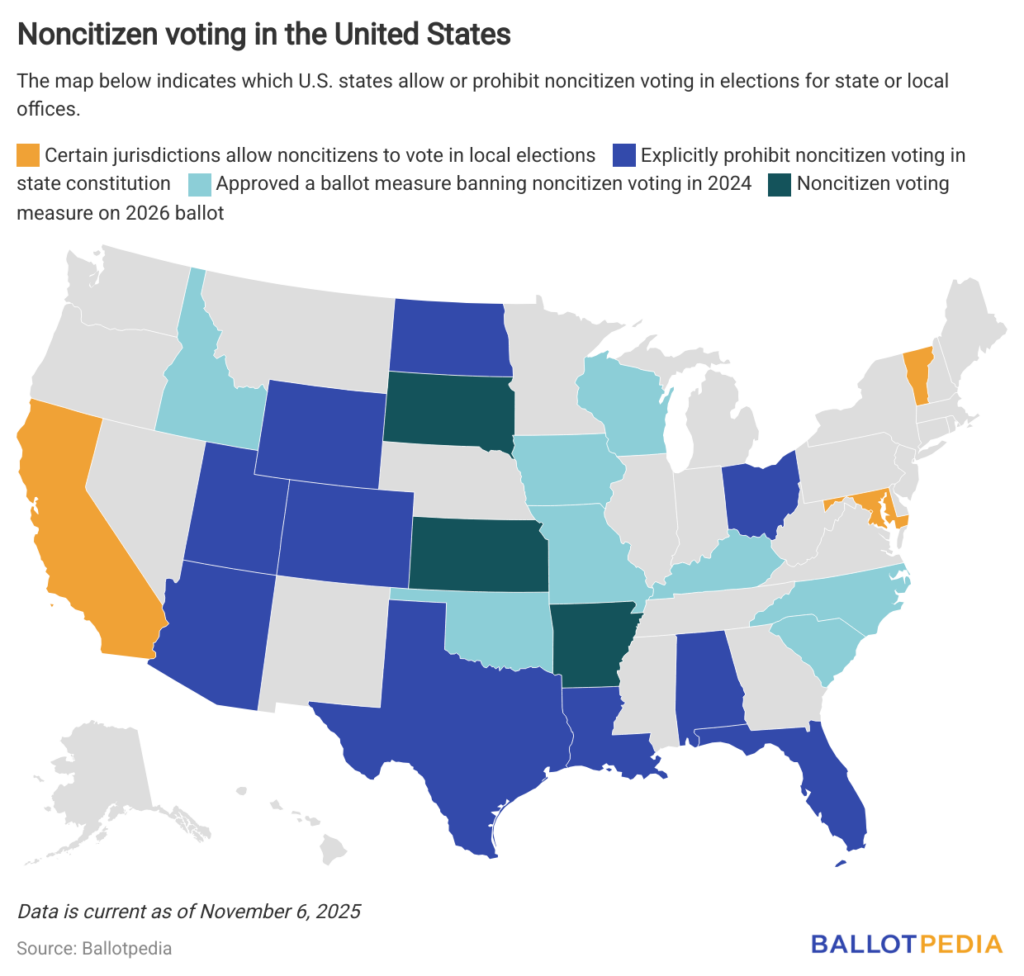
In 2024, eight states approved ballot measures that explicitly prohibited noncitizen voting in their state constitutions. In 2025, one state, Texas, approved such a measure. From 2018 to 2025, voters decided on 15 ballot measures related to citizenship voting requirements. Voters approved all 15.
Click here to learn more about ballot measures related to citizenship voting requirements.
The last mile of our representative democracy
In 2026, America will mark the 250th anniversary of its independence. There will be a vast array of educational activities reminding us of the big ideas, major events, and important people who launched our great experiment in self-governance.
Ballotpedia will be doing its part to celebrate America’s birthday. But we're going to focus on a different aspect — the parts of our democratic process that are largely unseen and uncelebrated — the kind of stuff we either take for granted or don't know much about, but that, if it weren’t there, our electoral process wouldn't function at all.
I think of it as the last mile of our representative democracy, where our ideals and notions of what our nation can or should be meet the reality of how our electoral processes work.
Here’s an example of what I mean. Ballotpedia is fortunate to have an increasing number of volunteers who do incredible work. A growing number of them are students from high school or college classes who work collectively on a volunteer project.
A common theme emerged from their feedback: individuals told us that their volunteer experience was the best civic education project they had ever participated in. This really struck me, so I asked what we were doing in our volunteer program that prompted people to say it was so meaningful.
I was quite surprised to discover that most of them had spent their volunteer shifts looking online for email addresses for school board and city council candidates — that this simple research task was what they found so educationally powerful.
Those emails are an essential piece of information we use to reach out to candidates and ask them to complete our Candidate Connection Survey — one of our five pieces of robust information that can help voters make informed choices about the candidates on their ballots.
When our volunteers undertake this type of work, they quickly discover one of the biggest challenges facing voters — that their candidates, particularly those running for local office, often lack an online presence or a publicly available email address. That’s something of a revelation for young people who’ve grown up in a digital culture and come from a learning environment that’s good at amplifying big ideas, important dates, and interesting people, but largely silent on the mechanics of how it all works.
That makes the entire experience of searching for those email addresses so unique and, for many, so profound. What our volunteers are learning is that the last mile of democracy is sometimes unpaved, or there’s no road at all — and they have to build it.
I think our volunteers find it very compelling and exciting to be the ones who help voters successfully and meaningfully navigate that last mile.
In 2026, we will expand our comprehensive coverage of all elections on the ballot from 26 states to 32 states. Our volunteers, along with other aspects of our programming, will enable us to gather significant information about what those candidates think, believe, and plan to do if they are elected. That's what Daily Brew readers want to know. It’s what voters need to know.
Trump issued the second fewest executive orders in his second term in November
President Donald Trump (R) issued seven executive orders in November, bringing his total to 217 in his second term. This was the second-fewest in any month of his second term. Trump issued orders on tariffs, artificial intelligence, foster care, and terrorism. Click here to read more about each order.
Trump issued the fewest executive orders in October, when he issued only one. Trump issued 46 executive orders in January, more than in any other month of his presidency.
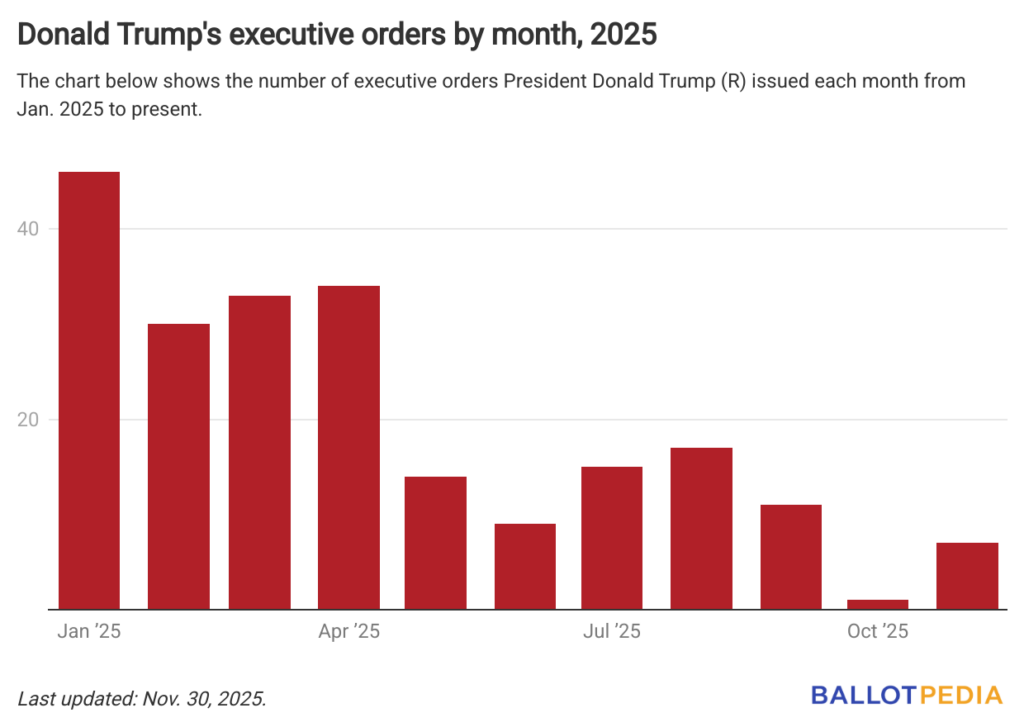
Among all U.S. presidents, Trump has issued the 10th-most executive orders with 430 orders across his two terms in office. Franklin D. Roosevelt (D) issued the most of all U.S. presidents with a total of 3,721 executive orders during his time in office. William Henry Harrison (Whig) issued the fewest, having issued none during his one month in office. Three presidents issued only one executive order each: James Madison (Democratic-Republican), James Monroe (Democratic-Republican), and John Adams (Federalist).
Click here to learn more about Trump’s executive orders and actions.
Thank you for your support!
Giving Tuesday is over — but the work isn’t! Thanks to the generosity of Ballotpedia supporters, we’re closer than ever to ensuring every voter has the information they need to make confident decisions.
But our work doesn’t stop after one day. Millions of voters still face ballots filled with unfamiliar names. Ballotpedia is committed to providing robust information, such as campaign themes, endorsements, pledges, ratings, and Candidate Connection survey responses about every candidate in every election.
If you missed Giving Tuesday, there’s still time to make a difference. Donate today to help us continue expanding election coverage and keep voters informed in 2026 and beyond.