


The Wyoming Legislature's Joint Corporations, Elections & Political Subdivisions Committee voted 11-2 last month to sponsor legislation limiting who may return another voter’s absentee ballot, meaning the legislature may consider the bill during the state’s 2026 legislative session. Wyoming is one of 23 states with a Republican trifecta.
The bill would prohibit individuals who are not immediate family members or caregivers from returning another voter's absentee ballot to a county clerk. The bill would allow nursing home staff to return up to five ballots per election cycle and require employees at those facilities to fill out an affidavit for each ballot they return.
Wyoming is one of 10 states, plus Washington, D.C., that do not specify in law who is allowed to return another voter’s ballot. Politicians have debated in recent years whether states should restrict who may collect and return absentee/mail-in ballots.
Forty states have laws specifying who can return an absentee/mail-in ballot. Politicians, advocacy groups, and researchers use a variety of terms when discussing these types of laws, including ballot harvesting, community ballot collection, ballot gathering, third-party possession of another's ballot, and ballot return.
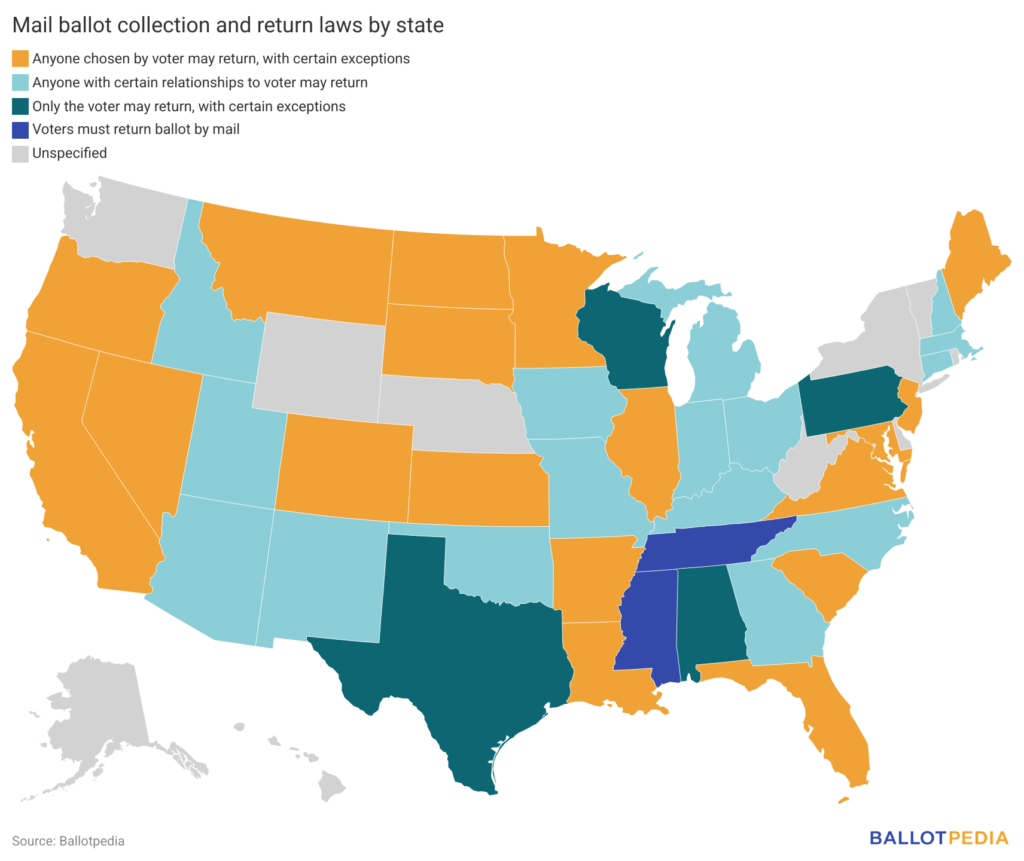
Eighteen states allow voters to choose anyone to return a ballot on their behalf, with certain exceptions such as candidates, employers, and union representatives. Sixteen states allow people with certain relationships to the voter, such as family members and caregivers, to return a ballot.
Four states allow only voters to return their ballots, with exceptions for certain groups. Two states require voters to return their ballots by mail.
Some states have other policies that affect how ballots can be collected and returned. Fourteen states limit the number of ballots a single person can return. Three states have restrictions on compensating individuals who collect ballots.
Some states have approved other types of laws that proponents describe as addressing ballot harvesting, which apply to other parts of the absentee/mail-in voting process. For example, an Alabama law that took effect in July restricts who may return an absentee ballot application. The state already requires voters to return their own absentee ballots, with certain exceptions for voters casting a medical emergency ballot.
In 2025, legislators in 13 states introduced 16 bills on ballot collection practices. No states passed legislation on the topic.
One state adopted a law on ballot collection in 2024. Idaho HB599 established who may return a ballot, including a voter’s relative, a member of their household, or a caregiver. It also restricted relatives, household members, and caregivers from returning more than six total voted ballots.
Three states adopted three ballot collection laws in 2023, and two states enacted two such laws in 2022.
Click here to read more about ballot collection laws in each state.