


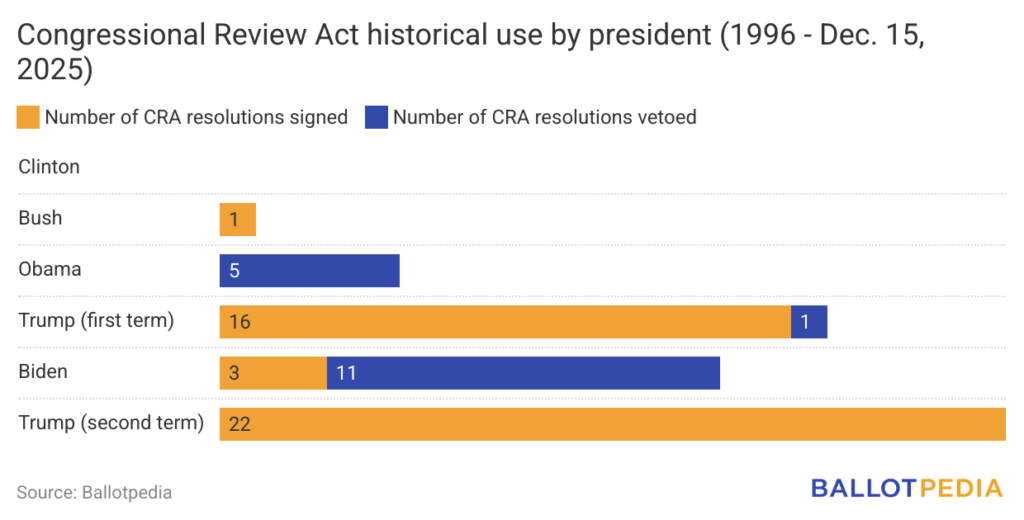
On Dec. 11, President Donald Trump (R) signed five resolutions of disapproval under the Congressional Review Act (CRA), bringing the total number of enacted CRA resolutions this year to 22. Trump has now signed more CRA resolutions in 2025 than all presidents in every other combined. Between his two administrations, Trump has signed 95% of all CRA resolutions that have become law (38 of 42).
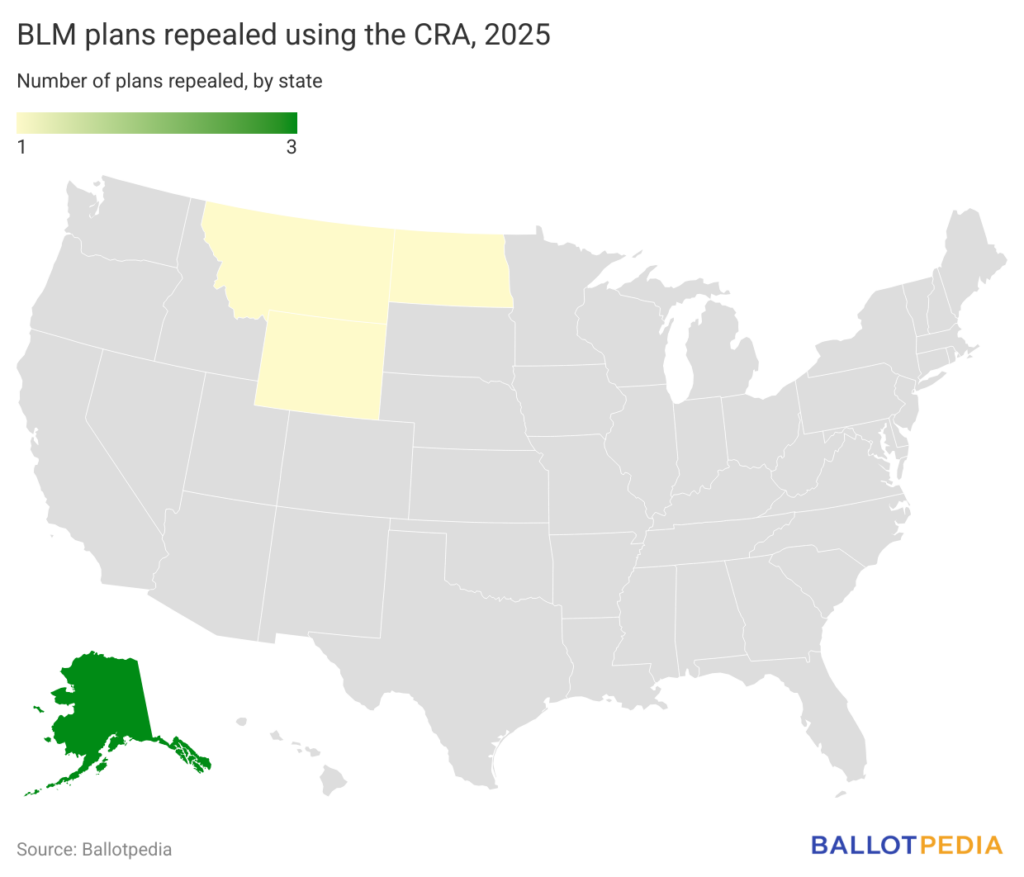
The most recent resolutions disapproved of Bureau of Land Management (BLM) resource management plans (RMP) for areas of North Dakota, Montana, Wyoming and northern and central Alaska. On Dec. 5, Trump became the first president to disapprove of an RMP when he signed a resolution of disapproval of for a BLM plan for the National Petroleum Reserve in Alaska.
What is the Congressional Review Act?
The Congressional Review Act (CRA) is a 1996 law that allows Congress to review and reject newly created agency rules. Under the CRA, agencies issuing a new rule must submit it to Congress for review before it can go into effect. If Congress wishes to disallow the rule, it has 60 working days to pass a joint resolution of disapproval. If the president signs a resolution, the rule is repealed. The CRA then prohibits agencies from issuing a new regulation that is “substantially the same” as the disapproved-of rule.
In the case of major rules (defined as those estimated to cost $100 million or more annually), Congress may delay the rule from taking effect in order to consider it beyond the 60-day window. The Comptroller General must also submit an assessment of a major rule to the relevant Congressional committees within 15 days of an agency submitting the rule to Congress or publishing it in the Federal Register.
What is a rule under the CRA?
Under the CRA, a “rule” issued by an agency is subject to Congressional review, with various exceptions for rules pertaining to internal agency matters. Agencies exercise their judgment in deciding which actions to send to Congress as rules under the CRA. In instances where members of Congress disagree with such agency decisions, they may consult the Government Accounting Office (GAO) for an opinion about whether an agency should submit its action to Congress as a rule under the CRA. Congress’ 60-day window to review a rule begins when an agency submits it for review, even if the agency action took place some time before this.
The growing use of the CRA
Between 1996—when the CRA became law—and 2016, Congress passed six resolutions of disapproval; of those, President George W. Bush (R) signed one, and President Barack Obama (D) vetoed five. Beginning in 2017, Congress' use of the CRA increased significantly. Congress passed 17 resolutions of disapproval during the first Trump administration, 16 of which President Trump signed and one of which he vetoed. During the Biden administration, Congress passed 14 resolutions of disapproval and President Joe Biden (D) signed three and vetoed 11 of them.
Congress has also expanded the scope of its use of the CRA in 2025, using their review authority to disapprove of different types of agency actions. On June 25, the GAO ruled that three BLM RMPs were rules under the CRA, with further rulings on July 24, Aug. 25, and Sept. 18. A group of 31 legal scholars disagreed with the June 25 rulings, saying in an open letter to Congressional leaders that “the view that RMPs are subject to review under the CRA is… contrary to long-standing interpretations on the nature and effect of land use plans.”
Along with BLM resource management plans, Congress used their CRA authority to disapprove three Environmental Protection Agency (EPA) notices of decision this year, conflicting with previous guidance from the GAO. Through these notices, the EPA had granted waivers of Clean Air Act emissions requirements for California which allowed the state to adopt its own emissions standards.
In 2023, the GAO ruled that one of these notices of decision was not a rule under the CRA, and on March 6, 2025, it found that its 2023 ruling applied to all three notices. On April 6, Senate Parliamentarian Elizabeth MacDonough concurred and issued a decision that the three notices were not rules under the CRA.
The House nonetheless took up the resolutions of disapproval, passing two of them on April 30, and the third on May 1. Through a series of procedural votes, the Senate found on May 21 that the three waivers were rules under the CRA, and on May 22 it voted to pass the resolutions of disapproval. President Trump signed the three resolutions of disapproval into law on June 12, repealing the EPA waivers. Litigation on this action is ongoing.
Trump also signed the first resolutions of disapproval for rules from the National Park Service, Department of Energy, Department of the Treasury, Internal Revenue Service, and Bureau of Ocean Energy Management this year.
Click here for details about these rules and more information on the Congressional Review Act.
See Also: