


Welcome to the Friday, Jan. 9, Brew.
By: Briana Ryan
Here’s what’s in store for you as you start your day:
- Utah Gov. Spencer Cox's proposal could be first expansion of a state's supreme court since 2016
- The ballot measures and issues to watch in 2026, by Leslie Graves, Ballotpedia Founder and CEO
- Two new ballot measures have been certified for this year’s ballot
Utah Gov. Spencer Cox's proposal could be first expansion of a state's supreme court since 2016
Utah Gov. Spencer Cox's (R) recent budget proposal includes nearly $3 million allocated to add two justices to the state's Supreme Court and two judges to its Court of Appeals. Currently, the Supreme Court has five justices, and the Court of Appeals has seven.
Deseret News’ Brigham Tomco wrote that “the proposal coincides with an increase in workload for Utah’s highest courts, and intends to speed up decisions, according to legislative leadership. It also comes amid Republican frustration over recent rulings that have stalled legislation and scrapped legal precedent.”
Utah is one of 16 states that have a five-member supreme court. Additionally, the Oklahoma Court of Criminal Appeals — one of the state’s two courts of last resort — also has five justices.
Twenty-eight state supreme courts have seven justices — the most common number of justices for a state supreme court. Seven state supreme courts have nine justices. Additionally, the Texas Court of Criminal Appeals — one of the state’s two courts of last resort — also has nine justices.
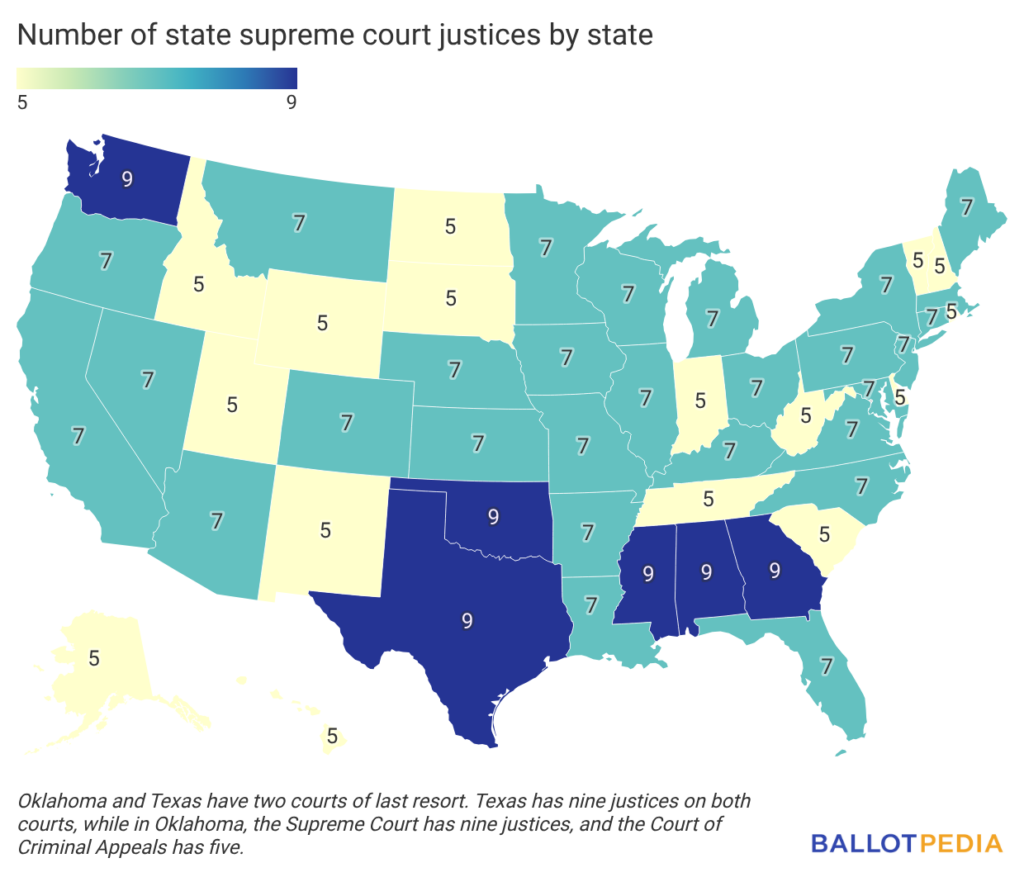
The most recent states to expand the number of justices on their supreme courts were Arizona and Georgia in 2016. The Arizona Supreme Court expanded from five justices to seven, and the Georgia Supreme Court expanded from seven justices to nine.
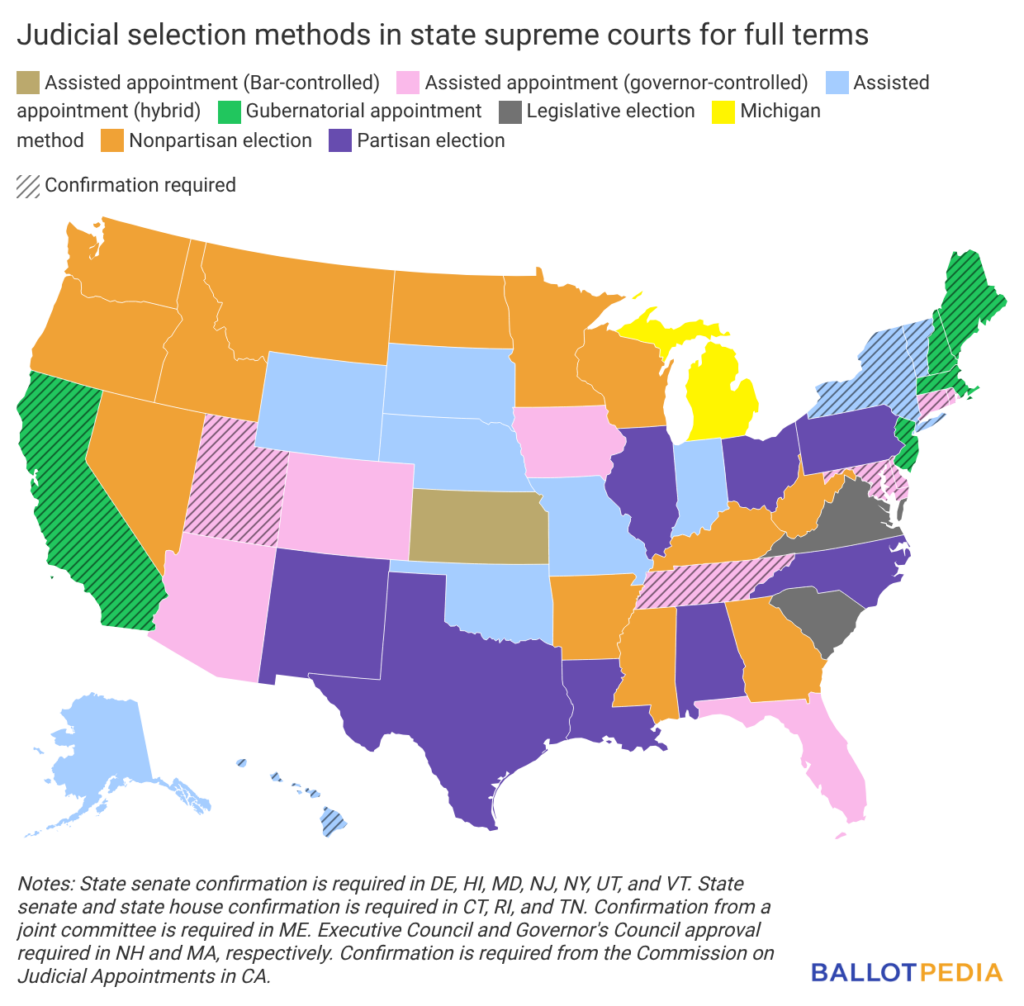
Utah is one of 21 states that selects its state supreme court justices through an assisted appointment method, which means the governor appoints justices with help from a nominating commission or board. However, states vary in how the commission is appointed. Utah is one of 10 states in which the commission is governor-appointed.
Of those 10 states, six — including Utah — require confirmation in the state Senate. So, if the bill to expand the number of justices passes, Cox would appoint two new justices, with approval from the Utah Senate.
According to The Salt Lake Tribune's Robert Gehrke, the bill's passage would mean Cox "will have appointed five of what would be seven justices, and with [Supreme Court justice Matthew] Durrant, now 68 years old, Cox could potentially appoint a sixth, plus a new chief justice, before the end of his second term."
Click here to read more about state supreme courts in Utah and across the country.
The ballot measures and issues to watch in 2026

Brew readers know that 2026 is a midterm election year, and that the overwhelming majority of our national attention will be focused on the races for the U.S. House and Senate.
But Brew readers also know that these elections — as important as they are for determining the ideological and policy direction of Congress for the next two years — are just a small fraction of the races voters will be deciding this year. Ninety-six percent of those races will be at the state and local level. Included in the mix in 2026 are several state ballot measures that could significantly influence politics, policy, culture, the economy, and more for years to come.
I asked Ryan Byrne, Ballotpedia’s in-house expert on ballot measures, about the major themes and specific issues to watch in 2026.
He noted that while the final slate of statewide measures won’t be completed until mid-September, there are four big areas to watch between now and then. First up, an issue that drew significant attention in the last half of 2025: congressional redistricting. Several state legislatures altered their congressional maps in the latter part of 2025. However, only one state, California, put the issue before voters as Proposition 50.
Ryan said, “Several states could address redistricting-related ballot measures in 2026. Some proposals could affect congressional elections this year, while others would not take effect until the next election cycle.”
He said the states to watch are Missouri, Virginia, and Utah.
“In Missouri, signatures were submitted for a veto referendum on the state's new map. In Virginia, the General Assembly could approve a constitutional amendment during the opening days of the upcoming legislative session, call a special election for the measure, and put a new map in place in time for this year’s elections.”
Ryan said there could be a measure on the ballot in Utah that would “repeal a voter-approved initiative from 2018 that created the Utah Independent Redistricting Commission.”
Another issue that’s been on our radar for some time is marijuana policy. Ryan said that since 2012, “voters have considered 27 ballot measures on legalizing recreational marijuana. While the trend continues into 2026, a reverse trend is also emerging, with proposals to recriminalize marijuana.”
He said measures that would repeal marijuana legalization have been proposed in Arizona, Maine, and Massachusetts. While none of these have made the ballot yet, an initiative in Massachusetts has cleared the signature threshold, allowing it to be taken up for consideration during this year’s session of the Massachusetts legislature.
Another issue that’s been on ballots, and continues in the national political debate, is abortion. Ryan said that following the Supreme Court’s 2022 ruling in Dobbs v. Jackson Women’s Health Organization, “abortion has become a more prominent ballot measure topic.”
“Voters in Idaho, Nevada, Oregon, and Virginia could decide on ballot measures providing for state constitutional rights to abortion.”
Abortion opponents are working on ballot measures, too. “In Missouri, voters will decide whether to repeal a constitutional amendment that was approved in 2024. Also on Jan. 6, Wyoming Gov. Mark Gordon (R) called for a state constitutional amendment to further regulate abortion after the state supreme court ruled that a constitutional amendment, approved in 2012, and designed as a response to the Affordable Care Act, provided a right to abortion.”
Another area to watch is something that we call “electoral systems” measures. Ryan said these kinds of ballot questions “can reshape core aspects of state government, including how candidates are elected.”
Ryan said that in Kansas, “the legislature is asking voters to approve a constitutional amendment that would allow for the direct election of state supreme court justices” (who are currently appointed).
“Voters in Alaska will decide on a ballot initiative to repeal the state's top-four ranked-choice voting system after a narrow defeat in 2024. Voters in Massachusetts could decide on a measure to establish top-two primaries, much like California and Washington.”
The bottom line is that 2026 will be another big year for ballot measures that touch on important political and social issues. But there’s another aspect to the 2026 ballot measure landscape that we will be watching closely: the emerging issues and trends that may shape ballot questions in the years to come. I’ll have more on those items as my discussion with Ryan Byrne continues in next week’s column.
Two new ballot measures have been certified for this year’s ballot
As of Jan. 7, the 58 measures certified for statewide ballots in 2026 are above the historical average for this point in the cycle across even-numbered years from 2014 through 2024.
By this time during even-numbered years from 2014 through 2024, an average of 53 statewide measures had been certified for the ballot. From 2014 to 2024, an average of 153 statewide measures were certified in even-numbered years.
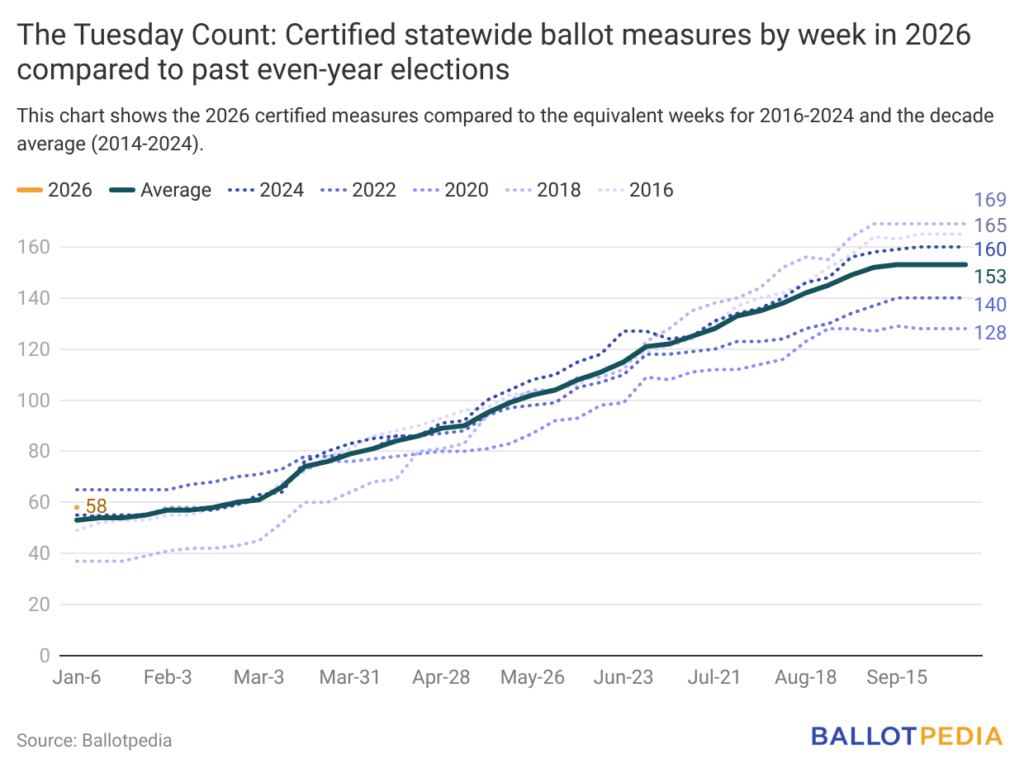
Over the past two weeks, two new measures were certified for the Nov. 3 ballot:
- Alaska: Repeal Top-Four Ranked-Choice Voting Initiative (Click here to read our coverage of this measure in the Jan. 7 Daily Brew.)
- Oregon: Increase to Gas Tax, Payroll Tax, and Vehicle Registration Fees Referendum (Click here to read our coverage of this measure in the Jan. 8 Daily Brew.)
Signatures have been submitted and are pending verification for four initiatives:
- Colorado: Notification of U.S. Department of Homeland Security for Certain Criminal Charges and Immigration Status Initiative
- Missouri: Congressional Map Referendum
- Washington: Limit Participation in Female Sports to Students Verified as Biologically Female Initiative
- Washington: Parental Right to Review Education Materials, Receive Notifications, and Opt Out of Sexual-Health Education Initiative
Enough signatures were verified for 11 initiatives — all in Massachusetts — to send them to the General Court. In Massachusetts, the initiative process is indirect, meaning that the General Court can pass the measure if enough signatures are valid. If the General Court does not pass it, proponents must collect an additional 12,429 valid signatures. Here are the 11 initiatives:
- Change State Tax Revenue Limit Initiative
- Decrease State Income Tax Rate to 4% Initiative
- Eliminate Recreational Marijuana Sales and Allow Limited Possession Initiative
- Establish the Nature for All Fund Initiative
- Legislative Stipend Calculation and Payment Rules Initiative
- Limit on Required Lot Size for Single-Family Homes Initiative
- Permit Collective Bargaining for Committee for Public Counsel Services Employees Initiative
- Permit Same-Day Voter Registration Initiative
- Public Records Requirements for Legislature and Governor’s Office Initiative
- Rent Control Initiative
- Top-Two Primary Elections Initiative
The next signature deadline for initiatives is Jan. 20, in Alaska, where proponents could file signatures for one additional initiative, the Citizenship Requirement for Voting Initiative.
Click here for more information about the ballot measures that could be on the ballot this year.