


The campaign behind Oklahoma State Question 836 (SQ 836), Vote Yes 836, submitted more than 200,000 signatures on Jan. 26 to the Oklahoma secretary of state. If approved, the initiative would create a top-two primary system in the state.
A top-two primary is a type of primary election where all candidates are listed on the same ballot. The top two vote-getters advance to the general election, regardless of their partisan affiliations. Consequently, it is possible for two candidates from the same political party to win a top-two primary and face off in the general election.
As of September 2025, three states—California, Nebraska, and Washington—used a top-two primary for some elections. As of the same date, Alaska and Louisiana used some variation of a top-two primary for some elections.
Alaska uses a top-four primary, where the top-four vote getters move on to the general election. Louisiana uses a majority-vote system for most statewide offices. Candidates running office appear on the same ballot. If a candidate wins a simple majority of all votes cast for the office, they win the election outright. If no candidate meets that threshold, the top-two vote getters advance to a second election.
The secretary of state’s office announced that they received 42 boxes of petition sheets with signatures. Beginning on Jan. 28, the office will verify each signature. To be placed on the ballot for voters to decide, the petition must have 172,993 valid signatures.
If the secretary of state verifies the signatures and the initiative is certified for the ballot, the governor then has the authority to set the election date. In September 2024, Governor Kevin Stitt (R) set the election date for State Question 832 as June 16, the state's gubernatorial primary election. The measure would increase the state’s minimum wage to $15 by 2029.
Vote Yes 836
The official campaign website for Vote Yes 836 lists three reasons that Oklahoma would benefit from primary election reform.
First, under the current system, “partisan primaries guarantee meaningless November elections in which the vast majority of all elected offices have already been filled in primaries or run-offs.”
Second, the current system of primary elections in Oklahoma “disenfranchises voters by barring them (especially independents) from participation in primaries, even though their tax dollars fund those elections.” As of Dec. 2025, 20% of Oklahoma voters are not registered with any political party.
Third, a top-two party system would increase voter participation and voter turnout because “every voter [could] vote in every election.”
Letter from members of the state legislature
On Jan. 22, 74 state representatives and 39 state senators, all Republicans, signed a letter announcing their opposition to the initiative and urging Oklahomans not to sign the petition for SQ 836. The letter listed three main reasons for their opposition to the measure.
First, the letter states the initiative is not what the supporters are advertising it as. The letter says it will not increase voter turnout or produce politically moderate candidates. Instead, the letter states that SQ 836 would motivate candidates to appeal to fringe voters.
Second, the letter states that the initiative would limit voters' choices. It says that, “in many cases, SQ 836 would limit voter choice in November to two members of the same political party, as happens routinely in California in state and federal elections.”
Thirdly, the letter states that the initiative would produce outcomes that are misaligned with voter preferences. The letter points to the 2018 gubernatorial election:
“Had SQ 836 been in place in 2018, Oklahomans would have had to choose between two Democrats for governor that November, because the Republican vote was split among 10 candidates in the primary. Thus, even though 452,606 Oklahomans cast a vote for a Republican gubernatorial candidate compared to just 395,494 for a Democrat, the 2018 general election would have involved only two Democratic candidates.”
Top-two primary ballot measures
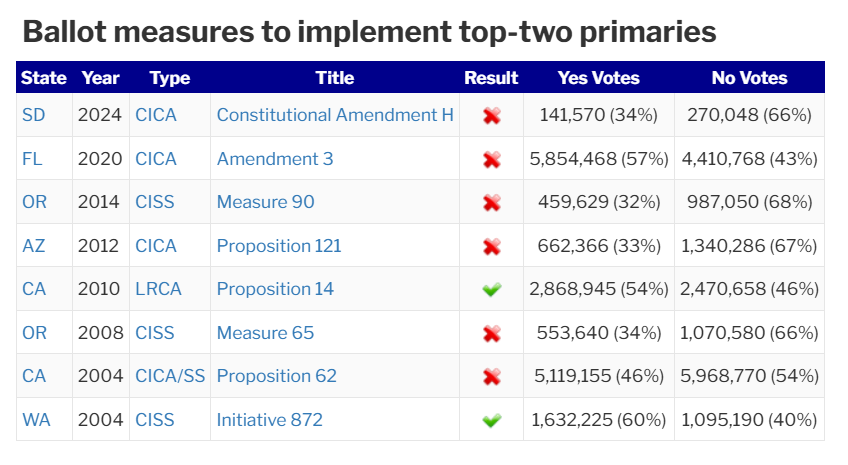
Between 2004 and 2025, six states have decided on eight ballot measures to implement top-two primary systems. Voters in California and Washington approved the measures. The other six measures were defeated. On average between the eight measures, 43.8% of voters approve the measure and 56.2% reject the measure.
Additionally, Massachusetts voters may decide on a ballot initiative to implement a top-two primary system. Supporters of the initiative have submitted signatures, and the measure was placed before the state legislature. In Massachusetts, initiatives are indirect. While a direct initiative is placed on the ballot once supporters file the required number of valid signatures, an indirect initiative is first presented to the state legislature. Should legislators take no action or reject the initiative, a second round of signatures is collected to place it on the ballot.
Additional reading: