



On March 3, 2026, North Carolina voters will vote in 39 contested Republican primaries for North Carolina House of Representatives.
The News & Observer's Luciana Perez Uribe Guinassi said this year’s elections "could be complicated by a group of candidates running in the upcoming primary election who switched political parties last year." According to Guinassi, 26 legislative candidates switched party affiliations ahead of the elections.
That includes six teachers, all previously Democrats or unaffiliated, who the group NC Educators on the Ballot recruited to run against current and former Republican incumbents in the Republican primaries. Group organizer Patricia Saylor said, "With the way our state is carved up into voter districts in a lot of places, the decision about who is going to Raleigh doesn’t happen in the November general election. It happens in the March primary. And so if that’s where it’s going to happen, then that’s where these people are entering the conversation and entering the race.”
On its website, the group described itself as "a statewide, grassroots effort to give voters across the state a choice to support educators on the ballot in Republican-held districts, keeping the needs of students and public schools at the center of the conversation." The state GOP said in a statement to the News and Observer, "NC Educators on the Ballot is led by a registered Democrat to interfere and mislead voters in Republican primaries. Republicans have led on education policy for years, from improving classroom performance to expanding school choice for every family."
Heading into the elections, Republicans are one seat shy of a supermajority in the House and hold a 30-20 supermajority in the Senate. Nine House seats are open, meaning no incumbent filed to run, the fewest in the chamber since 2014. Twenty-nine Republican House incumbents face primary challenges, the most for the party since 2010.
Of the 39 contested Republican primaries, Ballotpedia designated 21 as battlegrounds. Ballotpedia makes battleground designations for state legislative primaries based on electoral competitiveness and political context. Criteria include open seats, incumbents' prior electoral performance, and the presence of organized or experienced challengers.
Of the 21 battleground primaries:
- Six feature Republican candidates who NC Educators on the Ballot recruited to run against current and former Republican incumbents.
- Seven feature current or former officeholders (including five current municipal officeholders) running against Republican incumbents.
- One features a rematch between a Republican incumbent and a challenger who received 44.5% and 48.7% of the vote in the 2020 and 2022 primaries, respectively.
- One features a Republican incumbent and a challenger who finished fourth out of 11 Republican primary candidates in the 2024 election for lieutenant governor.
- One features a Republican incumbent and a challenger endorsed by North Carolina Commissioner of Agriculture Steve Troxler (R).
- Five are open seats
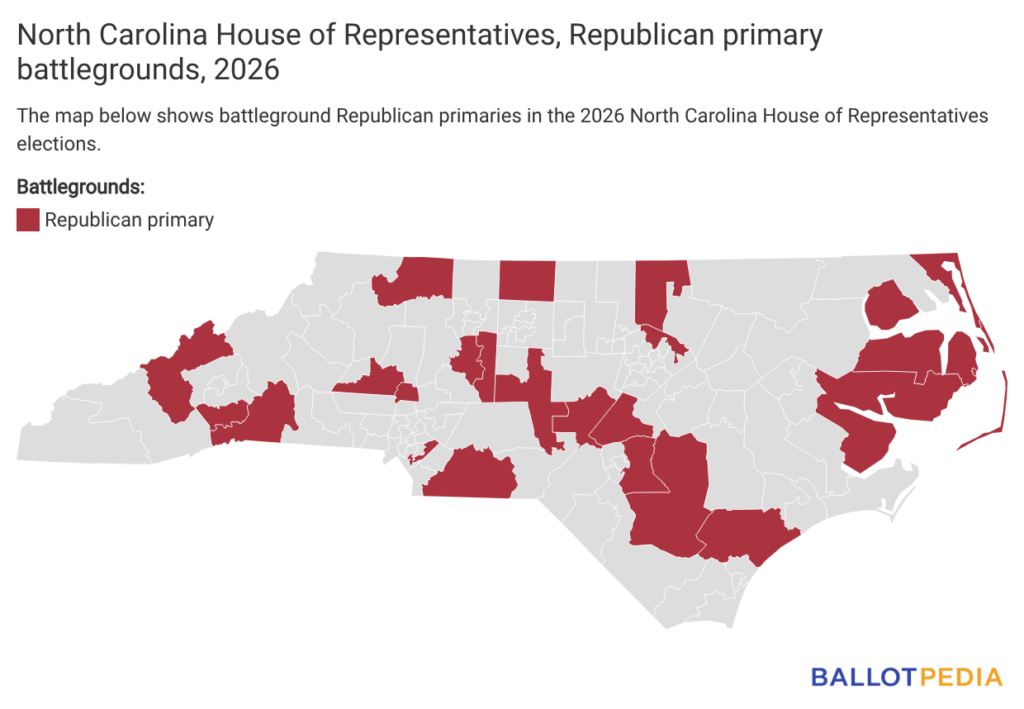
The North Carolina House of Representatives is one of 88 state legislative chambers with elections in 2026. The primary election is March 3, 2026.