


Welcome to the Friday, Jan. 30, 2025, Brew.
By: Lara Bonatesta
Here’s what’s in store for you as you start your day:
- Colorado voters to decide on initiative requiring law enforcement to notify DHS when individuals charged with certain crimes lack verified legal immigration status
- Forty-nine U.S. House members are not seeking re-election in 2026, the most at this point in any cycle dating back to 2018
- Six states have filing deadlines upcoming in the next two weeks
Colorado initiative would require law enforcement to notify DHS when individuals charged with certain crimes lack verified legal immigration status
On Nov. 3, Colorado voters will decide on a constitutional amendment that would establish law enforcement reporting requirements based on the type of crime an individual is charged with, their prior criminal history, and their immigration status.
The measure — Initiative 95 — would add a new section to Article XVIII of the Colorado Constitution that would require state and local law enforcement to notify the U.S. Department of Homeland Security within 72 hours of charging an individual when:
- The individual is unlawfully present in the United States, or their immigration status cannot be determined after a reasonable effort by the officers; and
- Either the individual is charged with a violent crime, or the individual has a prior felony conviction on their record.
If approved, the amendment would make Colorado the first state to add this type of requirement to their state constitution.
State statutes and policies about immigration and law enforcement vary widely, and many specifically mention collaboration or cooperation of state and local law enforcement with federal immigration authorities.
According to the Prison Policy Initiative, “States like Florida, Texas, Louisiana, and Georgia have required local law enforcement to deputize staff to serve ICE, leading to high numbers of arrests. Others like Illinois, New York, and Oregon have managed to suppress arrests by limiting cooperation and blocking access to sensitive areas of public buildings. And states like New Jersey, which have prohibited formal deputization while allowing federal agents informal access to people in custody, have swept hundreds of people out of local jails and into the hands of ICE.” According to the Prison Policy Initiative’s website, the organization’s mission is to produce research “to expose the broader harm of mass criminalization, and then sparks advocacy campaigns to create a more just society.”
The Colorado Secretary of State's office certified Initiative 95 for the ballot on Jan. 23 — almost a month after reviewing the signatures that Advance Colorado, an organization that describes its mission as "[pushing] back on the progressive policies" in the state, had gathered and submitted for review on Dec. 26, 2025. In their announcement, the Secretary of State's office said that the measure had met the required valid signature threshold of at least 124,238, and that the "Elections Division determined that proponents of Proposed Initiative #95 submitted the required number of valid signatures from each Senate district, and a total of 142,299 valid signatures."
Kristi Burton Brown, the Executive Vice President of Advance Colorado, said that the measure "really isn't a controversial issue when you narrow in on violent criminals and repeat felons and saying it's pretty common sense that no one wants them free on our streets."
The League of Women Voters of Colorado, which opposes the initiative, said "a person who is a lawful resident or U.S. citizen could be subjected to this provision in error, possibly due to racial profiling" and that "a person charged with a crime of violence is not necessarily guilty. The person is entitled to due process protections, including a presumption of innocence, until proven guilty."
This is the second Advance Colorado measure certified for the ballot in 2026. The other — Initiative 85 — which would increase penalties for the manufacturing, sale, and possession of fentanyl. The initiative would also require court-mandated treatment for certain types of felonies for possessing fentanyl, and remove drug possession exceptions in determining whether an individual is considered a habitual criminal. Initiative 85 was certified on Dec. 15, with the secretary of state announcing that the minimum signature threshold had been met.
In previous years, Advance Colorado filed and gathered signatures for measures in multiple policy areas, including taxes, law enforcement, and education. In 2024, they filed and gathered signatures for three ballot measures related to school choice, parole eligibility for persons convicted of certain violent crimes, and funding for law enforcement training and benefits for the families of deceased first responders. Voters approved the parole and law enforcement amendments and defeated the school choice amendment.
Colorado voters have decided 67 ballot measures since 2016. Of these, voters approved 41 and defeated 26, an approval rate of 61%.
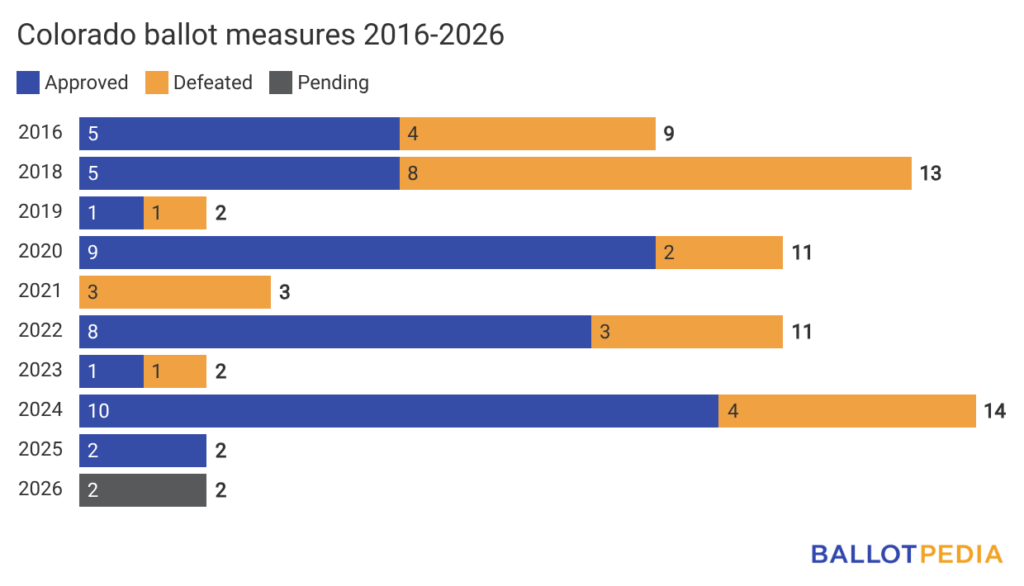
Click here to learn more about the proposed amendment in Colorado and here to learn more about Colorado’s 2026 ballot measures.
Forty-nine U.S. House members are not seeking re-election in 2026, the most at this point in any cycle dating back to 2018
Note: Our weekly column by Leslie Graves, Ballotpedia's founder and CEO, is taking a short break and will return soon.
Forty-nine members of the U.S. House of Representatives are not running for re-election in 2026. Compared to the last four election cycles, there were 40 retirement announcements at this point in 2024, 41 in 2022, 34 in 2020, and 42 in 2018. On Jan. 27, Rep. Vern Buchanan (R-Fla.) became the most recent U.S. House member to announce that he would not seek re-election.
In total, 58 members of the U.S. Congress — nine U.S. Senate members and 49 U.S. House members — have announced they will not seek re-election to their current seats in 2026. That’s more retirement announcements in both chambers than there were at this point in any of the last four election cycles.
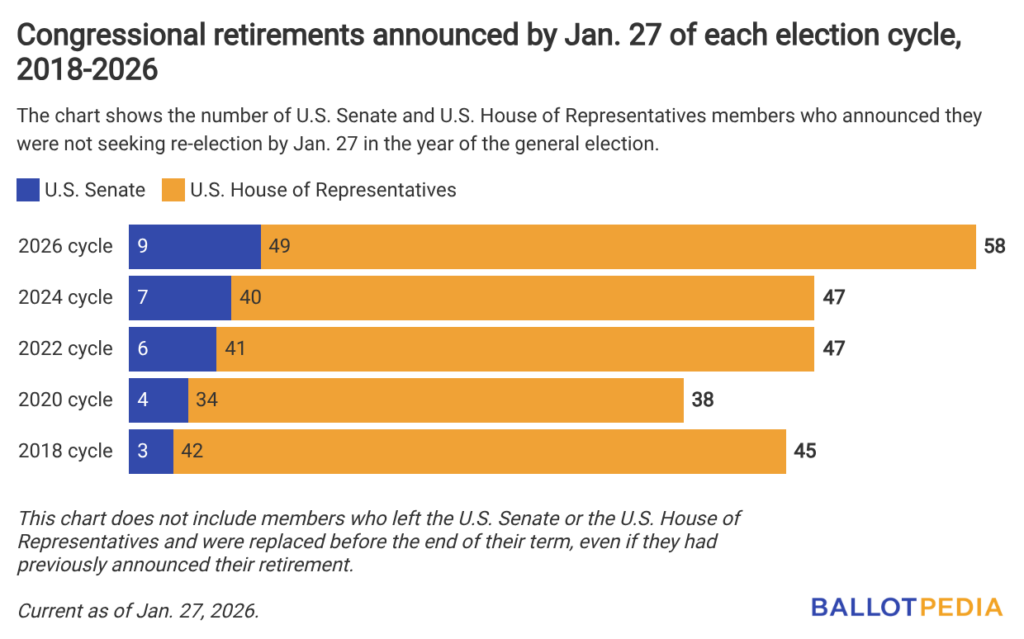
Of the 49 U.S. House incumbents who are not seeking re-election:
- Twenty-two — 13 Democrats and nine Republicans — are retiring from public office.
- Fifteen — seven Democrats and eight Republicans — are running for the U.S. Senate.
- Eleven — one Democrat and 10 Republicans — are running for governor.
- One Republican is running for state attorney general.
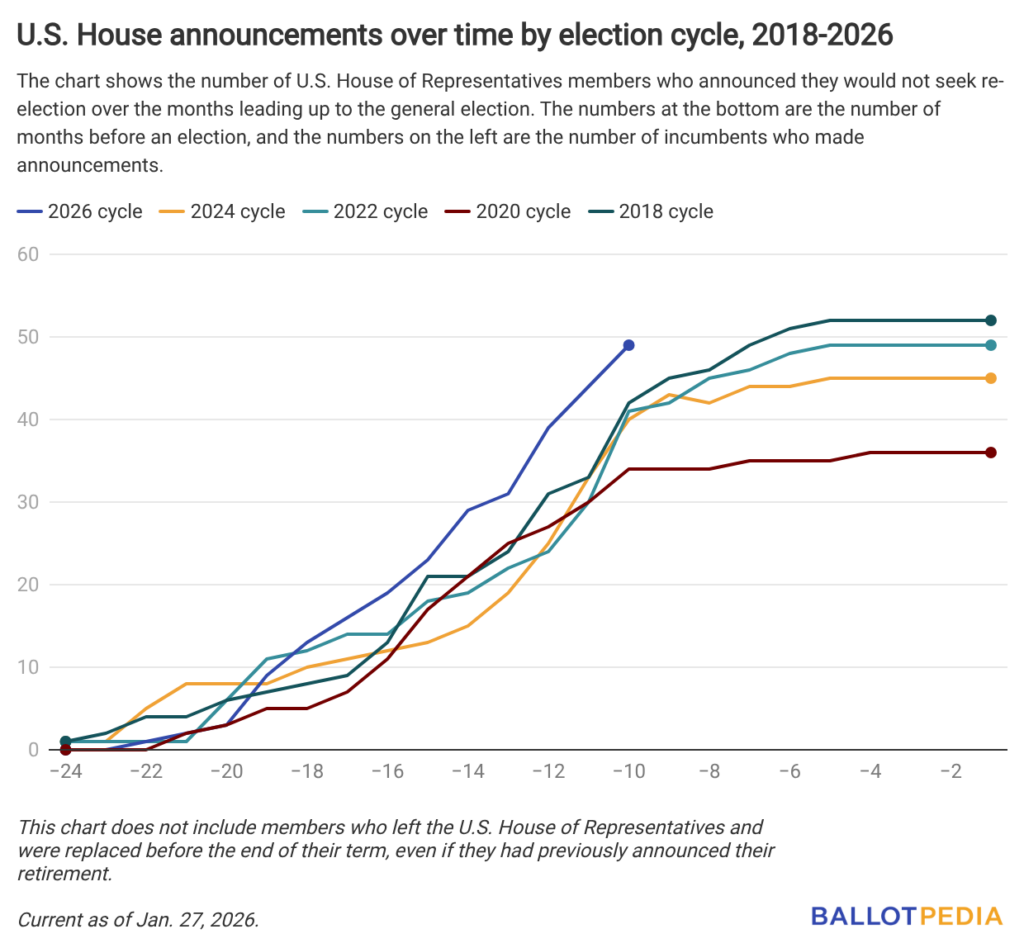
Between January 2011 and January 2026, Ballotpedia followed 348 announcements from U.S. House members who announced they would not seek re-election. The month with the most announcements was January at 57. The month with the fewest announcements was June at 15.
Click here to learn more about the members of Congress who are not seeking re-election in 2026.
Six states have filing deadlines upcoming in the next two weeks
Ten months out from November, midterm races are continuing to take shape.
Six states have upcoming candidate filing deadlines in the next two weeks. The map and bulleted list below show which states have candidate filing deadlines scheduled between Jan. 31 and Feb. 14.
- West Virginia: Jan. 31 (statewide filing deadline for primary candidates)
- New Mexico: Feb. 3 (statewide filing deadline for candidates seeking pre-primary designation)
- Ohio: Feb. 4 (statewide filing deadline for primary candidates)
- Indiana: Feb. 6 (statewide filing deadline for primary candidates)
- Louisiana: Feb. 13 (statewide candidate filing deadline)
- Wisconsin (Spring elections): Feb. 13 (statewide filing deadline for write-in primary candidates)
Looking back
One state had a candidate filing deadline in the past two weeks:
- Alabama: Jan. 23 (statewide filing deadline for primary candidates)
Candidates must meet various state-specific filing requirements and deadlines to appear on primary and general election ballots. These regulations, known as ballot access laws, determine whether and how candidates can make it onto the ballot. These laws are set at the state level and apply to candidates running for state and federal offices.
Upcoming primaries
Looking ahead, here are the five states with statewide primaries coming up in March, and some dates voters in those states should be aware of.
- Voter registration deadline: Feb. 2
- Early voting start date: Feb. 16
- Primary date: March 3
- Voter registration deadline: Feb. 17 by mail (March 1 online, March 17 in person.)
- Early voting start date: Feb. 5
- Primary date: March 17
- Voter registration deadline: Feb. 9
- Mississippi does not permit no-excuse early voting.
- Primary date: March 10
- Voter registration deadline: Feb. 6
- Early voting start date: Feb. 12
- Primary date: March 3
- Voter registration deadline: Feb. 2
- Early voting start date: Feb. 17
- Primary date: March 3
To read more about candidate filing deadlines for the upcoming midterm elections, click here. Click here to see a full list of statewide primaries.