



Since 1982, voters in 39 states have voted on 58 ballot measures concerning crime victims' rights. These measures include those related to the legal rights and protections of crime victims. They address a right to restitution, notification, participation in legal proceedings, and victim support services, among other rights guaranteed to victims of crimes.
Of the 58 ballot measures, 57 were constitutional amendments. One, in Oregon, was an initiated state statute.
Of the 57 constitutional amendments, 55 would have established or expanded crime victims' rights, and two would have limited them. Voters have never rejected a constitutional amendment that would establish or expand crime victims’ rights. The only rejected amendment was South Carolina Amendment 1, which would have permitted the state legislature to exempt victims of certain crimes from protections under the Crime Victims' Bill of Rights.
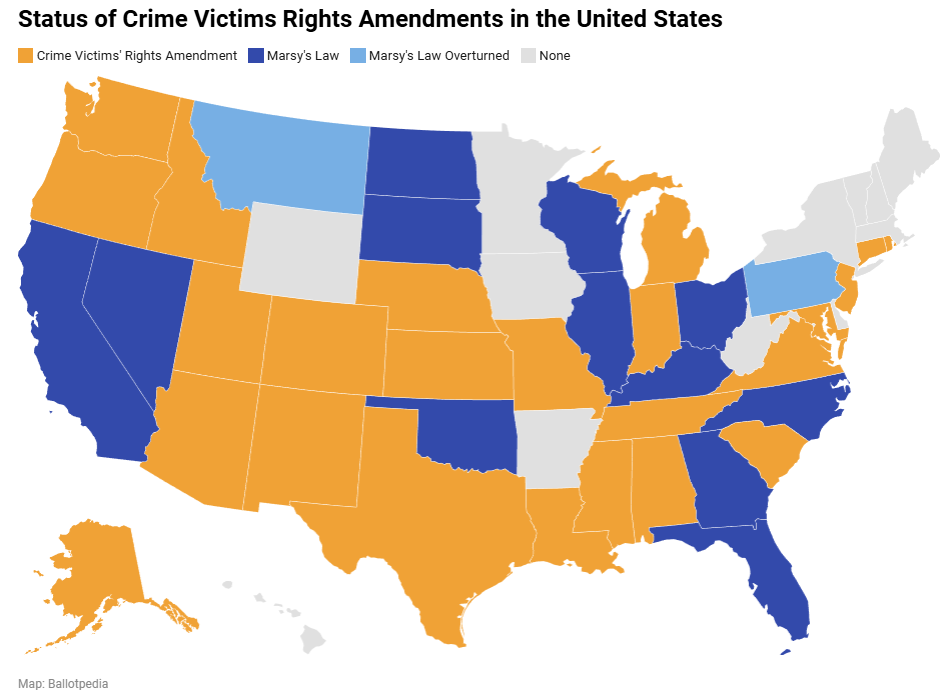
Of the 57 constitutional amendments on the ballot since 1982, 33 added a crime victims' bill of rights, 15 added Marsy's Law, three added a single right for victims of crimes, four amendments expanded the rights of crime victims in states with preexisting Marsy's Law or crime victims' bill of rights amendments, and two limited or would have limited the rights of crime victims in states with preexisting amendments.
Each state's crime victims' bill of rights amendment contains different guarantees of rights for crime victims. Some commonly included rights are the right to:
- be present at criminal proceedings;
- make a victim impact statement at sentencing hearings;
- restitution from their attacker or abuser;
- timely disposition of the case;
- be informed of the release of the accused due to parole or completion of their sentence; and
- be treated with fairness, dignity, and privacy during criminal proceedings.
Amendments referred to as Marsy's Law are a type of crime victims' bill of rights amendment, but they closely model an example constitutional amendment released by the organization Marsy's Law for All. The model constitutional amendment released by Marsy's Law for All includes the following key provisions:
- The right to be notified about and present at proceedings;
- The right to be heard at proceedings involving release, plea, sentencing, disposition, or parole of the accused;
- The right to have the safety of the victim and victim's family considered when making bail or release decisions;
- The right to be protected from the accused;
- The right to be notified about release or escape of the accused;
- The right to refuse an interview or deposition at the request of the accused; and
- The right to receive restitution from the individual who committed the criminal offense.
California was the first state to add Marsy's Law to its state constitution when voters approved Proposition 9 in 2008. Proposition 9 passed with 53.8% of the vote and became a model for several subsequent Marsy's Law ballot measures across the United States. Of the 15 states that have passed Marsy's Law, eight had previously passed a crime victims' bill of rights.
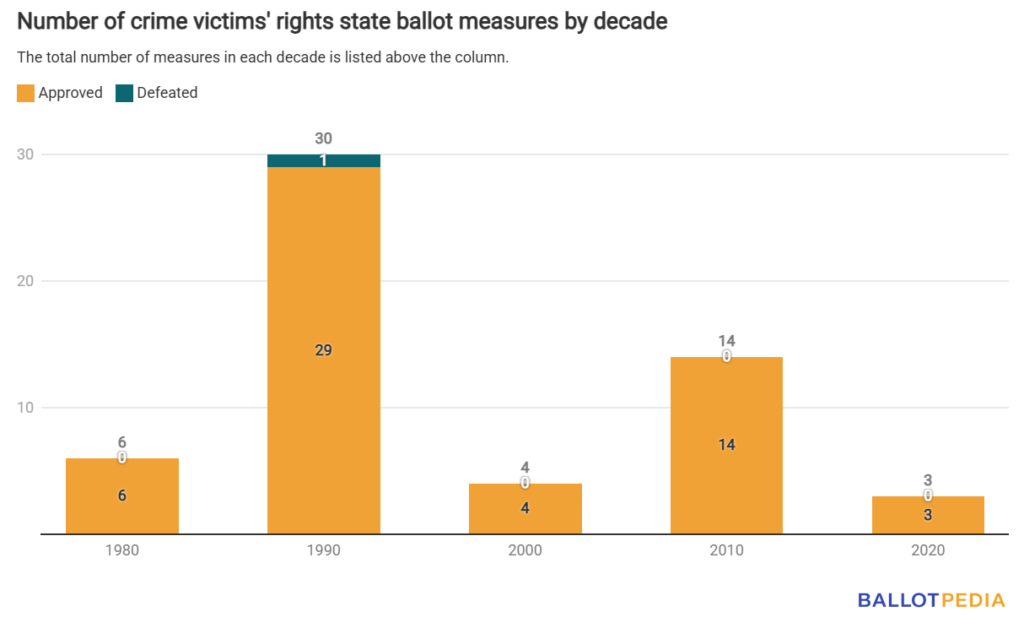
Constitutional amendments on statewide ballots granting crime victims' rights can be divided into two main time periods. During the first period, spanning 1982 to 1999, 35 constitutional amendments were approved, and one was defeated. Of the 35 constitutional amendments approved, 33 implemented a crime victims' bill of rights.
The second period is defined by the constitutional amendments implementing Marsy's Law. Since 2004, 21 constitutional amendments have been approved. Fifteen (15) of those 21 amendments (71.4%) added Marsy's Law to the state constitution.
In three states, courts have overturned constitutional amendments concerning crime victims’ rights that voters approved. All were patterned after Marsy’s Law. In Montana and Pennsylvania, the amendments were overturned because the courts ruled that the ballot measures violated the states' single-subject rules for constitutional amendments.
In Kentucky, the court overturned the amendment because the secretary of state’s office failed to meet the publication requirement in the state constitution for proposed constitutional amendments. In 2020, voters in Kentucky approved Marsy's Law for a second time, with the new ballot measure meeting the publication requirement.
In 2026, Tennessee voters will decide on a constitutional amendment that would add Marsy's Law to the state constitution. If approved, Tennessee will become the sixteenth state with Marsy's Law in its state constitution.