


Virginia has 11 congressional districts. Voters in each district elect one member to the U.S. House of Representatives. As of February 2026, Virginia’s delegation includes six Democrats and five Republicans. On April 21, at a special referendum election, voters will decide on a constitutional amendment that would allow the state legislature to draw congressional district maps ahead of the 2026 election.
On Feb. 6, 2026, the state House introduced amendments to House Bill 29 (HB 29), which detail the proposed boundaries of the new congressional districts. The state House approved HB 29 on Feb. 10, 63-35. The state Senate has not yet voted on the bill.
HB 29 contains changes to the state’s annual budget for fiscal years 2025 and 2026. Although most of its content is unrelated to congressional redistricting, HB 29 includes the proposed new congressional map. If the state legislature passes the measure, it will be provisionally approved. The map would not go into effect unless the constitutional amendment is approved by voters.
The following maps compare the state’s current congressional districts with the new districts proposed by HB 29. The maps show the partisan lean of districts based on results from the most recent gubernatorial election. Note that while Abigail Spanberger (D) received more votes in Congressional Districts 1 and 2 in the 2025 gubernatorial election, in 2024, Republican representatives were elected to the U.S. House in those districts, Reps. Robert J. Wittman and Jennifer Kiggans.
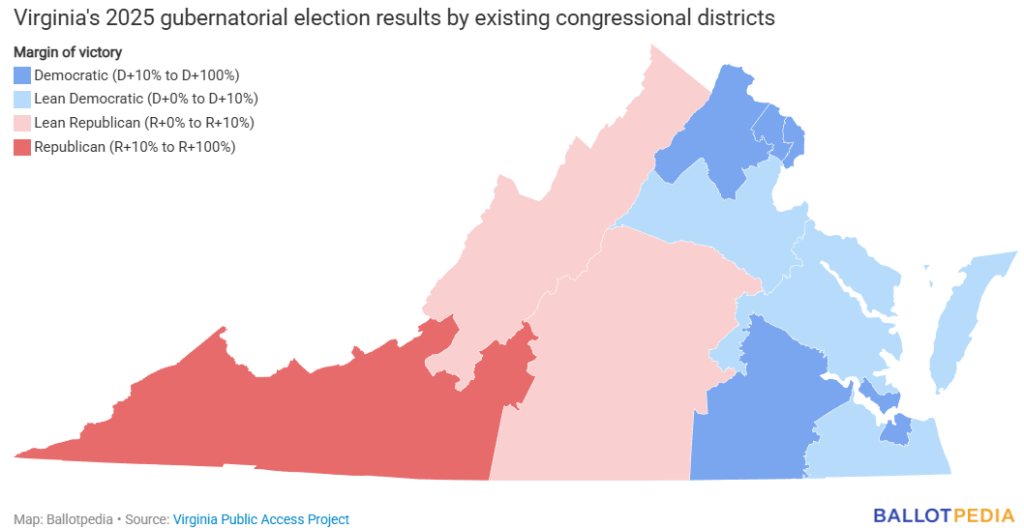
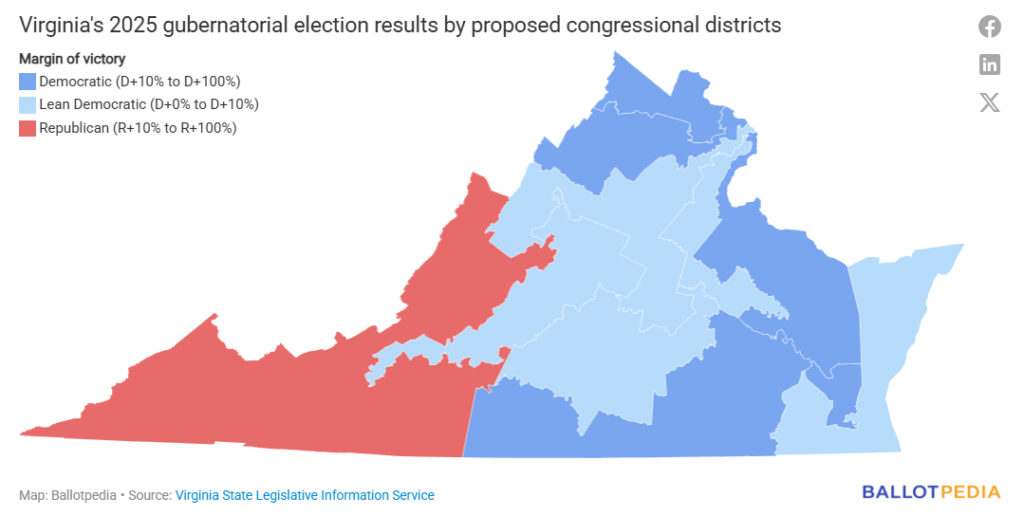
Currently, the partisan split of Virginia delegates in the U.S. House is 6-5. Based on the 2025 gubernatorial election results, the proposed map would result in a partisan split of 10-1, with Democrats potentially gaining four additional seats in the U.S. House.
Data provided by the Virginia General Assembly for the proposed districts did not include vote percentages or numbers for independent or minor-party candidates for governor. As such, the calculation of partisan leanings in each district is based only on votes for Abigail Spanberger and Winsome Earle-Sears, the Democratic and Republican candidates for governor, respectively.
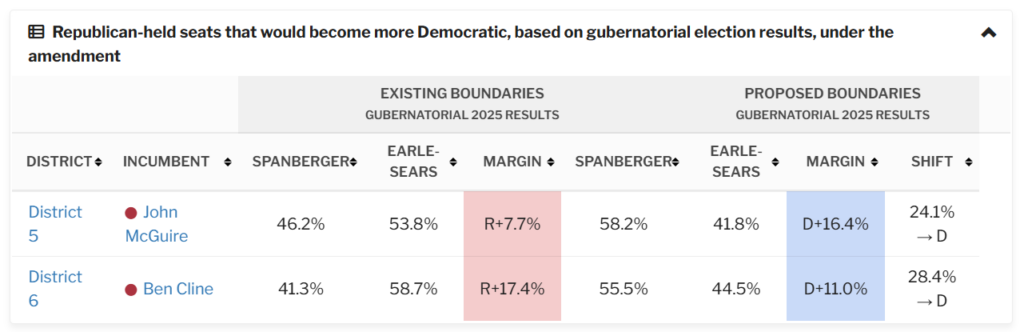
Republican-held districts that would become more Democratic
Under the constitutional amendment and HB 29, two Republican-held congressional districts would shift to become more Democratic, based on gubernatorial election results from 2025. Spanberger would have won both—District 5 and District 6—with margins above 10%.
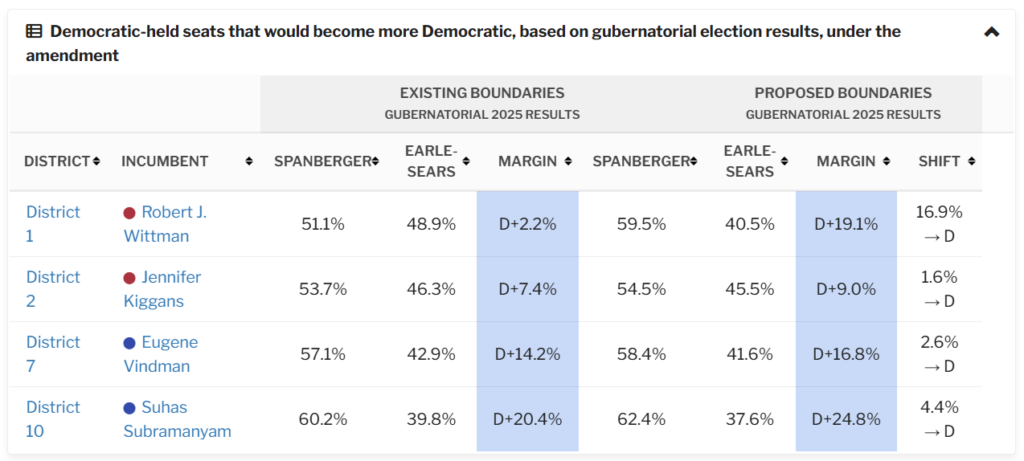
Democratic-held districts that would become more Democratic
Under the constitutional amendment and HB 29, four Democratic-held congressional districts would shift to become more Democratic, based on gubernatorial election results from 2025. District 1 is one of these districts that had the narrowest margin in the state gubernatorial election, with Abigail Spanberger (D) receiving 8,789 more votes than Winsome Earle-Sears (R).
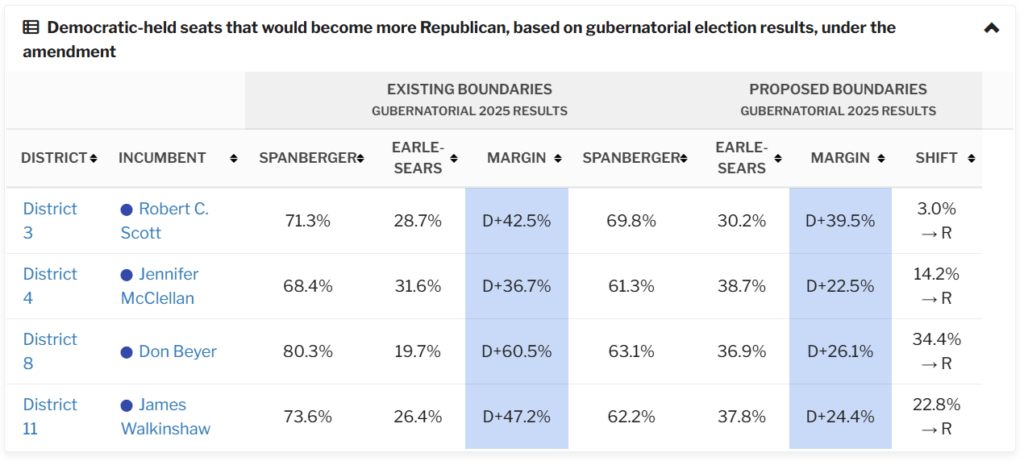
Democratic-held districts that would become more Republican
Under the constitutional amendment and HB 29, four Democratic-held congressional districts would shift to become more Republican, based on the 2025 gubernatorial election results. Spanberger still would have won all four districts, with margins of at least 11%.
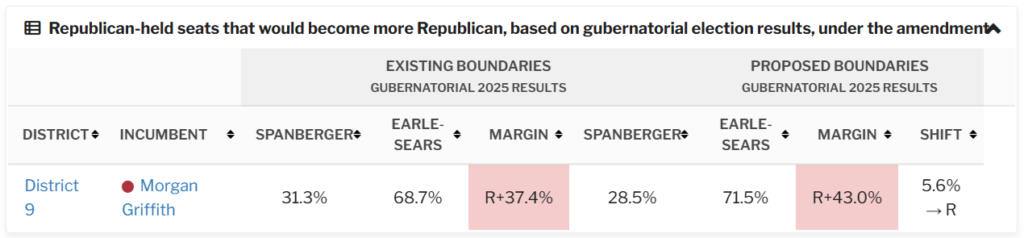
Republican-held districts that would become more Republican
Under the proposalmap, one Republican-held congressional district would shift to become more Republican, based on the gubernatorial election results from 2025. The change in election results in District 9, of which Earle-Sears won with a margin greater than 18%, is less than three percentage points.
Litigation surrounding the constitutional amendment
On Oct. 28, 2025, state Sens. Ryan McDougle (R-26) and William Stanley (R-7), House Minority Leader Terry Kilgore (R-45), and Virginia Trost-Thornton, a member of the 2020 redistricting commission, filed a complaint with the Virginia Circuit Court requesting that the amendment be blocked from being placed on the statewide ballot. The complaint stated that the Speaker of the House lacked the authority to convene or expand the scope of the special legislative session in 2025 when the constitutional amendment was introduced.
On Jan. 27, 2026, Judge Jack Hurley ruled that the constitutional amendment could not be placed on the 2026 ballot because it was introduced to the Virginia General Assembly in violation of state law.
On Jan. 28, Virginia House Speaker Don Scott (D-88) and the other defendants filed an appeal in the case. On Feb. 13, the Virginia Supreme Court denied a motion to pause the referendum, stating that it could be placed on the ballot for the April 21 special election and that they would decide the case on an expedited basis.
Redistricting in other states ahead of the 2026 elections
If the constitutional amendment is approved by voters, Virginia would join six other states that have conducted congressional redistricting between 2024 and 2026.
As of February 2026, six states changed congressional maps before the 2026 elections—California, Missouri, North Carolina, Ohio, Texas, and Utah. Three states had taken official action toward voluntary redistricting, and three states had congressional maps that were subject to change due to litigation. Before 2025, only two states had conducted voluntary mid-decade redistricting since 1970.
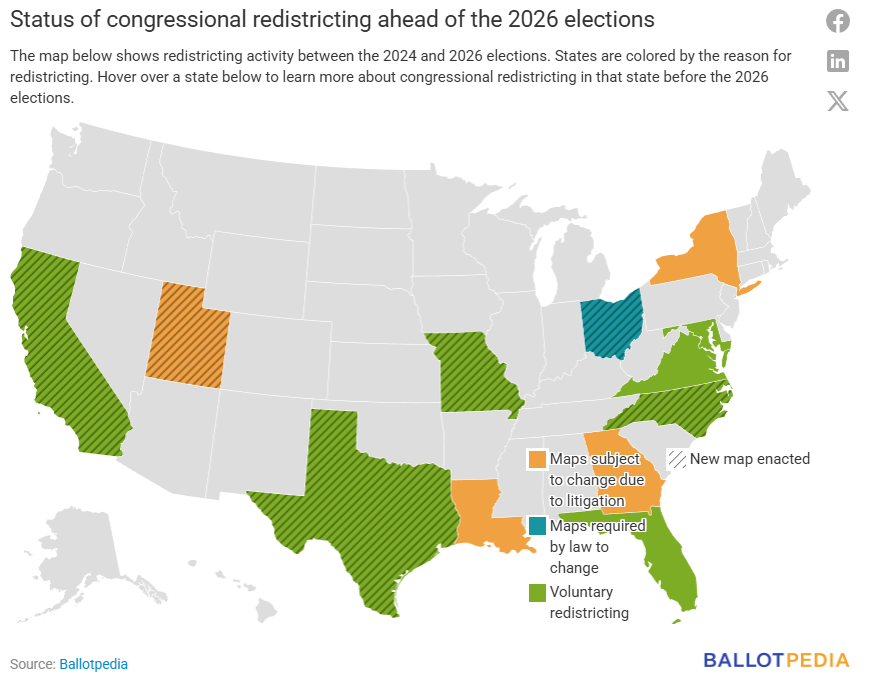
California is the only state that has implemented a new congressional district map by ballot measure between 2024 and 2026. On Nov. 4, 2025, voters approved Proposition 50, with 64.4% voting 'Yes'. The measure amended the state constitution to allow the state to use a legislature-drawn congressional district map for elections between 2026 and 2030. Donors to campaigns in support and opposition of Proposition 50 contributed a combined $167 million, making the measure the fourth-most expensive ballot measure in the state’s history.
Other 2026 Virginia constitutional amendments
The Virginia legislature also approved three other constitutional amendments on Jan. 16 that will be placed on the ballot in 2026.
The first would remove the state’s constitutional ban on same-sex marriage, which defined marriage as between one man and one woman. Following the Obergefell v. Hodges ruling, the ban has been inoperative since 2015. The second would add a right to reproductive freedom to the state constitution. The amendment defines this as "the right to make and effectuate one's own decisions about all matters related to one's pregnancy." The third would provide that persons convicted of felonies will be entitled to vote following release from incarceration. As of 2026, the governor can restore voting rights to a previously incarcerated felon on an individual basis.
While the redistricting constitutional amendment will be decided by voters at a special election on April 21, the other three amendments will be on the general election ballot on Nov. 3.
Additional reading: