


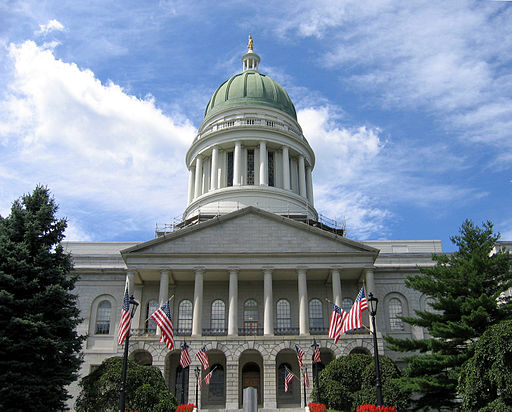
On Feb. 10, Maine legislators approved a bill requiring the use of ranked-choice voting to elect the governor and members of the state legislature. Before advancing the legislation to Gov. Janet Mills (D), the legislature is waiting for advice from the Maine Supreme Judicial Court.
In the ranked-choice voting system currently used in Maine, a candidate who wins a majority of first-preference votes is the winner. If no candidate wins a majority of first-preference votes, the candidate with the fewest first-preference votes is eliminated.
Ballots that ranked an eliminated candidate as their first or highest choice, depending on the round, are then reevaluated and counted as first-preference ballots for the next-highest-ranked candidate in that round. A new tally is conducted to determine whether any candidate has won a majority of ballots. The process is repeated until a candidate wins an outright majority.
In 2016, voters approved the Maine Ranked Choice Voting Initiative, which authorized the use of RCV for all congressional, state legislative, and gubernatorial elections.
A year later, however, the state supreme court issued an advisory opinion holding that using RCV in general elections for governor and state legislature violated the Maine Constitution: "According to the terms of the Constitution, a candidate who receives a plurality of the votes would be declared the winner in that election. ... In essence, the Act is inapplicable if there are only two candidates, and it is in direct conflict with the Constitution if there are more than two candidates."
Since 2018, Maine has used RCV for congressional races, as well as primary elections for governor and state legislature. In 2019, the use of RCV was expanded to include presidential primaries and general elections.
In 2025, legislators in both chambers approved a bill to require RCV for gubernatorial and legislative elections, but recalled it from Mills' desk and kept it for consideration in 2026.
This year, the Maine House approved LD 1666 on a 71-52 vote on Feb. 10, with 71 Democrats voting in favor, 51 Republicans and one Democrat voting against, and 25 legislators absent.
Later that day, the Maine Senate approved the bill on a 19-13 vote. But instead of sending the bill to Mills’ desk, the Senate voted to request an advisory opinion from the state supreme court on the measure’s constitutionality. Under the Maine Constitution, the court is required to issue an advisory opinion if it is requested by the governor or either chamber of the legislature.
State Sen. Cameron Reny (D) argued that court rulings in Alaska have addressed a similar constitutionality issue. The Alaska Supreme Court ruled in 2022 that the election is not complete until all ranked-choice voting tabulation occurs. “It’s long past time to eliminate this confusion, honor the will of the voters and affirm the constitutionality of [ranked choice voting] in gubernatorial and legislative elections,” Reny said.
Speaking against the legislation, Rep. David Boyer (R) said it was not good policy to make changes to how voting is conducted in an election year. “It’s not good for the voters. It’s not good for the rule of law,” Boyer said. “It’s clearly unconstitutional. We can change the words we want in statute, but it doesn’t change the fact that we know what’s going to happen to this after this passes, it’s going to go right to court.”
Currently, seven states have laws authorizing or requiring the use of RCV for certain elections, while 18 states have laws prohibiting or restricting the use of RCV.
The legislation in Maine is one of 34 bills that have been introduced in 2026, requiring or allowing at least some state or local elections to use RCV. The Virginia Senate has approved legislation allowing all local governing bodies, rather than just county boards of supervisors and city councils, to use RCV.
Legislators have also introduced 18 bills repealing or prohibiting RCV. Four bills — in Indiana, Iowa, Michigan, and Ohio — have passed at least one chamber of a state legislature.
Click here to read more about ranked-choice voting in the United States.