


Welcome to the Wednesday, March 4, Brew.
By: Briana Ryan
Here’s what’s in store for you as you start your day:
- 160 state legislative chamber control changes since 1992 — including 20 where both changed at once
- Campaign behind California's wealth tax initiative reports collecting 25% of the required signatures to qualify for the ballot
- Eight state executives are retiring across Ohio and Louisiana this year
160 state legislative chamber control changes since 1992 — including 20 where both changed at once
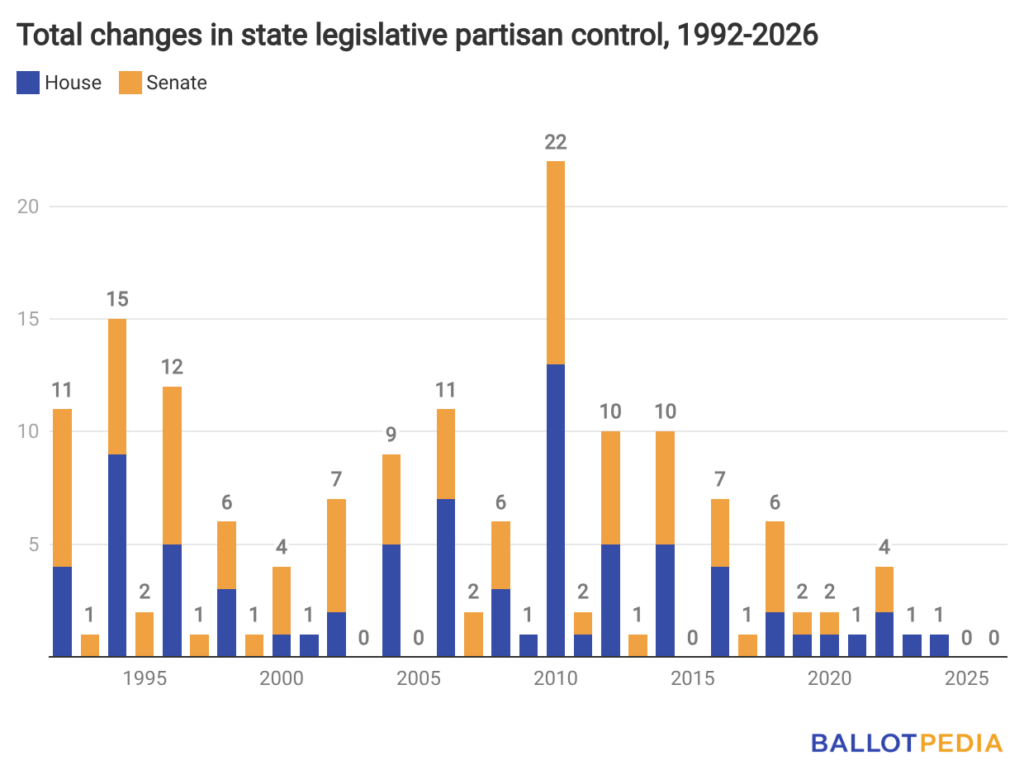
Since 1992, 160 changes in state legislative chamber partisan control have happened across the country. That includes 20 instances in which both of a state's legislative chambers changed partisan control in the same year (14%) and 120 instances in which a single chamber changed partisan control (86%).
While chambers may have periodic split control, especially chambers with an even number of seats, these figures include only complete transfers of power from one major party to the other. Seventy-eight of these changes have occurred in lower legislative chambers since 1992, and 82 have occurred in upper chambers. The Washington Senate and Wisconsin Senate changed control more than any others, at seven times each.
There were seven years with 10 or more changes in chamber control. That last happened in 2014 when five upper chambers and five lower chambers changed partisan control nationwide.
Simultaneous control changes
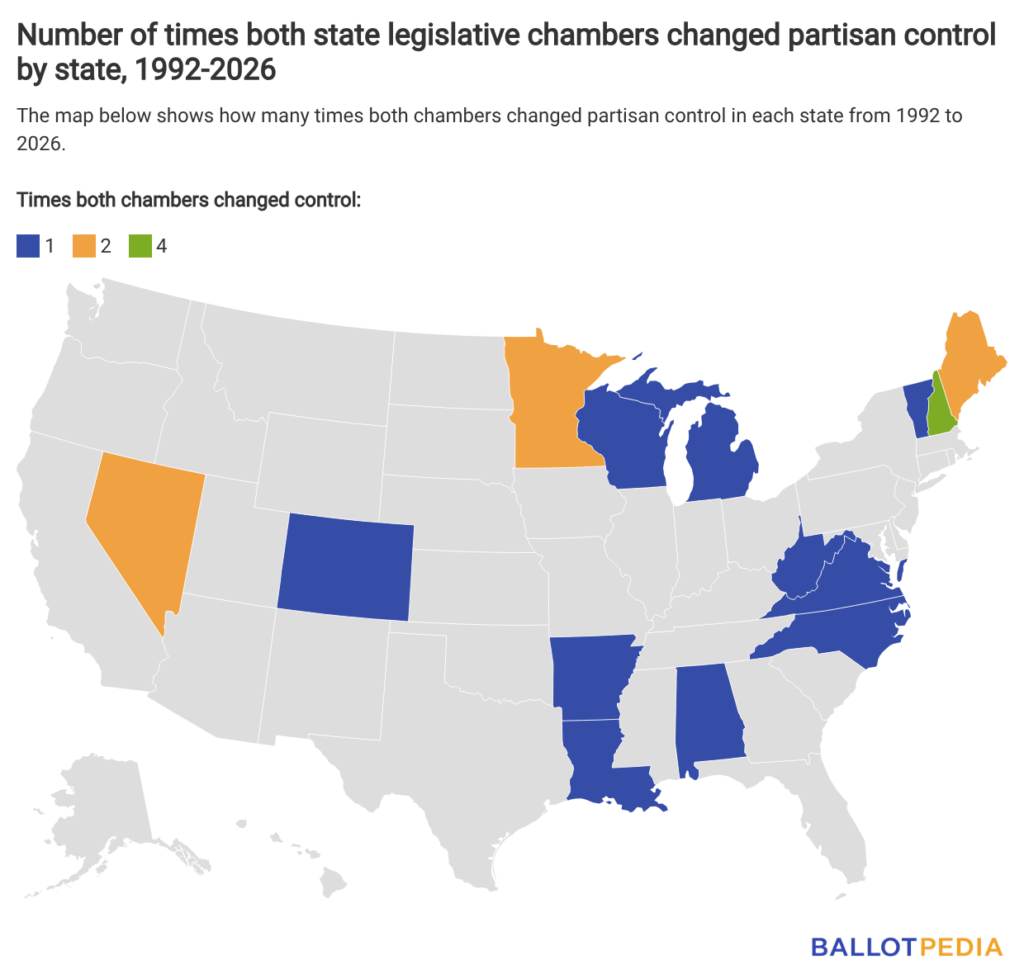
There were 20 instances in which both of a state's legislative chambers changed partisan control during the same year. The chambers changed from Democratic to Republican control in 11 of those instances and from Republican to Democratic control in eight. One time, in Vermont in 1992, the Senate changed from Democratic to Republican control while the House changed from Republican to Democratic control.
The most control changes occurred in 2010, when both legislative chambers changed from Democratic to Republican control in six states. The Washington Times' Joseph Weber wrote at the time, "The Republican midterm wave swept through state capitals across the nation Tuesday, with historic gains in state legislative races that will give the GOP a major advantage in influencing congressional races over the next 10 years through redistricting." Republicans gained control of 22 chambers formerly controlled by Democrats that year.
Maine, Minnesota, and Nevada had both state legislative chambers change partisan control twice between 1992 and 2026. New Hampshire had both state legislative chambers change partisan control four times between 1992 and 2026.
Individual chamber changes
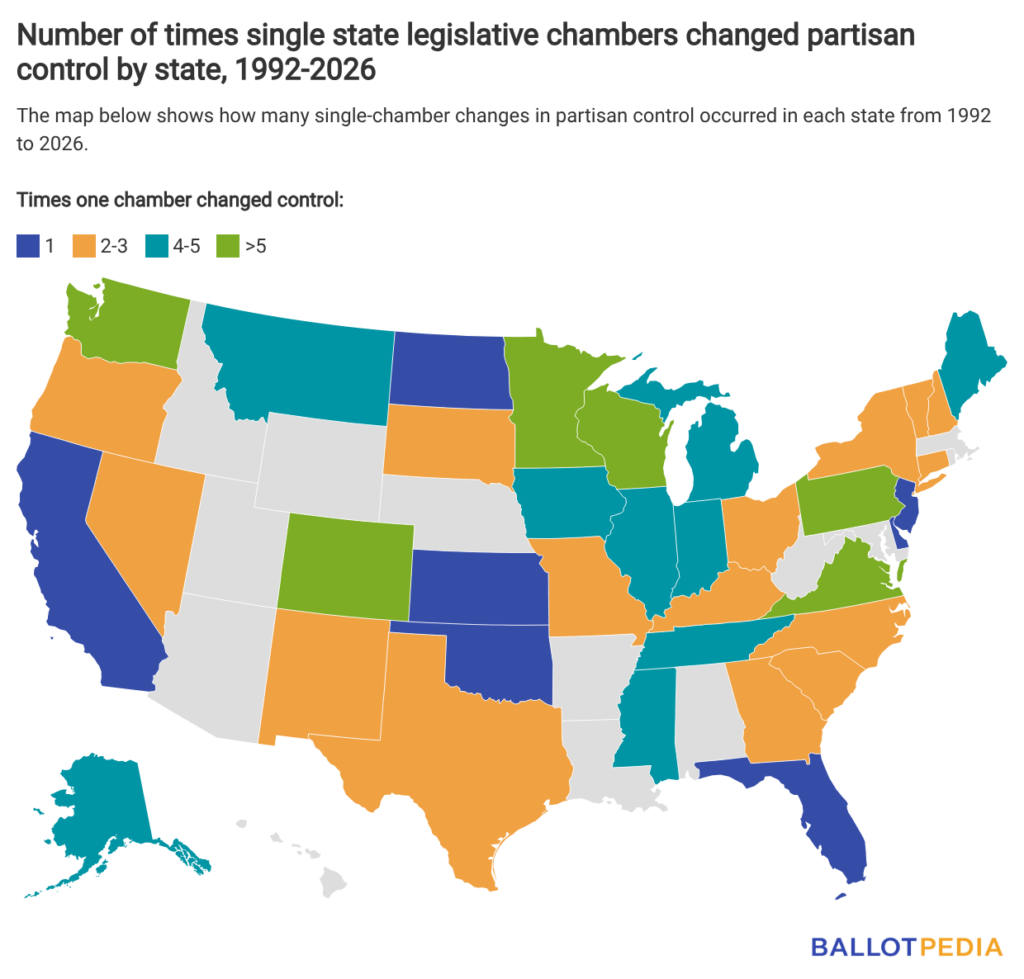
Single state legislative chambers changed partisan control 120 times. Those are instances where only one state legislative chamber changed control, while the other chamber's control remained the same. While the vast majority of changes in partisan control occurred through regularly scheduled elections, a few occurred after an officeholder changed party affiliations or through special elections.
Colorado, Minnesota, Pennsylvania, Virginia, Washington, and Wisconsin had more than five elections in which a state legislative chamber changed partisan control. Washington and Wisconsin had the most changes in chamber control, with eight. Twelve states had no state legislative chambers change partisan control. Nebraska's officially nonpartisan, unicameral Legislature was not included in this analysis.
Click here to read more about changes in state legislative chamber partisan control since 1992.
Campaign behind California's wealth tax initiative reports collecting 25% of the required signatures to qualify for the ballot
The campaign “Save California Health Care and Public Education” has collected at least 25% of the required signatures to qualify a combined initiated constitutional amendment and state statute known as the billionaire tax to get the 2026 ballot. The total number required is 874,641, which is 8% of the votes cast in the 2022 gubernatorial election. The SEIU-UHW, a labor union for healthcare workers, is sponsoring the campaign.
The initiative would impose a one-time 5% tax on an individual billionaire’s net wealth. Ninety percent of the revenue would be allocated to state-funded healthcare programs and 10% of revenue would be allocated to education-related and food assistance programs (10%). The campaign formally launched on Feb. 18.
The committee “Save California Health Care and Public Education” is registered in support of the initiative. The committee has raised more than $3.5 million as of Feb. 26, with a majority of the contributions being in-kind contributions representing signature gathering or campaign consulting by SEIU-UHW.
Two committees — “Stop the Squeeze” and “Golden State Promise” — registered in opposition to the initiative. Stop the Squeeze has so far raised $300,000, and the Golden State Promise has raised $10 million from Chris Larsen and his San Francisco-based blockchain company, Ripple Labs.
Separately, the committee “Building a Better California” is sponsoring three initiatives that compete with provisions of the proposed billionaire tax. All three are currently collecting signatures. Building a Better California has raised $35 million to date, with $20 million coming from Google co-founder Sergey Brin.
The first initiative would prohibit taxes enacted after Jan. 1, 2026, from being exempted from the state minimum guarantee for education funding established when voters approved Proposition 98 in 1988. The billionaire tax initiative includes a provision excluding the revenue the tax generates from the state’s General Fund for purposes of calculating the state minimum guarantee for education funding.
A second initiative would prohibit new taxes after Jan. 1, 2026, on the ownership or accumulation of retirement holdings, individually owned assets, and other forms of personal savings. It would also prohibit enacting retroactive taxes that result in a tax liability based on activities that occurred or were present before the tax took effect.
The third initiative would apply to any new special tax enacted after Jan. 1, 2026, through state law or ballot initiative. Government entities or departments receiving revenue from the new tax would be required to eliminate their lowest-performing programs and reinvest those savings in higher-performing programs.
The wealth tax initiative would be the first ballot measure in the country to enact such a tax. In 2023, Texas voters approved Proposition 3 68% to 32%. This amendment prohibits the Texas Legislature from enacting a wealth tax or net worth tax.
Click here to read more about the California One-Time Wealth Tax for State-Funded Healthcare, Education, and Food Assistance Programs Initiative.
Eight state executives are retiring across Ohio and Louisiana this year
In February, statewide filing deadlines passed in five states: Ohio (Feb. 4), Indiana (Feb 6), Louisiana (Feb. 13), Maryland (Feb 24), and Idaho (Feb. 27). Across these five states, 23 statewide offices and board seats are up for election.
In Ohio, every single state executive office is open, while in Indiana, Maryland, and Idaho, every incumbent is seeking re-election. In Louisiana, two state executives are retiring, while another is running for a full term after being appointed.
In Ohio:
- Gov. Mike DeWine (R) is term-limited and is not seeking another office.
- Lt. Gov. Jim Tressel (R) is not seeking another office.
- Attorney General Dave Yost (R) is term-limited and is not seeking another office.
- Secretary of State Frank LaRose (R) is term-limited and is running for state auditor
- Auditor of Public Accounts Keith Faber (R) is term-limited and is not seeking another office.
- Treasurer Robert Sprague (R) is term-limited and is running for attorney general.
In Louisiana:
- Public Service Commissioner Eric Skrmetta (R) is term-limited. He ran for U.S. Senate, but withdrew and is not seeking another office.
- Public Service Commissioner Foster Campbell (D) is term-limited and is not seeking another office.
As a result of these retirements, the total of state executives retiring in 2026 is now four Democrats and nineteen Republicans. This includes officials from three other states. The types of offices included are:
- Five members of a state board of education
- Three lieutenant governors
- Three attorney generals
- Three secretaries of state
- Two governors
- Two public utility commissioners
- One agriculture commissioner
- One auditor
- One commissioner of lands
- One comptroller
- One treasurer
Of these retiring state executives, 14 are retiring from public office, and nine are running for another office.
Click here for more information about the elections for state executive offices happening in 2026.