


On Feb. 20, Governor Katie Hobbs (D) vetoed House Bill 2206, which would have required the Arizona Department of Economic Security to lower the state's Supplemental Nutrition Assistance Program (SNAP) payment error rate to 3% or lower by December 30, 2030. This bill was introduced after the One Big Beautiful Bill Act (OBBBA or H.R.1) established a performance-based state cost-share formula for SNAP benefits beginning in 2028 and is tied to payment error rates.
A payment error occurs when SNAP benefits are issued incorrectly, either to an ineligible household, in the wrong amount, or based on misapplied eligibility rules. Common causes include incorrect reporting of income, household size, or allowable expenses. Error rates are determined through federally required quality control reviews on sampled cases. States submit their rates to the USDA, which verifies the data, and works with states to locate the source of errors or implement corrective action plans.
HB 2206 passed the Arizona House on Feb. 12 with a vote of 33-25, with all Republicans voting in favor and all Democrats, except for two who did not vote, opposed. In the Senate, the bill was passed 17-12 on Feb. 16, with all Republicans in favor and all Democrats, except one who did not vote, opposed.
OBBBA changes and payment errors
Section 10105 of the OBBBA established a performance-based cost-share system that ties state financial responsibility to payment error rates. Historically, the federal government has paid for the full cost of SNAP benefits and has split administrative costs with the states. Beginning in FY2028, states will be required to pay a share of SNAP benefit costs if their error rate exceeds 6%. States with error rates from 6 to 8% will pay 5% of benefits, states with 8 to 10% will pay 10% of benefits, and states with error rates over 10% will pay 15%. For states with error rates under 6%, the federal government will continue to pay all of SNAP benefits.
Arizona's payment error rate for FY2024 (most recent data) was 8.84%, meaning that if the state's error rate stayed the same until FY2028, the state would be required to pay 10% of the cost of SNAP benefits. Based on Ballotpedia's analysis of the cost of states' SNAP benefits in May 2024 (most recent data), if Arizona was required to pay 10% of benefits, it could cost the state about $16 million per month. Other states may pay significantly more, such as California and New York, which as of 2024 had error rates of 10.98% and 14.09%, respectively. According to the analysis, California could pay about $153 million per month for SNAP benefits and New York could pay $97 million. There are also eight states that had error rates below 6% in 2024 and are projected to have no cost-share. They are Idaho, Nebraska, Nevada, South Dakota, Utah, Vermont, Wisconsin, and Wyoming.
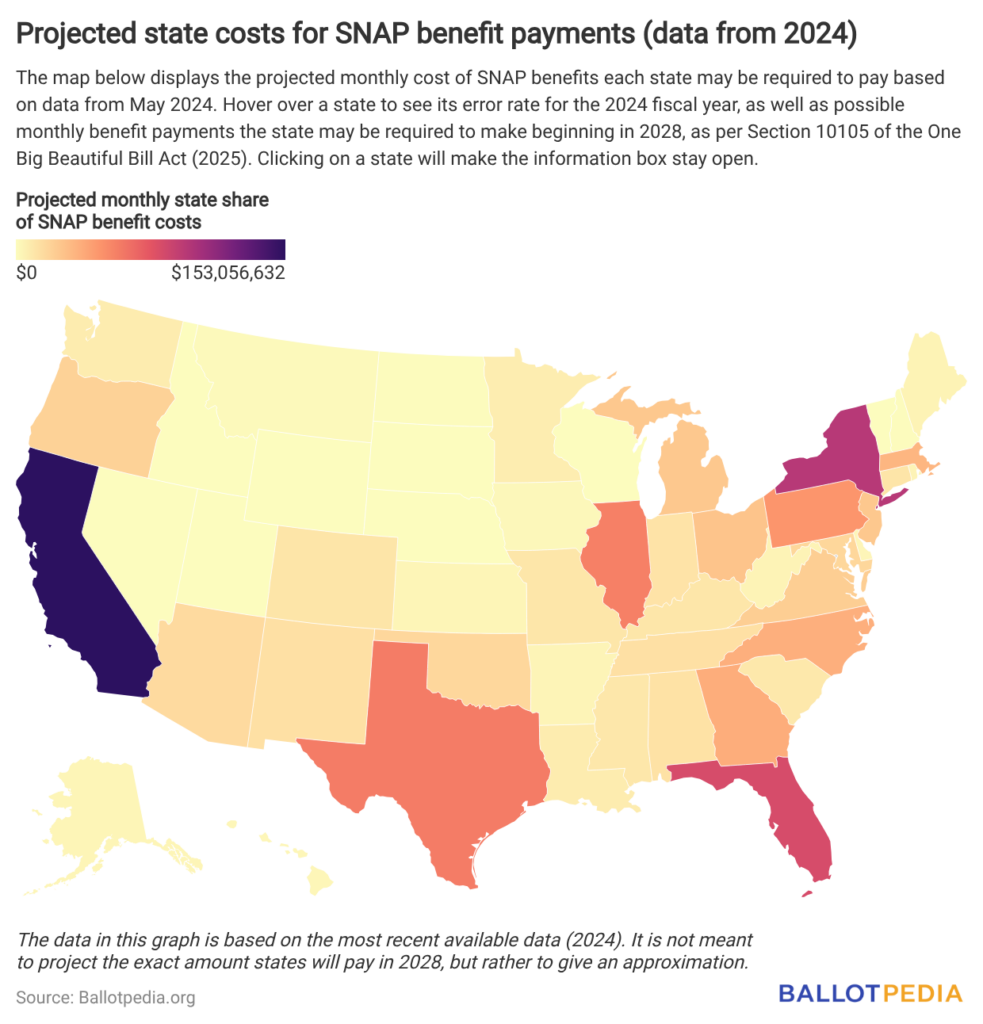
To read more about SNAP error rates, the cost-share system, and the implementation of other SNAP-related changes made by the One Big Beautiful Bill Act, click here.
Arizona lawmakers' approach
Arizona HB 2206 sought to require the state's Department of Economic Security, which administers the state's SNAP program, to lower the payment error rate to below 3% by Dec. 30, 2030 by creating financial incentives for the Department of Economic Security. The bill states that if the department failed to meet interim targets, they would need to:
- submit a corrective action plan to the legislature that explains why the targets were not met and proposes timelines for corrective action,
- pay half of any federal liabilities that may be imposed due to the payment error rate, and
- implement a corrective plan.
HB 2206 also would have created a penalty for failing to implement a corrective plan, stating that administrative funding for the department would be reduced by 10% until a plan has been implemented. The bill also states that if the department lowers the error rate ahead of schedule, the legislature may allocate more funds to the department for program improvements.
Bill sponsor Nick Kupper (R) stated that reducing the error rate to 3% instead of 6% would save taxpayers $80 million. He further stated, “For anyone who says, ‘Oh, 3%’s impossible,’ there are dozens of states that have been below 3% over the past two decades. So, this is not impossible. This is something very doable. And I put teeth in the bill, because people don’t really tend to get off their butts unless there’s something kicking them in it.”
In her veto statement, Governor Katie Hobbs (D) said, "With H.R. 1 [the OBBBA] now on the books, and with significant penalties to come if operational changes are not made this year, the Arizona Department of Economic Security (DES) has already taken decisive action to improve the accuracy of SNAP benefit determinations. These include: enhancing eligibility verifications, increasing staffing and training focused on accuracy, and investing in technology solutions. This legislation would duplicate these efforts and disrupt the operations of an already overburdened agency. H.R. 1 is also full of unfunded mandates, directly contributing to significant staffing shortages at DES, resulting in delayed case decisions and frustrated callers. ... The legislation you sent me contains yet more unfunded mandates and not a dollar to help our state agencies implement these changes now, or to modernize our systems for the future."