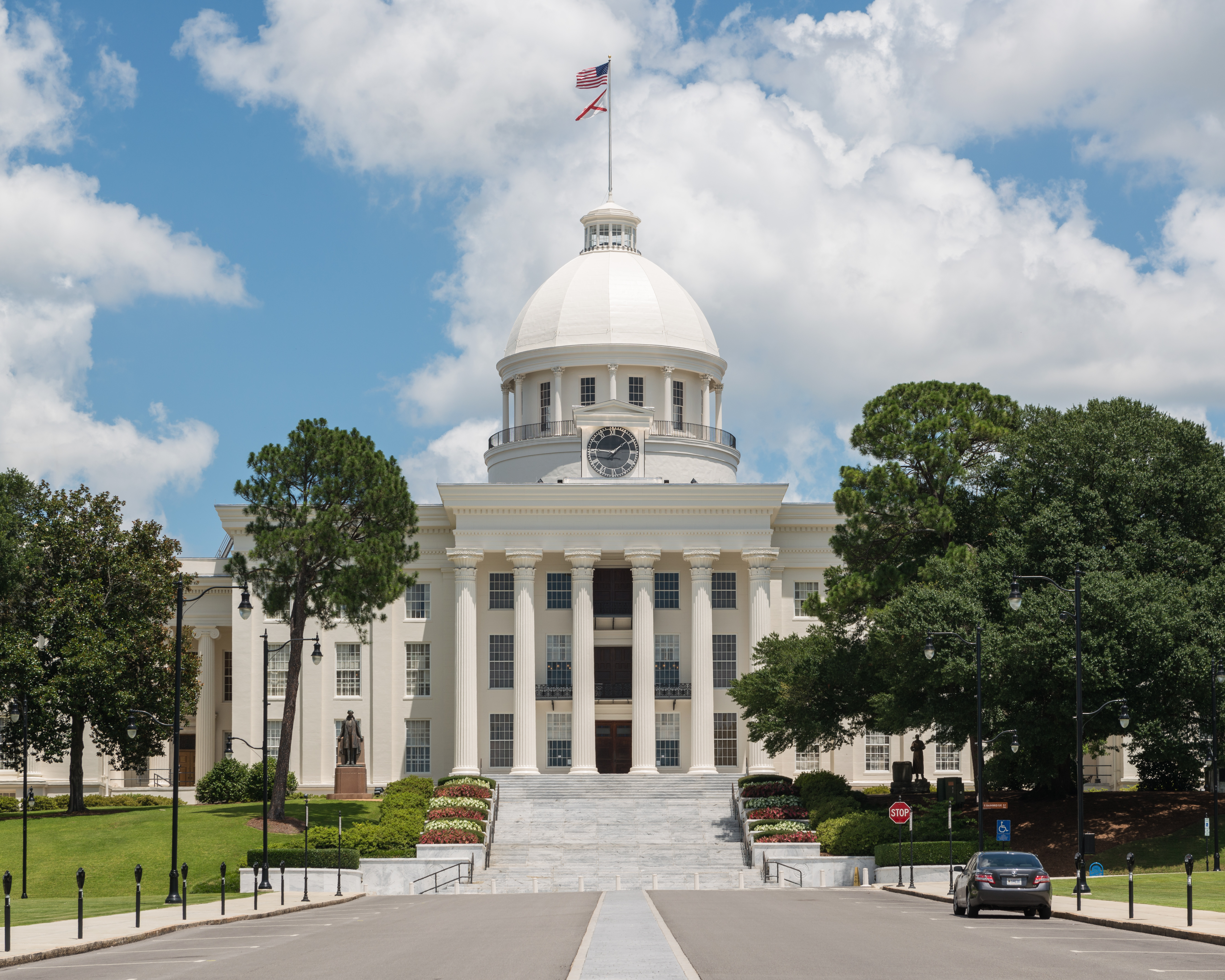
On March 31, 2026, Alabama GovernorKay Ivey (R) signed SB 167, ending judicial deference practices in state courts. Judicial deference is a practice by courts by which they adopt an agency’s reading of an ambiguous statute, regulation, or other document in cases involving that agency.
SB 167 removes language in the state Administrative Procedure Act instructing courts that "the agency order shall be taken as prima facie just and reasonable and the court shall not substitute its judgment for that of the agency as to the weight of the evidence on questions of fact," and substitutes language which says that courts “may consider, but shall not defer to” state agencies’ interpretations of state statutes or regulations. “After applying all customary tools of interpretation,” the new text continues, “the court shall exercise any remaining doubt in favor of a reasonable interpretation.”
The bill was introduced by state Sen. Arthur Orr (R) on January 14, 2026. The bill passed the Alabama Senate on February 5, 2026, with a vote of 34-0 (seven Democrats and 27 Republicans voting yes), and passed the Alabama House of Representatives on March 17, 2026 with a vote of 105-0 (29 Democrats and 76 Republicans voting yes).
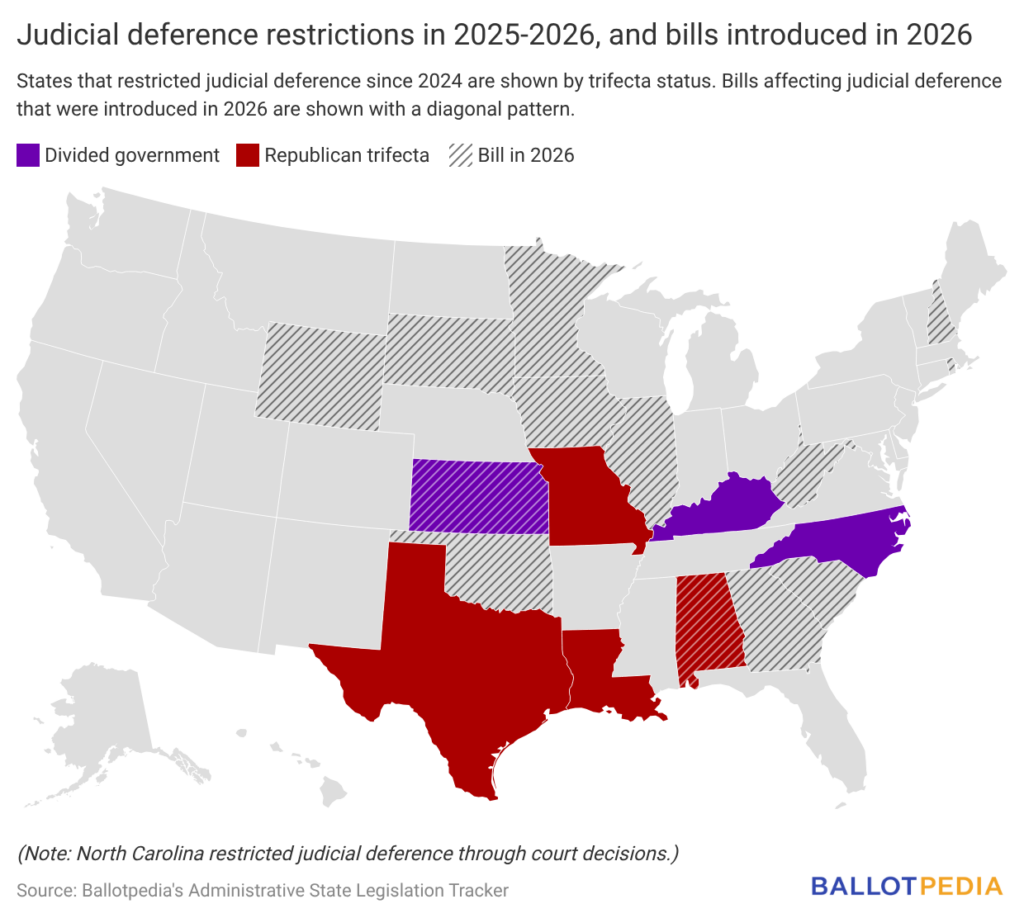
Alabama is the second state to comprehensively end judicial deference in 2026, with Kansas having enacted a similar bill on Feb. 6. South Dakota also enacted a REINS-style law which limits judicial deference in cases to determine whether an agency regulation is a “major regulation” for the purposes of the law.
The Georgia Legislature passes HB 1247
The Georgia Legislature passed a similar bill, HB 1247, on April 3. This bill, which supporters call the Georgia Bureaucratic Deference Elimination Act, would prohibit state courts from deferring to agency interpretations “when interpreting this state's Constitution, statutes, or published rules.”
The bill was introduced on February 9 and passed by the Georgia House of Representatives on March 4 with a vote of 98-63 (63 Democrats voted no, and one Democrat joined 97 Republicans in voting yes). The Georgia Senate amended the bill to include provisions of another bill, called the Red Tape Rollback Act, which would require legislative review of proposed agency rules. The Senate passed this amended version of the bill March 25, with a vote of 48-2 (two Democrats voted no, 18 Democrats joined 30 Republicans in voting yes).
The House added its own amendments (on public disclosure of legislative records and state outreach services) to the amended bill on April 2, and passed it with a vote of 98-70 (70 Democrats voted no, and two Democrats joined 96 Republicans in voting yes). The Senate then passed the House-amended bill on April 3, with a vote of 34-18 (17 Democrats and one Republican voted no, and three Democrats and 31 Republicans voted yes). The bill will now be delivered to Gov. Brian Kemp for potential signature.
Judicial deference in context
At the federal level, the the U.S. Supreme Court transformed deference jurisprudence with the 2024 Loper Bright Enterprises v. Raimondo case, in which it struck down the Chevron doctrine of judicial deference to federal agencies’ interpretations of statute. While this case restricted some judicial deference practices at the federal level, it did not affect practices like Auer deference, under which federal courts defer to agencies’ interpretations of their own regulations.
Because the Loper Bright case was a federal-level case, it also did not affect judicial deference practices at the state level. However, at least eight states, including Alabama, have restricted judicial deference by state courts since the Loper decision was announced. Seven states (Kentucky, Texas, Oklahoma, Louisiana, Missouri, Kansas, and Alabama) have enacted laws restricting state-level judicial deference in 2025 and 2026. The North Carolina Supreme Court struck down state-level judicial deference practice in the 2025 cases of Thurman Crofton Savage v. N.C. Department of Transportation and Alvin Mitchell v. University of North Carolina Board of Governors. Ballotpedia has tracked 23 bills in 13 states related to judicial deference in 2026, including the Alabama and Georgia bills.