


Welcome to Ballot Bulletin: Ballotpedia's Weekly Election Policy Digest. Every Tuesday, we deliver the latest updates on election policy around the country, including nationwide trends and recent legislative activity.
In this week’s edition, we cover 358 bills state legislatures acted on in the last week and look at new state laws requiring proof of citizenship for voter registration.
The state of election legislation in the U.S.
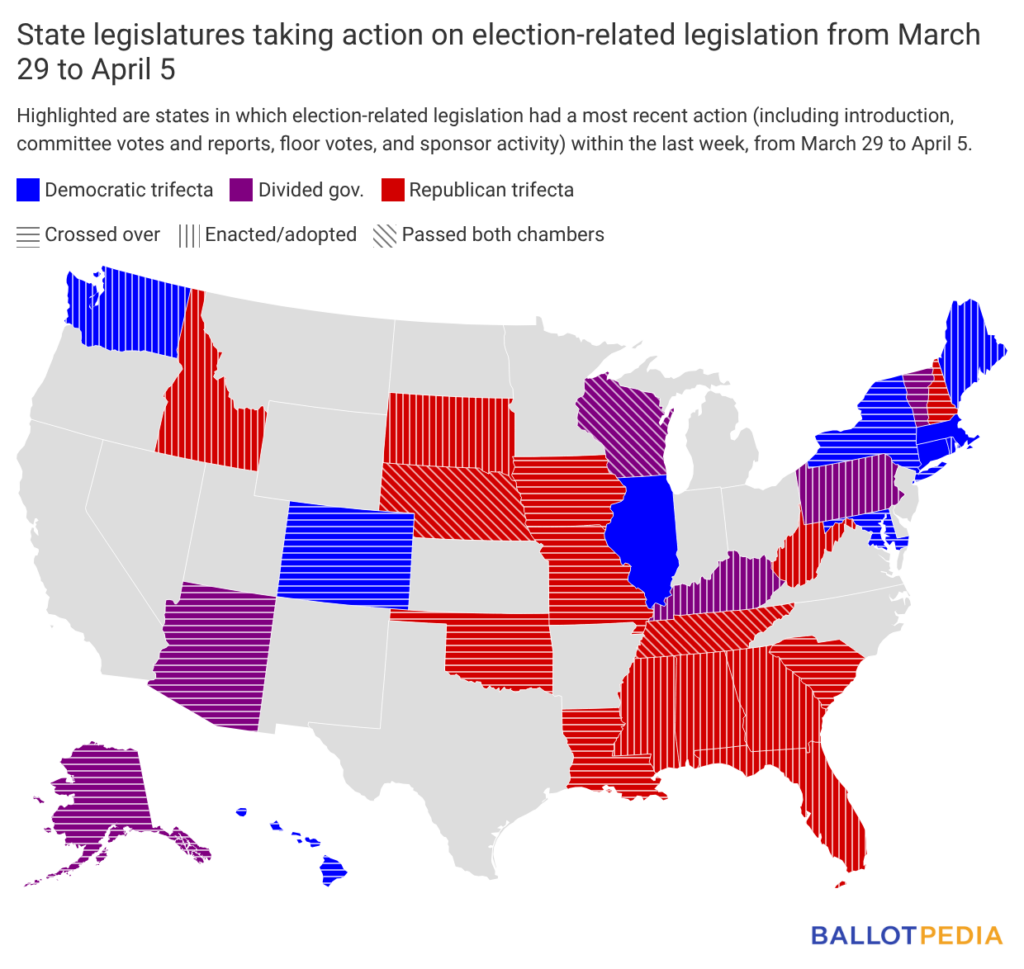
Lawmakers in 32 states acted on 358 election-related bills over the past week. Thirty-one state legislatures are in regular or special sessions. In the last week, 38 bills were enacted, 16 bills passed both chambers of a state legislature, and zero bills were vetoed.
Of the bills acted on this week, 159 (44.4%) are in states with Democratic trifectas, 168 (46.9%) are in states with Republican trifectas, and 31 (8.7%) are in states with divided government. The most active bill categories this week were campaign finance (128), election types and stages (84), and voter registration and list maintenance (66).
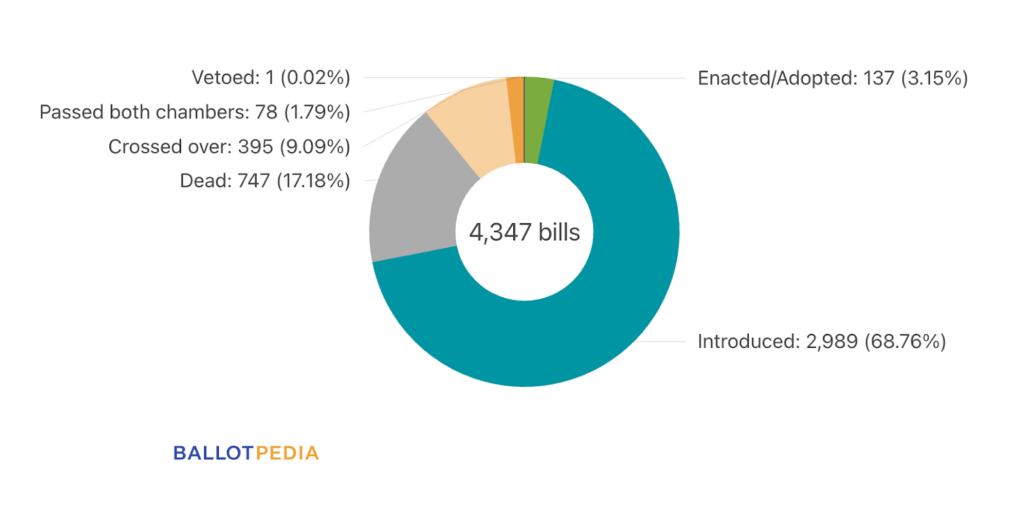
Ballotpedia is currently tracking 4,347 election-related bills across the country. We are actively processing bills filed since March 31.
The chart below breaks down the status of those 4,347 bills by where they stand in the legislative process:
Note: In some states, legislators can file hundreds of bills per day. We are actively reviewing those bills to determine their relevance to election administration. As a result, during this period of heightened legislative activity, the newsletter may not yet account for all relevant bills introduced in 2026.
Enacted bills
On April 1, Mississippi Gov. Tate Reeves (R) signed SB 2588, also known as the Safeguard Honesty Integrity in Elections for Lasting Democracy (SHIELD) Act, into law. It requires the state’s voter rolls to be checked against federal citizenship data, in addition to the state’s driver’s license database. It also requires SAVE be used to crosscheck individuals who do not provide a driver’s license number with their voter registration application. If a person’s citizenship status cannot be confirmed, they must provide proof of citizenship to register to vote.
Other noteworthy bills enacted in the past week include Florida H 991 and South Dakota SB 175, covered in the policy spotlight below.
Thirty-five other bills were enacted this week. They are:
- Alabama (Republican trifecta)
- Florida (Republican trifecta)
- Georgia (Republican trifecta)
- Idaho (Republican trifecta)
- Kentucky (Divided government)
- Maine (Democratic trifecta)
- Pennsylvania (Divided government)
- Rhode Island (Democratic trifecta)
- South Dakota (Republican trifecta)
- Washington (Democratic trifecta)
- West Virginia (Republican trifecta)
Bills passing both chambers
Sixteen bills passed both chambers this week. They are:
- Idaho (Republican trifecta)
- Kentucky (Divided government)
- Maine (Democratic trifecta)
- Nebraska (Republican trifecta)
- Tennessee (Republican trifecta)
- Wisconsin (Divided government)
To see a full list of bills awaiting gubernatorial action, click here.
Vetoed bills
No election-related bills we are following were vetoed in the past week. For a list of all vetoed bills, click here.
All bills
The chart below shows all bills Ballotpedia is currently tracking, broken down by partisan sponsorship:
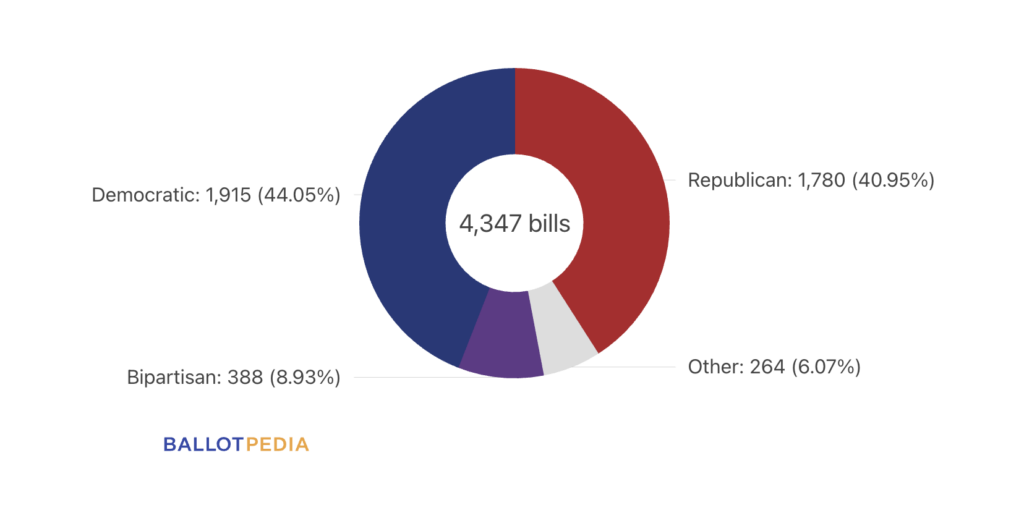
We are currently following 4,347 election-related bills, including bills carried over from the previous year.
- Trifecta status
- Democratic: 1,870 (43%)
- Republican: 1,597 (36.7%)
- Divided: 880 (20.2%)
- Partisan sponsorship
- Democratic: 1,915 (44.1%)
- Republican: 1,780 (40.9%)
- Bipartisan: 388 (8.9%)
- Other: 264 (6.1%)
In the news
On March 31, President Donald Trump (R) signed an executive order requiring the U.S. Postal Service (USPS) to mail absentee/mail-in ballots only to an approved list of voters eligible to vote in federal elections. The order, entitled Ensuring Citizenship Verification and Integrity in Federal Elections, requires the U.S. Department of Homeland Security to use federal data to create a list of U.S. citizens who are eligible to vote in each state and submit each state’s list to its respective chief election official.
The order also requires the U.S. attorney general to prioritize the investigation and prosecution of state and local officials "who issue Federal ballots to individuals not eligible to vote in a Federal election" and directs executive departments and agencies to withhold federal funds from non-compliant state or local governments.
“The Federal Government has an unavoidable duty under Article II of the Constitution of the United States to enforce Federal law, which includes preventing violations of Federal criminal law and maintaining public confidence in election outcomes,” the executive order states. “To enhance election integrity via the United States Mail, additional measures are necessary.”
On April 1, four Democratic Party groups, as well as Senate Minority Leader Chuck Schumer (D) and House Minority Leader Hakeem Jeffries (D), filed a federal lawsuit challenging the constitutionality of the executive order. In the complaint, lawyers for the plaintiffs wrote that the executive order “dramatically restricts the ability of Americans to vote by mail, impinging on traditional state authority … by directing the Postal Service to take actions unrelated to the agency’s statutory mandate.”
On April 3, 23 states sued the federal government over the executive order. The complaint, filed in the U.S. District Court for the District of Massachusetts, says that the president has no constitutional authority to regulate mail-in voting and create a federal list of approved voters. It also says that the executive order, if implemented, will disrupt the electoral process by interfering with the administration of upcoming elections.
Here are other news stories from across the country:
- On April 6, the Maine Supreme Court ruled that LD 1666 would violate the state constitution. The bill would require general and special elections for governor, state senator, and state representative to use ranked-choice voting to determine a winner. In a unanimous opinion, the justices wrote that the bill's “conception of a vote as being a series of instructions or rankings that when tabulated pursuant to a ranked-choice process leads to an eventual final vote is inconsistent with the constitutional concept of a ‘vote.’”
- On April 3, the Georgia Legislature concluded its regular session without passing legislation to extend a July 1, 2026, deadline to remove QR codes from ballots or provide for new voting equipment in advance of the deadline. SB 214, which would have extended the deadline two years, passed the Georgia House 132-39 on April 2. If a special session is not called, hand-marked paper ballots may be used in November.
- On March 26, Tennessee Gov. Bill Lee (R) signed SB 336 into law. The bill removes requirements for individuals to pay all outstanding court costs before their voting rights can be restored, and modifies related child support payment requirements. House Minority Leader Karen Camper (D),who sponsored the House version of the bill, said, “I think people are at a point where they want to just remove the barriers out of the way and allow people to be fully functional members of society.”
Policy spotlight: Florida, South Dakota, Utah enact proof of citizenship laws for voter registration
The story below is adapted from a recent Ballotpedia News story by Andrew Bahl.
Florida, South Dakota, and Utah have joined nine other states in enacting laws requiring documentary proof of citizenship to register to vote.
On April 1, Florida Gov. Ron DeSantis (R) signed HB 991, which includes a proof of citizenship requirement that takes effect on Jan. 1, 2027. On March 26, South Dakota Gov. Larry Rhoden (R) signed SB 175. The bill takes effect immediately, meaning the documentary proof of citizenship requirement will be in place for the state’s June 2 primary. On March 25, Utah Gov. Spencer Cox (R) signed HB 209, which takes effect on May 6, ahead of the state's June 23 primary.
The Florida law requires election officials to verify whether a prospective voter provided proof of citizenship when applying for a driver’s license or state ID card. If not, the person must provide proof of citizenship to be registered to vote. This also applies to individuals who are updating their registration with a change of name, address, or party affiliation. Six groups filed a federal lawsuit on April 1 seeking to block Florida’s law from being implemented.
The South Dakota and Utah laws allow voters who do not provide proof of citizenship to cast a ballot in federal elections only. To vote in state or local elections, however, voters must provide proof of citizenship. Documents establishing citizenship include a state driver’s license or ID card, a birth certificate, a naturalization certificate, or a passport. South Dakota and Utah do not require individuals who previously provided proof of citizenship to do so again when re-registering to vote, such as after an address change.
Individuals who are currently registered to vote in South Dakota do not have to provide proof of citizenship unless they have been removed from the voter rolls. South Dakota’s voter removal process begins when any voter “has failed to vote, has not updated the voter's registration information, and has not replied to a confirmation mailing at least once during the last preceding four consecutive years.”
The new Utah law does not require currently registered voters to provide proof of citizenship unless election officials notify them that their citizenship could not be established. The law requires election officials to complete a review by July 1, 2026, of registered voters using state and federal data to determine U.S. citizenship.
Federal law prohibits noncitizens from voting in any federal election, and no state constitutions explicitly allow noncitizens to vote in state or local elections. All 49 states with voter registration systems require voters to attest they are a U.S. citizen when registering to vote. The District of Columbia and municipalities in three states allow noncitizens to vote in local elections.
While the South Dakota and Utah laws only apply to state or local offices, prospective voters in all 50 states would be required to provide proof of citizenship in order to vote in federal races under legislation currently before the U.S. Senate.
The Republican-sponsored SAVE America Act says states could not accept voter registration applications for federal elections unless they include documentary proof of citizenship, such as a passport, military ID, or an enhanced REAL ID. Applicants could also present a different government-issued photo ID plus another document, such as a birth certificate or naturalization certificate.
The SAVE America Act would also require voters who register by mail to present their proof of citizenship in person to an election official before the election. In states that have same-day voter registration, voters could provide such proof at the polls on Election Day.
Individuals who have changed their name would need to provide proof of citizenship with their old name, as well as either "additional documentation as necessary to establish that the name on the documentation is a previous name of the applicant" or an affidavit attesting that the name on the documentation is their previous name.
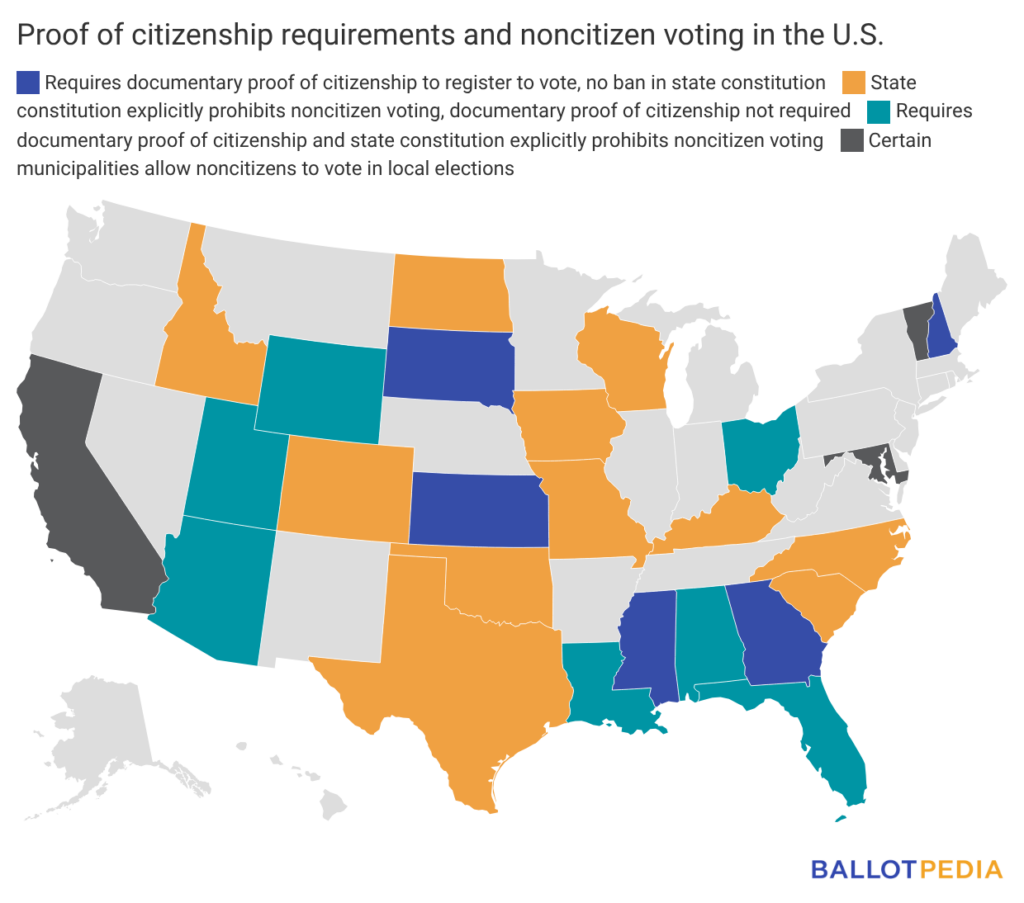
Florida, Utah, and South Dakota are the 10th, 11th, and 12th states to enact laws requiring proof of citizenship to register to vote in at least some cases, joining Alabama, Arizona, Georgia, Kansas, Louisiana, Mississippi, New Hampshire, Ohio, and Wyoming.
Alabama and Louisiana have not implemented their proof-of-citizenship laws. A U.S. District Court blocked Kansas' proof-of-citizenship law in 2018.
Ten of the 12 states with laws requiring proof of citizenship have Republican trifectas, while Arizona and Kansas have divided government. Of the states without documentary proof of citizenship laws, 16 have Democratic trifectas, 13 have Republican trifectas, and nine have divided government.
So far in 2026, legislators in 24 states have introduced or carried over 41 bills related to proof of citizenship for elections. An Iowa bill requiring proof of citizenship for registration has passed one chamber.
Wyoming was the only state to enact a proof-of-citizenship law in 2025. Two states, Louisiana and Oklahoma, enacted legislation related to proof of citizenship in 2024.
For more information on documentary proof of citizenship laws, click here.