


Welcome to the Friday, April 17, 2026, Brew.
By: Briana Ryan
Here’s what’s in store for you as you start your day:
- Exploring how candidates get on your ballot
- Alabama voters to decide on a constitutional amendment regarding county school board consolidation
- Ten new measures have been certified for this year’s statewide ballots
Exploring how candidates get on your ballot
Today, we're sharing the third installment in our project marking America's 250th anniversary: The Blueprints of Democracy.
In 1755, a 23-year-old George Washington decided to make his first run for elected office, seeking a seat representing Fairfax County in the Virginia House of Burgesses.
But behind that tale are some lesser-known details about how candidates were chosen at that time in our history:
It is unclear if Washington knew beforehand that his name was submitted. Voting took place by voice with the voter announcing to the crowd their vote. During this first election, Washington only received 40 votes. There were two other candidates; Hugh West received 271 votes and Thomas Swearingen got 270. Washington kept a copy of the poll sheet, which listed how each person voted, his entire life.
How candidates appear on the ballot has changed markedly since then. Candidates have to meet residency, age, and citizenship requirements, such as those found for members of Congress in the Constitution’s Qualifications Clause. But these qualifications only tell part of the story about ballot access.
The rules vary by state, by the office someone wants to run for, and sometimes by party.
In some states, such as Wisconsin, a candidate’s sole option for getting on the ballot is to collect signatures on a petition nominating them for the office they seek. In states like Louisiana, a candidate can pay a filing fee instead of gathering signatures, though this option may be reserved for major-party candidates (meaning either the Democratic or Republican parties).
In Georgia, a major party candidate must pay a filing fee and cannot gather signatures. Some states, such as California, allow candidates to submit petition signatures to offset the filing fee.
If a candidate is running for local office in Louisiana, the requirements are the same as for those seeking statewide office. A candidate must pay a filing fee or gather signatures, with the fee and signature thresholds varying based on the office sought.
How many signatures and what fees a candidate must submit also vary from state to state. In Virginia, for example, someone who wants to run for a local school board has to gather 125 signatures from qualified voters in order to earn a place on the ballot. This requirement does not apply to a town with fewer than 1,500 registered voters. Then, no signatures are required for ballot access.
A candidate who wants to run for the U.S. Senate in Michigan has to gather 15,000 signatures, the highest requirement in the country. Kentucky requires just two signatures — the lowest in the country.
According to the National Conference of State Legislatures, some states originally instituted candidate filing fees “to deter candidates perceived as frivolous, and to help pay for the administration of elections.” And those fees could be quite high, with “some from the 1960s and 1970s … close to $40,000 once adjusted for inflation.”
Supreme Court rulings have forced states and political parties to adjust their filing fees, resulting in many states charging no fee at all. Texas has the highest filing fee for a state Senate seat at $1,250. The lowest is in New Hampshire, at $10. For state House chambers, Texas and New Hampshire are also the highest and lowest, with Texas requiring a $750 fee and New Hampshire requiring a $2 fee.
Sometimes, political parties have a role in dictating the qualifications for candidates seeking to gain ballot access. This is the case in Alabama, Arkansas, and Mississippi, where parties determine the filing fee that a candidate for certain offices (such as governor, U.S. Senate, the state legislature, and state supreme court) must pay to appear on the ballot.
A half dozen states allow political parties to nominate candidates for the primary election ballot, allowing them to bypass the normal ballot access process.
In Connecticut, for example, a candidate can become the party-endorsed candidate and qualify for the primary by receiving an endorsement at a party's convention. Party-endorsed candidates are placed first on the ballot, with an asterisk following their name. Candidates who don’t get this endorsement can still qualify for the primary either by winning at least 15% of convention delegate votes during any roll-call vote on the proposed endorsement of the candidate or by gathering a certain number of signatures from enrolled party members in the state.
There is also the question of whether write-in candidates are allowed and, if so, whether they must first file papers with the state declaring their intent to be a write-in candidate in order to have their votes counted. Seven states do not permit write-in candidates at all, while 31 states require those candidates to register before the election in order to have their votes counted. In other states, voters may write in any name as a write-in vote, though some states may require registration for presidential and vice presidential candidates.
One recent trend in ballot access policy relates to the qualifications that a candidate must have to appear on the ballot.
For instance, Florida recently passed legislation requiring candidates to sign an oath or affirmation of their U.S. citizenship and to disclose whether they are dual nationals. At least four states have introduced bills or constitutional amendments requiring candidates for some or all offices to be U.S. citizens. Wyoming passed legislation in 2026 prohibiting convicted sex offenders from holding elected office.
Click here to read about how candidates get on the ballot and past installments of this series.
Alabama voters to decide on a constitutional amendment regarding county school board consolidation
On April 8, the Alabama Legislature referred a constitutional amendment to the Nov. 3 ballot that would establish a process for two or more public county school boards to combine into a single, multi-county board of education.
Currently, Alabama state law provides for county school boards, districts within counties, and independent city districts.
Multi-county boards of education would be responsible for any debts and contractual obligations incurred by their member counties.
According to the language that would be added to the Alabama Constitution, the Alabama Board of Education would need to conduct an impact study on the potential effects of a consolidation proposal, including, but not limited to:
- Impact on students and families
- Educational quality, programs, staff, and facilities
- Transportation and operations
- Finances and taxes
- Community identity
- Governance
The amendment would also allow residents within any school system proposed for consolidation to call a public vote on the proposal. They could do so by submitting an initiative within 30 days after the adoption of the formal resolution. If such an initiative is submitted and deemed valid, the consolidation must be approved by a majority vote in each county covered by the proposal at the next general election. The initiative must be signed by at least 25% of the qualified electors residing within the boundaries of the school systems covered by the proposal.
Section 16-8-14 of the Alabama Code allows for school boards from counties that border each other to consolidate. HB 380 would incorporate this into the Alabama Constitution and add the referendum system.
State Rep. Terri Collins (R) sponsored the amendment that was introduced as House Bill 380 (HB 380) on Feb. 3. Collins said, "They could join with another board, or two or even three. They could combine some of that administration and they could put more money back in the classroom."
State Rep. Curtis Travis (D), who voted against HB 380, said he was concerned about how it would affect rural communities: “I can take my system in Hale County. For instance, we have two high schools, two middle schools, two elementary schools and a career [and technical education] building. But then my system in Greene County has one high school, one middle school and one elementary school. So if you try to combine those systems, how would you balance it?”
In Alabama, a 60% vote in both legislative chambers during a single legislative session is required to put a constitutional amendment on the ballot. The Alabama House of Representatives passed HB 380 96-2, with four Republicans and three Democrats not voting. Two Democrats voted against it. The Alabama Senate passed HB 380 30-0, with three Republicans and two Democrats not voting.
This measure is one of seven that will appear on Alabama's statewide ballots this year. Two measures will be on the May 19 ballot, and five will be on the Nov. 3 ballot.
Click here to read more about the Alabama School District Consolidation Process Amendment.
Ten new measures have been certified for this year’s statewide ballots
Statewide ballot measure certifications are above their historical average for this point in the cycle across even-numbered years from 2014 through 2024.
As of April 14, 94 measures have been certified for statewide ballots this year. By this time during even-numbered years from 2014 through 2024, an average of 84 measures have been certified for statewide ballots. From 2014 to 2024, an average of 153 statewide measures were certified.
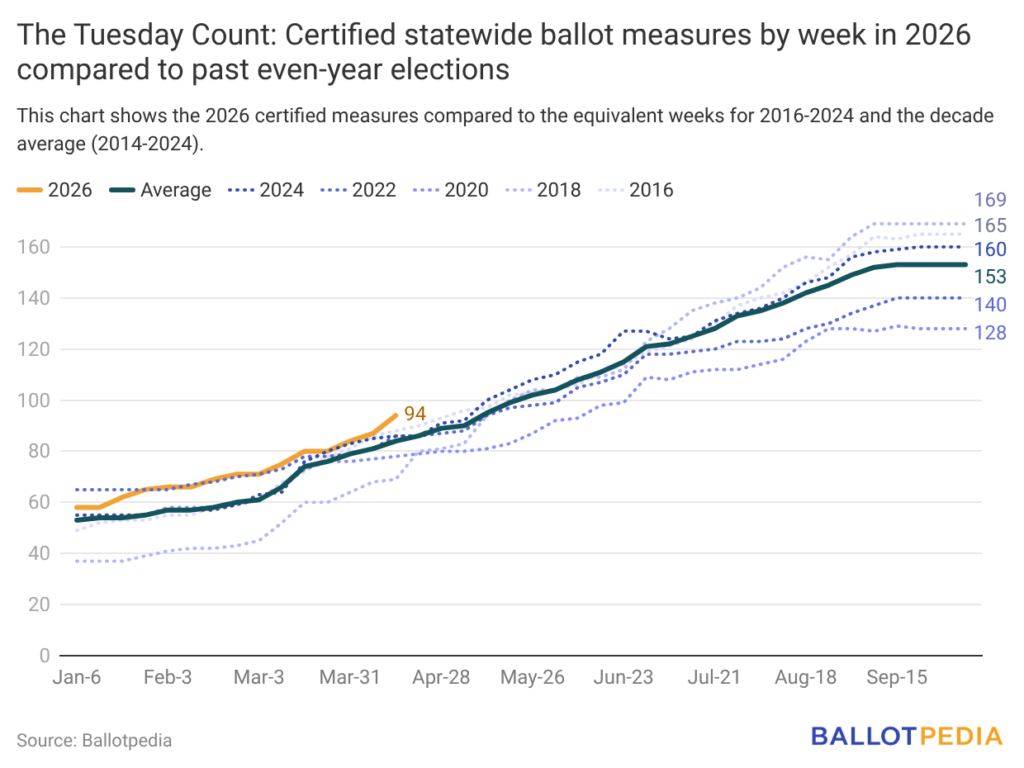
Over the past two weeks, 10 new measures were certified for statewide ballots in their respective states.
Four of those measures address education policy and governance:
- Alabama Broadcast The Star-Spangled Banner in Public Schools Amendment
- Alabama Require Pledge of Allegiance and Allow Student-Led Prayer in Public Schools Amendment
- Alabama School District Consolidation Process Amendment
- Maine Birth Certificate Sex Requirement for Public School Sports Initiative
The six other measures address various other topics:
- Alabama Require Special Election for Lieutenant Governor Vacancies Amendment
- Idaho Official State Gun Question
- Kentucky Limit Governor's Pardon Power and Commutations Near General Election Amendment
- Maryland Changes to Collective Bargaining for State Employees Amendment
- Maryland Transit Administration Authority to Take Property for Transit Purposes Amendment
- Oklahoma Require Legislature to Establish Tax Revenue Reimbursement Methodology Amendment
In Maryland, the General Assembly passed a revised version of the Commission on Judicial Disabilities Vacancies Amendment, replacing the version certified in 2025.
Signatures have been submitted and are pending verification for eight citizen initiatives:
- California Homeownership Loan Program and Single-Family Home Construction Initiative
- California Limit Compensation of Healthcare Executives Initiative
- California Spending Requirements for Federally Qualified Health Centers Initiative
- California Two-Thirds Vote Requirement for Special Taxes and Charter City Real Estate Transfer Tax Prohibition Initiative
- California Voter Identification and Voter List Maintenance Requirements Initiative
- Michigan Citizenship Requirement for Voting Initiative
- Missouri Congressional Map Referendum
- North Dakota Require Schools to Provide Free Meals to Students Initiative
Enough signatures were verified for 11 indirect initiatives to certify them to the Massachusetts General Court. Click here to learn more about the measures.
The next signature deadline is May 1 in Idaho, where initiatives related to the sales tax, abortion, medical marijuana, and recreational marijuana have been approved for signature gathering.
Click here for more information about the measures that could be on statewide ballots this year.