


Iowa voters will decide on a constitutional amendment at the November 3, 2026, election that would require a two-thirds (about 66.67%) vote from both chambers of the general assembly to approve a bill that would increase the individual or corporate income tax rate.
The amendment would also require a two-thirds vote in both chambers of the general assembly to create a new tax “on any type of income or legal and special reserves.” As of 2026, only a simple majority vote is required to pass bills that create or increase an income tax.
Path to the 2026 ballot
In Iowa, a constitutional amendment must be approved by the general assembly during two successive legislative sessions with an election for state legislators in between. Amendments do not require the governor's signature to be referred to the ballot.
The constitutional amendment was first introduced in the Iowa General Assembly as House Joint Resolution 2006 (HJR 2006) in the 2023-2024 legislative session. On March 26, 2024, the state House approved HJR 2006 in a vote of 61-35. On April 10, 2024, the state Senate approved HJR 2006 in a vote of 31-13. Both votes were along partisan lines, with Republicans voting for the amendment and Democrats voting against it.
During the 2025-2026 legislative session, the amendment was introduced as Senate Joint Resolution 11 (SJR 11). On April 10, 2025, the state Senate approved SJR 11 in a vote of 32-15. On May 2, 2026, the state House approved SJR 11 in a vote of 57-21. Both votes were along partisan lines, with Republicans voting for the amendment and Democrats voting against it.
Support and opposition to the measure
The Iowans for Tax Relief Foundation has publicly supported the amendment. It said, “A supermajority requirement is not designed to make tax increases impossible. Rather, it forces consensus. By raising the threshold for approval, a tax increase must appeal to a broader coalition of elected officials, ensuring that a tax increase isn’t the default option when the budget gets tight.”
Tyler Raygor, a lobbyist with Americans for Prosperity, agreed, saying the constitutional amendment is “a prudent safeguard against reckless spending and over taxation of Iowa.”
Common Good Iowa has publicly opposed the amendment. Concerning SJR 11, it said “[the measure] would lock in regressive revenue raising and force budget cuts. The bill would visit its biggest harms on lower-income Iowans, who saw little benefit from recent tax cuts skewed to the wealthy. In fact, this group pays higher shares of their incomes in state and local taxes than their wealthier neighbors do. They would also bear the brunt of cuts to the services they depend on to get by and get ahead.”
Luke Elzinga with the Des Moines Area Religious Council said the measure could negatively affect the potential of social welfare programs. He said, “If we see changes in our economy that leads more people to rely on public assistance programs from SNAP, it's going to be really important that we have all tools available for the state to address those needs.”
Other states with supermajority requirements for income taxes
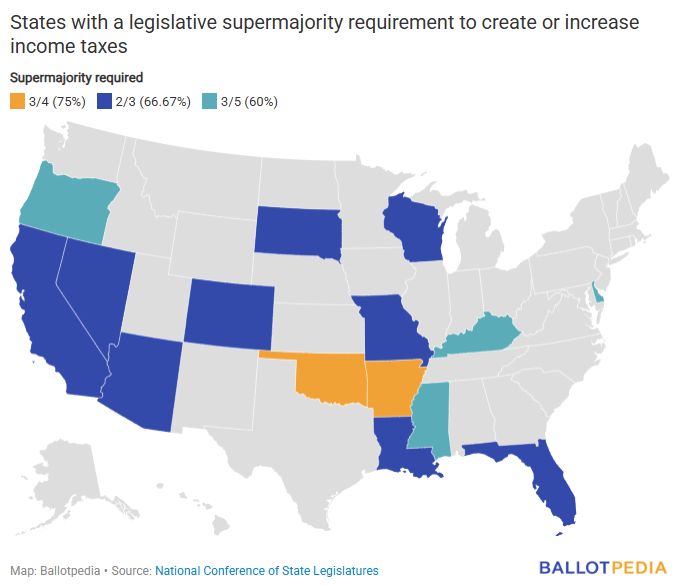
According to the National Conference of State Legislatures, 15 states have a supermajority requirement for raising income taxes, as of April 2025. In four states, the supermajority requirement is 3/5 (60%), in nine states it is 2/3 (66.67%), and in two states the requirement is 3/4 (75%).
Other legislative vote requirement ballot measures in 2026
As of May 4, 2026, Iowa is the only state with a measure on the ballot concerning legislative vote requirements. However, ballot measures concerning legislative vote requirements have been introduced in four states. Two, in Alaska and Arizona, concern potential bills concerning fees and tax rates. Two, in Nebraska and South Dakota, concern the amendment or repeal of initiated ballot measures.
- Alaska - The constitutional amendment would require a two-thirds vote to overturn a governor's veto of a bill that raises revenue or appropriates funds. As of 2026, a three-fourths vote (75%) is required to overturn a veto of any bill.
- Arizona - The constitutional amendment would require that a bill be approved by the state legislature by a two-thirds vote if that bill would authorize a fee or assessment.
- Nebraska - The initiated constitutional amendment would require a four-fifths legislative vote to change, impair, or repeal an approved ballot initiative.
- South Dakota - The initiated constitutional amendment would require a three-fourths vote of the state legislature, as well as voter approval, to change initiated state laws within seven years of their approval by voters.