


Welcome to Ballot Bulletin: Ballotpedia's Weekly Election Policy Digest. Every Tuesday, we deliver the latest updates on election policy around the country, including nationwide trends and recent legislative activity.
In this week’s edition, we cover 286 bills state legislatures acted on last week and look at a bill in Hawaii restricting corporate election spending.
The state of election legislation in the U.S.
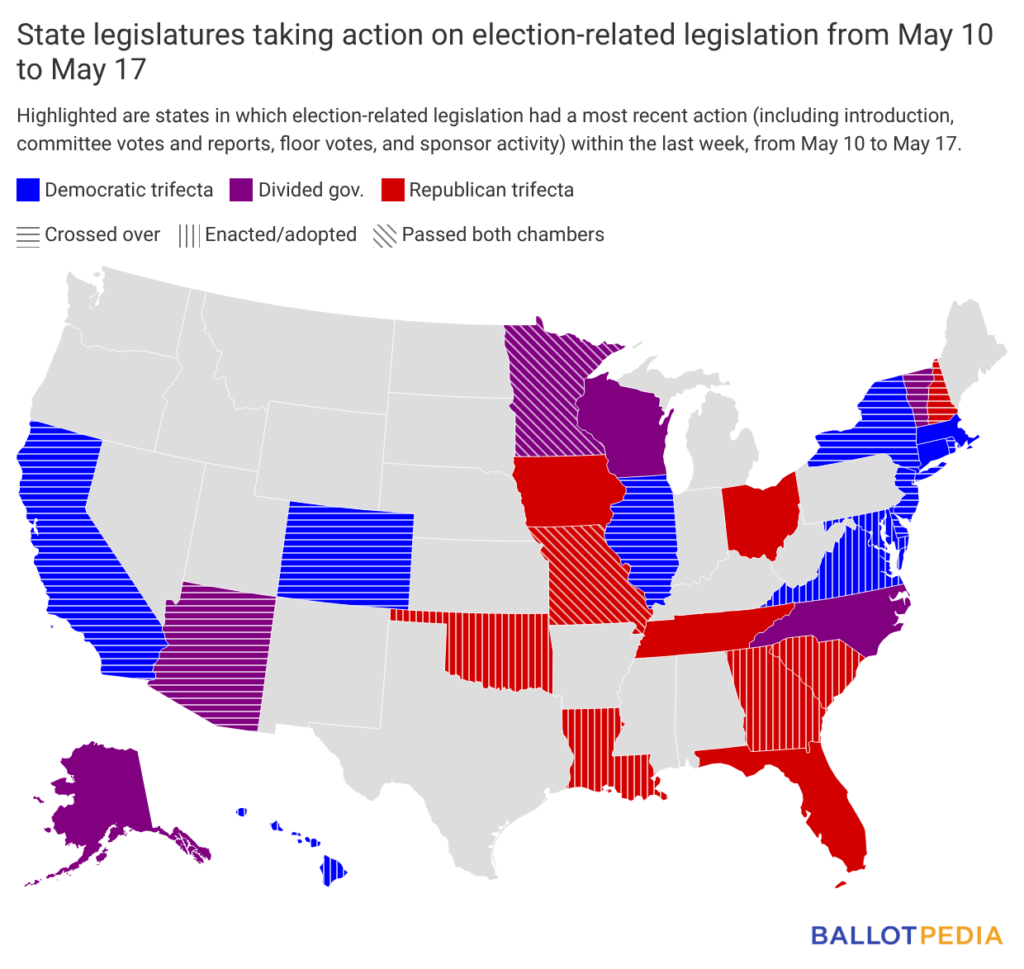
Lawmakers in 28 states acted on 286 election-related bills last week. Twenty-one state legislatures are in regular or special sessions. Last week, 27 bills were enacted, 22 bills passed both chambers of a state legislature, and no bills were vetoed.
Of the bills acted on last week, 112 (39.2%) are in states with Democratic trifectas, 152 (53.1%) are in states with Republican trifectas, and 22 (7.7%) are in states with divided government. The most active bill categories last week were ballot measures (91), election types and stages (81), and campaign finance (69).
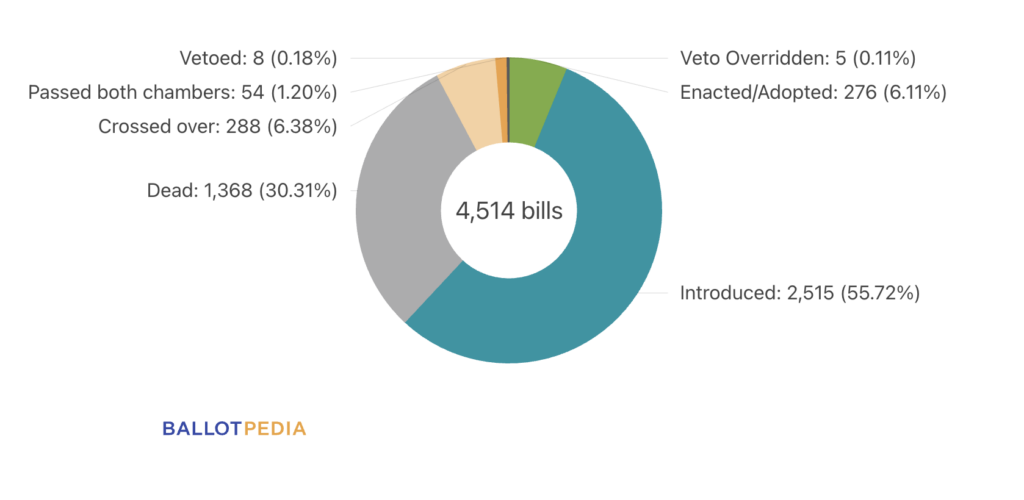
We are currently tracking 4,514 election-related bills across the country. The chart below breaks down the status of those bills by where they stand in the legislative process:
Enacted bills
On May 14, Louisiana Gov. Jeff Landry (R) signed HB 842, moving the state’s 2026 U.S. House races from the state’s party election, with semi-closed primaries on May 16, to the state's majority-vote system election, with the first round on Nov. 3. The bill moved the filing deadline for all majority-vote races to Aug. 7. Landry issued an executive order on April 30 suspending the U.S. House primary elections so that new maps could be drawn and enacted, as covered in the May 5 edition of Ballot Bulletin.
On May 14, Hawaii Gov. Joshua Green (D) signed SB 2471 into law, limiting corporate spending in elections. See the policy spotlight below for more coverage of this legislation.
Twenty-five other bills were enacted or adopted last week:
- Georgia (Republican trifecta)
- Maryland (Democratic trifecta)
- Oklahoma (Republican trifecta)
- South Carolina (Republican trifecta)
- Virginia (Democratic trifecta)
Bills passing both chambers
On May 11, Louisiana HB 691 passed the state Senate, sending the bill to Landry. The bill requires the secretary of state to annually check every registrant’s name in the state voter registration computer system against the U.S. Department of Homeland Security’s Systematic Alien Verification for Entitlements (SAVE) program.
It also requires the Division of Election Integrity to conduct an investigation after receiving the names of every potential noncitizen registrant submitted by the secretary of state. If the division determines that there may be a noncitizen registrant in the state voter registration system, the findings must be submitted to the appropriate agency for further investigation or prosecution. The secretary of state would have to notify the appropriate parish registrar of voters of any noncitizen matches verified by the division. The registrar would then be required to challenge the person’s registration.
Twenty-one other bills passed both chambers last week:
- Louisiana (Republican trifecta)
- Minnesota (Divided government)
- Missouri (Republican trifecta)
- Oklahoma (Republican trifecta)
- South Carolina (Republican trifecta)
To see a full list of bills awaiting gubernatorial action, click here.
Vetoed bills
No election-related bills were vetoed last week.
To see a list of all bills vetoed this session, click here.
All bills
The chart below shows all bills Ballotpedia is currently tracking, broken down by partisan sponsorship
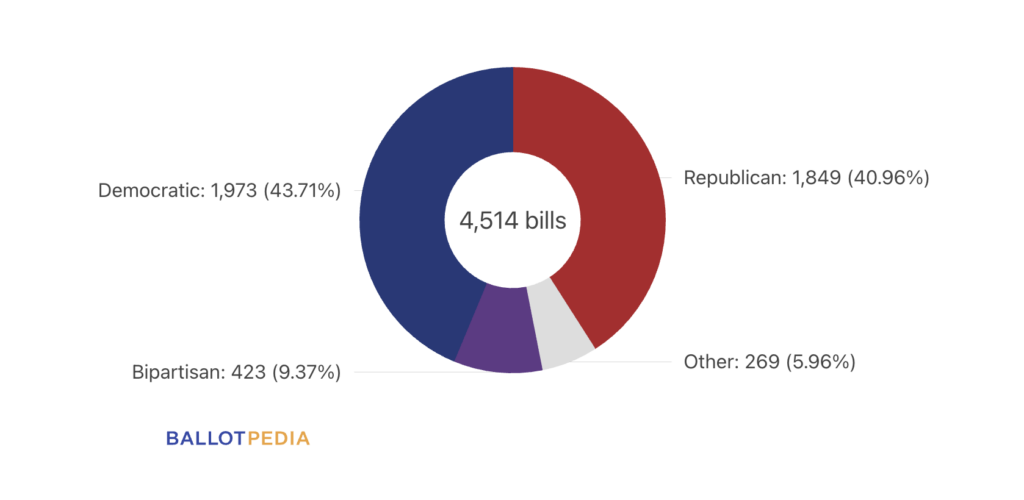
We are currently following 4,514 election-related bills, including bills carried over from the previous year.
- Trifecta status
- Democratic: 1,926 (42.7%)
- Republican: 1,643 (36.4%)
- Divided: 945 (20.9%)
- Partisan sponsorship
- Democratic: 1,973 (43.7%)
- Republican: 1,849 (41%)
- Bipartisan: 423 (9.4%)
- Other: 269 (6%)
In the news
On May 14, the Louisiana Senate passed new congressional maps in a mid-decade redistricting effort following the U.S. Supreme Court’s decision in Louisiana v. Callais.
Several other states are considering mid-decade redistricting. On May 13, Georgia Gov. Brian Kemp (R) called a June special session for the Georgia Legislature to consider redistricting for the 2028 elections. On May 14, South Carolina Gov. Henry McMaster (R) called a special session starting May 15 to address appropriations and redistricting. On May 14, Mississippi Lt. Gov. Delbert Hosemann (R) formed a select committee to study mid-decade redistricting.
On May 18, the U.S. Supreme Court reversed a ruling from the U.S. District Court for the Southern District of Mississippi in State Board of Election Commissioners v. Mississippi State Conference of the NAACP that found the state’s congressional district boundaries illegally diluted Black voting power in the state. The Supreme Court order sends the case back to the district court for additional oral arguments following the Louisiana v. Callais decision.
Here are other news stories from across the country:
- On May 15, the U.S. Supreme Court rejected an emergency appeal from Virginia Attorney General Jay Jones (D) asking the court to restore the redistricting plans voters approved 51.5% to 48.5% in the April 21 redistricting amendment election. The Virginia Supreme Court voided the results of the election in a May 8 ruling. The proposed map would have shifted four Republican-held districts to be more Democratic, based on the 2025 gubernatorial election results.
- On May 15, the Texas Supreme Court denied Gov. Greg Abbott (R) and Attorney General Ken Paxton’s (R) emergency petitions to expel 14 Democratic members of the Texas House of Representatives. Abbott and Paxton submitted the petitions in response to Democratic representatives leaving the state to deny a legislative quorum necessary to consider new congressional maps in the first summer 2025 special session. Chief Justice James Blacklock said that the political remedies for compelling the attendance of absent House members to establish a quorum does not involve the judiciary.
- On May 12, the Missouri Supreme Court issued two rulings related to the state’s new congressional maps enacted in a 2025 special redistricting session. In the court’s opinion in Healey v. State of Missouri upholding the new districts, Chief Justice Wesley Brent Powell wrote that the map “was not drawn in a manner violative of article III, section 45 of the Missouri Constitution.” In a second case, Maggard v. State of Missouri, Justice Ginger Gooch authored the majority opinion finding that the filing of a petition for a veto referendum of the new maps did not automatically prevent them from going into effect pending the results of the ballot measure.
Policy spotlight: Hawaii Gov. Joshua Green signs bill restricting corporate political activity
The story below is adapted from a recent Ballotpedia News story by Andrew Bahl.
On May 14, Hawaii Gov. Joshua Green (D) signed SB 2471 into law. It modifies the powers given to corporations, prohibiting them from spending money or participating in election or ballot measure activities. It also establishes that corporations have artificial-person powers, defined as the ability to carry out their business or other affairs, but they cannot engage in election or ballot measure activity in Hawaii.
The bill’s supporters say their aim is to limit how the U.S. Supreme Court’s 2010 Citizens United v. Federal Election Commission decision applies to corporate political spending in the state.
In that ruling, the Supreme Court held that the First Amendment protects independent corporate election spending. The ruling struck down parts of the Bipartisan Campaign Reform Act, a federal campaign finance law enacted in 2002.
State Rep. Scot Matayoshi (D) said, “If the states are not brave enough to challenge Citizens United and other court rulings at the highest court in the land, those rulings will stand forever. We need states to step forward in order to challenge these rulings.”
Speaking in opposition to the bill during a March 18 committee hearing, Deputy Attorney General Christopher Han said in written testimony that “While many Americans strongly disagree with the U.S. Supreme Court’s holding in Citizens United, under our federal system of government, it is our duty to state that this opinion remains the law of the land, irrespective of its merits (or lack thereof).”
SB 2471 passed the House on May 8 with 41 Democrats and nine Republicans voting in favor and one Republican voting in opposition. That same day, it passed the Senate unanimously.
Legislators in 14 other states have introduced similar bills in 2026, though none have advanced. Six of the bills were introduced in states with Democratic trifectas, four in states with Republican trifectas, and four in states with divided government.
On April 1, the Montana Supreme Court ruled that supporters could continue gathering signatures for a ballot measure that would prohibit corporations from engaging in political or ballot measure activities.
The unanimous ruling came in response to a lawsuit from corporate and industry groups challenging the measure as unconstitutional. The measure could appear on the November ballot.
For more information on campaign finance regulations, click here.