


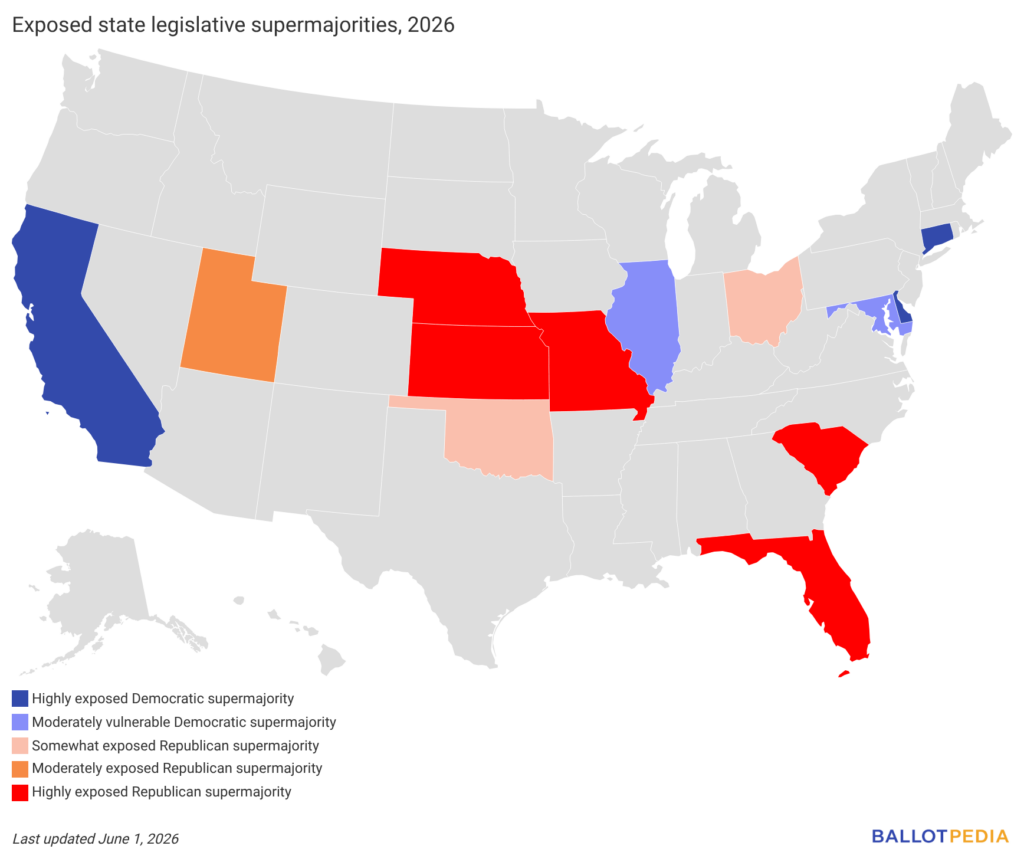
In eight states holding legislative elections this year, fewer than 5% of seats would need to change party control to break an existing supermajority. We call those state supermajorities highly exposed to breaking. If a majority party loses its supermajority, they lose the ability to override a governor's veto without votes from the minority party.
The Republican supermajority in Florida is the closest to breaking, where a one-seat loss in the Senate would bring the party's majority below the 27-seat threshold required to override the governor’s vetoes.
Ballotpedia assessed the possibility that existing state legislative supermajorities could be broken and the potential for new supermajorities to form in the 2026 elections. According to this analysis, 13 state legislative supermajorities are exposed to breaking in the 2026 elections, including the eight rated highly exposed. Democrats are defending five exposed supermajorities and Republicans are defending eight.
The analysis scored each chamber individually by assessing the percentage and raw number of seats that would have to change party control for a supermajority to be gained or lost in the chamber. There are currently 27 state legislative supermajorities: 19 Republican supermajorities and eight Democratic supermajorities. The remaining 23 states have no supermajority.
The Republican supermajorities in Florida, Kansas, Missouri, Nebraska, and South Carolina were rated highly exposed to breaking, because Republicans are fewer than five seats or less than five percentage points more than the supermajority threshold in at least one of those states' legislative chambers:
- Florida Republicans have a 27-12-1 supermajority in the Senate, where a one-seat loss would result in the party falling below the two-thirds threshold of 27 seats.
- Kansas Republicans have an 88-37 supermajority in the House, where a five-seat loss (or 4% of the 125 seats up for election) would result in the party falling below the two-thirds threshold of 84 seats.
- Missouri Republicans have a 24-10 supermajority in the Senate and a 111-52 supermajority in the House. A two-seat loss in the Senate or a three-seat loss in the House would result in the party falling below the respective two-thirds thresholds of 23 and 109.
- Nebraska Republicans have a 33-14-2 supermajority in the Senate, where a four-seat loss would result in the party falling below the three-fifths threshold of 30 seats.
- South Carolina Republicans have an 88-36 supermajority in the House, where a six-seat loss (or 4.8% of the 124 seats up for election) would result in the party falling below the two-thirds threshold of 83 seats.
The Democratic supermajorities in California, Connecticut, and Delaware were rated highly exposed to breaking:
- California Democrats have a 30-10 supermajority in the Senate, where a four-seat loss would result in the party falling below the two-thirds threshold of 27 seats.
- Connecticut Democrats have a 25-11 supermajority in the Senate and a 102-49 supermajority in the House. In both chambers, a two-seat loss would result in the party falling below the two-thirds threshold.
- Delaware Democrats have a 15-6 supermajority in the Senate and a 27-14 supermajority in the House. In both chambers, a three-seat loss would result in the party falling below the three-fifths threshold.
In five additional states, less than 15% of seats up for election would need to change party control to break a supermajority. These are the Democratic supermajorities in Illinois and Maryland, and the Republican supermajorities in Ohio, Oklahoma, and Utah.
Potential new supermajorities
Ballotpedia also assessed the chances of new supermajorities forming in states where one party already has simple majority control of both state legislative chambers. Possible Democratic supermajority pickups are Colorado, Maine, Nevada, New York, Oregon, Vermont, and Washington. Possible Republican pickups are Alaska*, Arizona, Georgia, Iowa, Montana, New Hampshire, North Carolina, Texas, and Wisconsin. (Note: Alaska Republicans have a numerical majority in both legislative chambers and are three Senate seats and six House seats from supermajority status, but multipartisan coalitions currently control both chambers.)
Additional information
Forty-six states are holding elections for 88 of the country's 99 state legislative chambers this year. While the supermajority exposure and potential ratings highlight a subset of states with particularly close legislative supermajorities, supermajority status could change in up to 45 states. A supermajority is not possible in New Mexico, where Democrats are below the supermajority threshold in the state Senate, which does not have elections in 2026.
Click here to learn more about the supermajority outlook in the 2026 elections.