


Welcome to Ballot Bulletin: Ballotpedia's Weekly Election Policy Digest. Every Tuesday, we deliver the latest updates on election policy around the country, including nationwide trends and recent legislative activity.
In this week’s edition, we cover 68 bills state legislatures acted on last week and look at a documentary proof of citizenship case taken up by the U.S. Supreme Court.
The state of election legislation in the U.S.
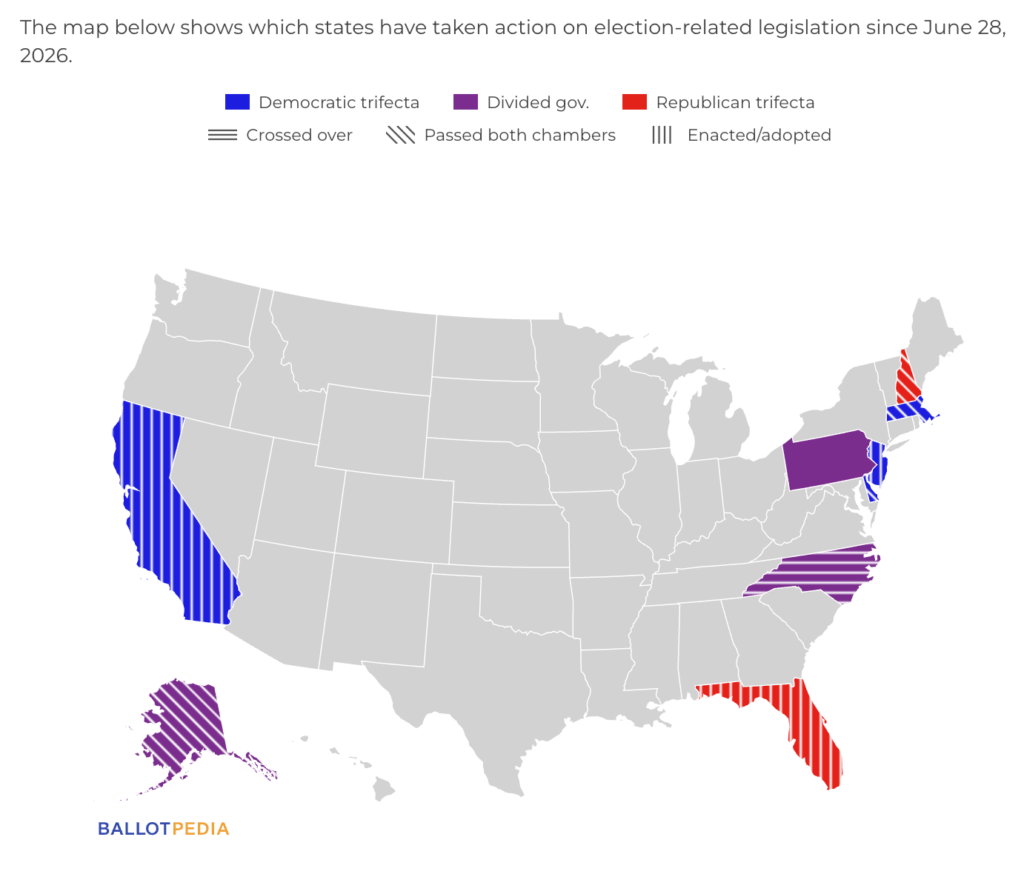
Lawmakers in nine states acted on 68 election-related bills last week. Nine state legislatures are in regular or special sessions. Last week, five bills were enacted, 18 bills passed both chambers of a state legislature, and no bills were vetoed.
Of the bills acted on last week, 50 (73.5%) are in states with Democratic trifectas, 12 (17.6%) are in states with Republican trifectas, and six (8.8%) are in states with divided government. The most active bill categories last week were campaign finance (25), ballot measures (16), voter registration and list maintenance (11), ballots and voting materials (11), ballot access (11), and election law disputes and voting rights (11).
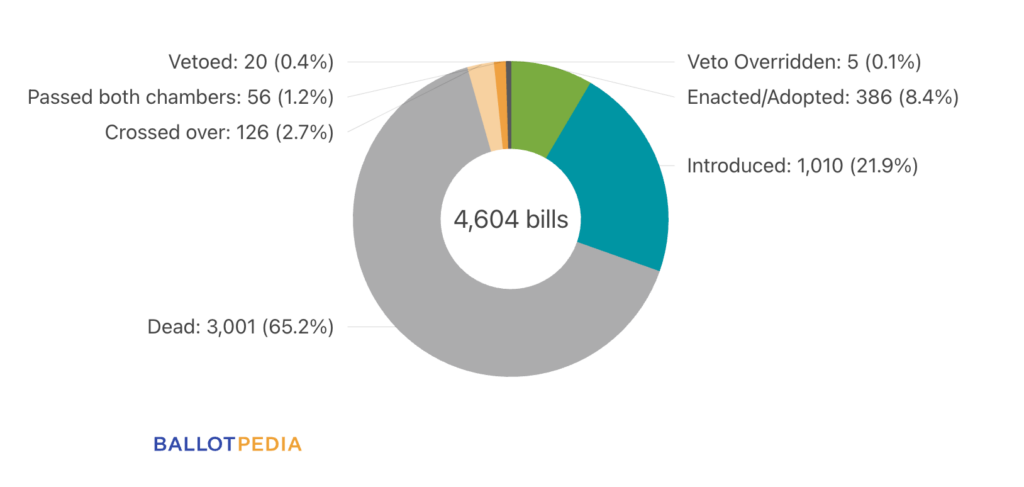
We are currently tracking 4,604 election-related bills across the country. The chart below breaks down the status of those bills based on where they stand in the legislative process:
Enacted bills
On July 2, New Jersey Gov. Mikie Sherrill (D) signed A 1715 into law. The bill, titled the John R. Lewis Voter Empowerment Act of New Jersey, prohibits election officials from implementing election policies and practices that deny or abridge the right to vote. It also prohibits local election offices or political subdivisions from using an electoral method which has the effect of impairing the ability of protected classes to elect candidates of their choice. A 1715 also sets criteria for determining if the right to vote has been abridged or if vote dilution has occurred.
Four other bills were enacted or adopted last week:
- California (Democratic trifecta)
- Florida (Republican trifecta)
- New Jersey (Democratic trifecta)
Bills passing both chambers
HB 444, titled the Delaware John Lewis Voting Rights Act, passed the Delaware Senate on June 30. Once the bill is formally sent to Gov. Matt Meyer (D), he will have 10 days to sign or veto it. The bill prohibits political subdivisions, state agencies, and officials from implementing, imposing, or enforcing any election policy or practice which results in, is likely to result in, or is motivated by the intent to create a material disparity in the voter participation of protected classes or an impairment of the equal opportunity of protected classes to participate in the political process. If enacted, HB 444 would make Delaware the 12th state to adopt a state-level voting rights act.
On June 30, HB 430 passed the Delaware Senate. It proposes an amendment to the Delaware Constitution that would authorize only natural persons to vote in elections in the state. Corporations and other artificial entities would not be deemed natural persons for purposes of determining voter eligibility. The constitutional amendment will take effect if the next Delaware General Assembly again passes the measure with at least a two-thirds majority.
Sixteen other bills passed both chambers last week:
- Delaware (Democratic trifecta)
- Massachusetts (Democratic trifecta)
- New Hampshire (Republican trifecta)
- New Jersey (Democratic trifecta)
To see a full list of bills awaiting gubernatorial action, click here.
Vetoed bills
No bills were vetoed this week.
To see a list of all bills vetoed this session, click here.
All bills
The chart below shows all bills Ballotpedia is currently tracking, broken down by partisan sponsor.
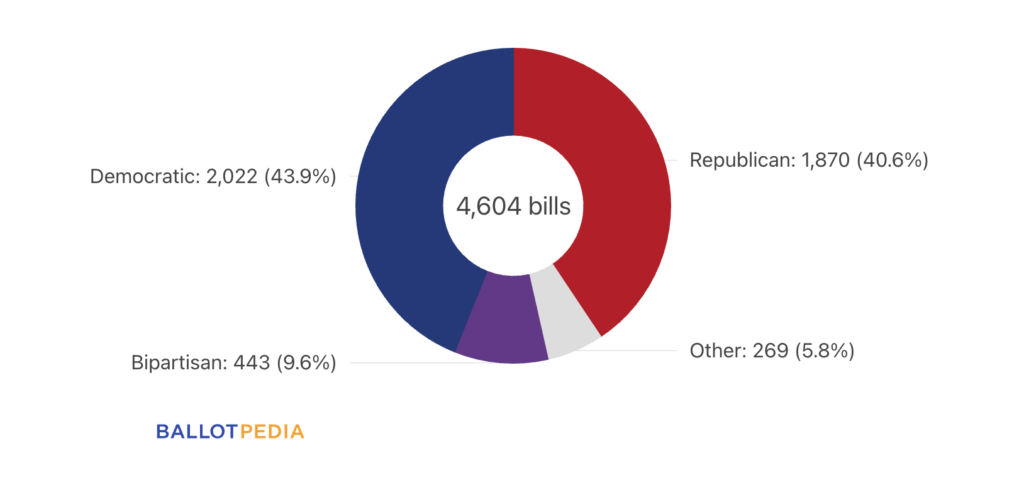
We are currently following 4,604 election-related bills, including bills carried over from the previous year.
- Trifecta status
- Democratic: 1,981 (43%)
- Republican: 1,649 (35.8%)
- Divided: 974 (21.2%)
- Partisan sponsorship
- Democratic: 2,022 (43.9%)
- Republican: 1,870 (40.6%)
- Bipartisan: 443 (9.6%)
- Other: 269 (5.8%)
In the news
On July 1, the U.S. District Court for the District of Columbia blocked the U.S. Postal Service’s proposed rule to implement President Donald Trump’s (R) March 31, 2026, executive order titled Ensuring Citizenship Verification and Integrity in Federal Elections. In the ruling, Judge Emmet Sullivan said that the executive order would violate the settlement agreement reached between the NAACP and USPS in December 2021, in which USPS agreed “to prioritize monitoring and timely delivery of election mail.”
Also on July 1, the DOJ filed an appeal in the U.S. District Court for the District of Massachusetts following the court’s June 25 decision blocking parts of the executive order, covered in last week’s edition of the Ballot Bulletin. The DOJ also requested a stay of the lower court’s decision. In last week’s court order, Judge Indira Talwani wrote that “Sections 2 and 3 of the EO are legally void as they are ultra vires and unconstitutionally violate the separation of powers” and blocked their implementation in the 23 states and Washington, D.C., that challenged the law. In its appeal, the DOJ said the provisions of the executive order cannot yet be challenged, since “none of its provisions have yet been implemented via any final agency action.”
Here are other news stories from across the country:
- On June 29, the Colorado Supreme Court issued two rulings rejecting proposed ballot measures concerning mid-decade congressional redistricting for the 2028 election. In the court’s opinion on two of the ballot measures, which would have submitted new congressional maps to voters for 2028 and 2030, Chief Justice Monica Márquez said that "changing long-settled law by modifying the timing, frequency, criteria, and entity responsible for congressional redistricting represents a significant change beyond the proponents' stated central purposes." In the court’s opinion concerning the three other ballot measures, which would have also proposed new maps and changes to the state’s independent redistricting commission, Justice Richard Gabriel said that the measures violated the single-subject requirement contained in Art. V, Sec. 1(5.5) of the Colorado Constitution.
- On June 29, the Arizona Supreme Court upheld Proposition 211 (2022), also called the Voters’ Right to Know Act, which requires the public disclosure of major donors to election-related public communications and the original sources of their contributions. In the court’s opinion, Justice Ann Timmer wrote that “the framers and the People viewed disclosure of election-related contributions and contributor identities as essential, effective tools in preserving fair and transparent elections.” The Center for Arizona Policy and Arizona Free Enterprise Club filed the original complaint in December 2022, saying that Prop 211 violated the free speech and private affairs clauses of the Arizona Constitution.
- On June 30, the U.S. District Court for the Western District of Arkansas upheld a preliminary injunction blocking the implementation of several Arkansas laws concerning the petition and referendum process. The blocked laws include a requirement for canvassers to ask signers for photo ID and for sponsors of paid canvassing to submit the home addresses of signature-gatherers to the state. In the court’s opinion, Judge Timothy Brooks wrote that these laws violated the First Amendment of the U.S. Constitution while refraining from issuing a permanent injunction pending a trial. The League of Women Voters filed the initial complaint in district court on April 21, 2025.
Policy spotlight: U.S. Supreme Court agrees to review Arizona's documentary proof of citizenship and noncitizen voter removal laws
The story below is adapted from a recent Ballotpedia News story by Andrew Bahl.
On June 29, the U.S. Supreme Court announced that it would hear Republican National Committee v. Mi Familia Vota, a case disputing whether two Arizona laws requiring documentary proof of citizenship (DPOC) to register to vote in federal elections and requiring election officials to remove noncitizens from voter rolls violate the National Voter Registration Act (NVRA). Federal courts have blocked most of the challenged provisions from being enforced.
The NVRA requires 44 states, including Arizona, to accept a standardized registration form for federal elections and prohibits the systematic cancellation of voter registration within 90 days of an election, among other requirements. The other six states are exempt from the NVRA.
The questions presented to the court are as follows: "(1) Does the National Voter Registration Act or a federal consent decree prohibit Arizona from requiring voter-registration applicants to produce 'satisfactory evidence' of U.S. citizenship when registering with a state registration form?" and "(2) Does the National Voter Registration Act prohibit Arizona from implementing a program within 90 days of a federal election to cancel the registrations of voters who are not U.S. citizens?"
In 2022, Arizona Gov. Doug Ducey (R) signed HB 2492, a law requiring election officials to reject any voter registration application using the state-provided registration form if it was submitted without DPOC, such as a state driver’s license or ID card, a passport, a naturalization certificate, or a photocopy of a birth certificate. Under the law, anyone who did not provide DPOC when registering with a federal voter registration form and whose citizenship could not be verified using other data sources would only be registered to vote in federal elections.
Ducey also signed HB 2243 in 2022, a law requiring county recorders to conduct a monthly check of the Systematic Alien Verification for Entitlements program for individuals suspected to be noncitizens and to cancel the voter registration of any individual about whom they received information that the person was not a U.S. citizen. The law required the county recorder to notify the person by mail that their registration would be canceled if they did not provide DPOC within 35 days. It did not block these cancellations from occurring within the 90 days before the election.
After Ducey signed the bills, several nonprofit groups, the Democratic National Committee, and the U.S. Department of Justice under President Joe Biden (D) separately filed eight lawsuits in the U.S. District Court for the District of Arizona, alleging that the laws violated the NVRA.
Judge Susan Bolton consolidated the eight lawsuits and struck down the challenged provisions of the laws in 2023, holding that both laws violated the NVRA and that the DPOC requirement violated a 2018 consent decree from an earlier lawsuit. Republican lawmakers and the Republican National Committee appealed to the U.S. Court of Appeals for the Ninth Circuit.
In August 2024, while the case was pending in the Ninth Circuit, the Republican National Committee asked the Supreme Court to stay Bolton's rulings. The Supreme Court granted a partial stay, reinstating the provision of the law that required election officials to reject state voter registration forms submitted without DPOC.
In February 2025, a Ninth Circuit panel upheld Bolton's rulings that the laws violated the NVRA and the 2018 consent decree. "The DPOC requirement renders the state form not 'equivalent' to the federal form for applicants without DPOC," Judge Ronald Gould wrote. "That difference prevents the forms from being 'virtually identical' for applicants without DPOC, and the requirement of DPOC for state-form applicants violates Section 7 of the NVRA."
Gould also wrote, "We hold that H.B. 2243’s periodic cancellation of registrations violates the 90-day Provision of the NVRA to the extent that H.B. 2243 authorizes systematic cancellation of registrations within 90 days before a federal election."
The Ninth Circuit denied the state's request to rehear the case en banc.
In February 2026, the Republican National Committee, which intervened to defend the laws, appealed to the U.S. Supreme Court.
Attorneys for the RNC wrote, "The Ninth Circuit’s decision threatens States’ ability to protect the integrity of their elections. Arizona passed laws 'protecting the right of all citizens to vote, and … ensuring non-citizens do not vote.' … The Ninth Circuit’s decision striking those measures down 'undermines republican government, shreds federalism and the separation of powers, and imperils free and fair elections.'"
Lawyers for Mi Familia Vota and Voto Latino, two of the groups that challenged the laws, wrote that the Supreme Court should not take the case, as the "Ninth Circuit’s resolution of both questions presented was correct, did not conflict with any other circuit’s decisions, and does not implicate any other State’s law. There is no basis for the Court’s review."
The case marks the second time an Arizona DPOC law has been reviewed by the Supreme Court. In 2013, the court ruled that a previous law requiring DPOC to register to vote with the federal voter registration form violated federal law.
Twelve states — Alabama, Arizona, Florida, Georgia, Kansas, Louisiana, Mississippi, New Hampshire, Ohio, South Dakota, Utah, and Wyoming — have laws requiring DPOC to register to vote in at least some cases.
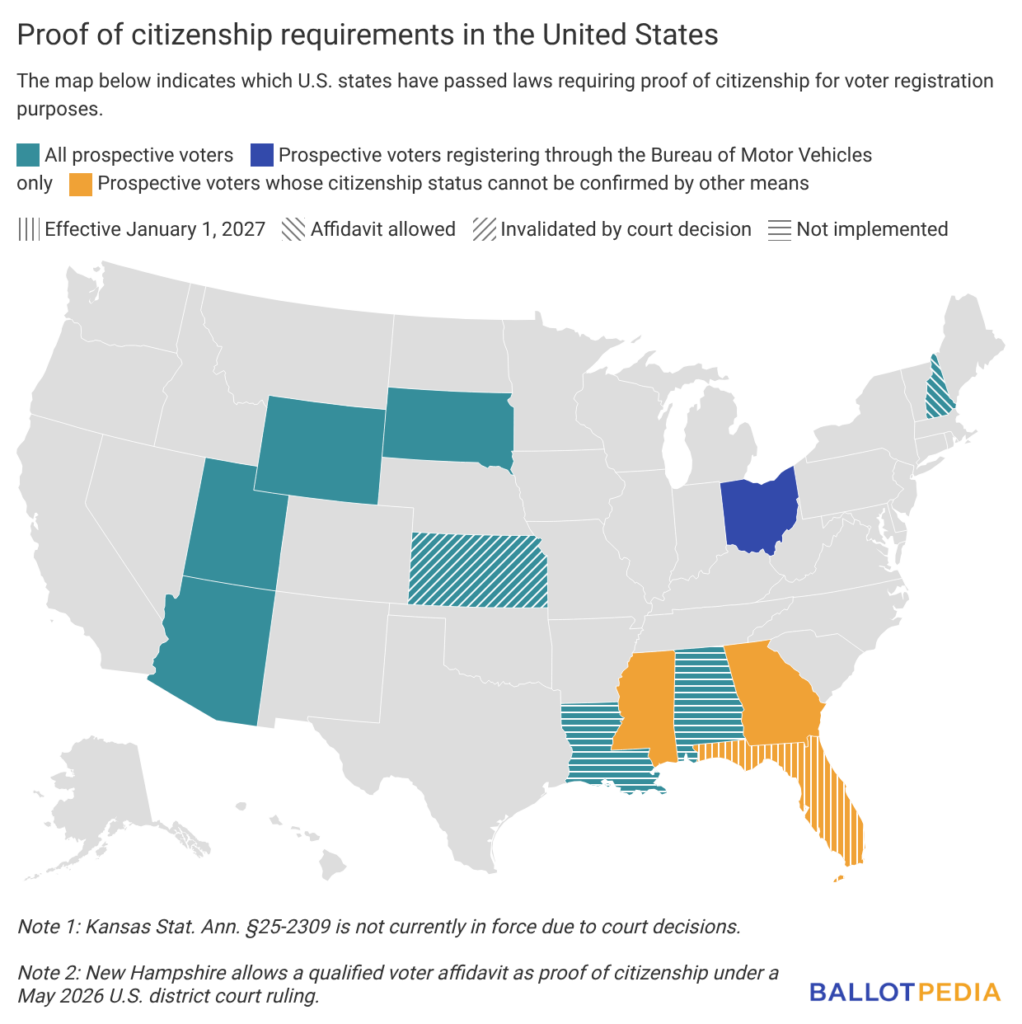
Alabama and Louisiana have not implemented their DPOC laws. A federal court blocked Kansas' DPOC law in 2018.
Arizona, South Dakota, and Utah allow individuals who do not provide DPOC to vote in federal elections only. New Hampshire and Wyoming are exempt from the NVRA and require all voters to provide DPOC to register to vote.
Three other states — Florida, Georgia, and Mississippi — require DPOC at the time of registration if a person's citizenship status cannot be confirmed by other means. Ohio requires DPOC when registering to vote at a Bureau of Motor Vehicles office.
So far this year, four states — Florida, Mississippi, South Dakota, and Utah — have enacted legislation creating or expanding a DPOC law.