


On July 16, a Kansas district judge ordered the temporary reinstatement of a policy allowing advance mail ballots to be accepted if the ballots are postmarked by election day and are received within three days of the election, blocking a 2025 law that changed the deadline for ballots to be received to 7:00 p.m. on election day while litigation continues.
The same day, Kansas Secretary of State Scott Schwab (R) appealed the decision to the Kansas Court of Appeals and, on July 20, asked the court to keep the 2025 law in place in the meantime. On July 27, the court of appeals denied Schwab's request to reinstate the election day deadline ahead of the state's Aug. 4 primary.
Kansas Attorney General Kris Kobach (R) and Schwab's attorneys appealed that decision to the Kansas Supreme Court on July 28. Kobach previously filed an emergency motion to transfer the case to the supreme court on July 20.
Absent further court rulings, the three-day grace period will remain in place for the Aug. 4 primary election. County election officials have asked voters to mail back their advance ballots early enough to ensure they arrive by the close of polls on election day.
In March 2025, Kansas' Republican-controlled Legislature overrode Gov. Laura Kelly's (D) veto of Senate Bill 4, which eliminated the state's previous three-day grace period for ballots postmarked by election day and required all advance ballots to arrive by 7:00 p.m. on election day in order to be counted.
Kansas Appleseed, Loud Light, and the Disability Rights Center of Kansas filed a lawsuit in May 2025 challenging SB 4. In their complaint, the groups alleged that the change in deadline would harm their "rights to equal protection, due process, and suffrage under the Kansas Constitution."
In his July 16 ruling, Douglas County District Court Judge Carl Folsom III agreed to temporarily block SB 4, writing that there was a "substantial likelihood that SB 4 will result in arbitrary treatment of voters because ballots will be rejected due to postal delays outside the voters’ control." Folsom also cited a recent U.S. Supreme Court decision upholding Mississippi's post-election grace period in responding to an argument that federal law requires ballots to be received by election day.
Following Folsom's ruling, Kobach said that "over 44,000 Kansas voters have received or are about to receive, probably in today’s mail, their advance ballot. ... And it’s accompanied by a note saying 'You have to get this in by Election Day.' ... We would like the higher courts to intervene as soon as possible and give clarity and presumably restore Kansas law."
In denying the state's request to block Folsom's ruling, Court of Appeals Chief Judge Sarah Warner wrote, "This court finds that the potential for irreparable harm of voter confusion weighs against the requested stay. ... This very real and irreparable harm—that the votes of well-meaning Kansans, acting in good faith based on a judicial decision, would not be counted—outweighs the administrative burden of counting the mail-in ballots received within three days after Election Day."
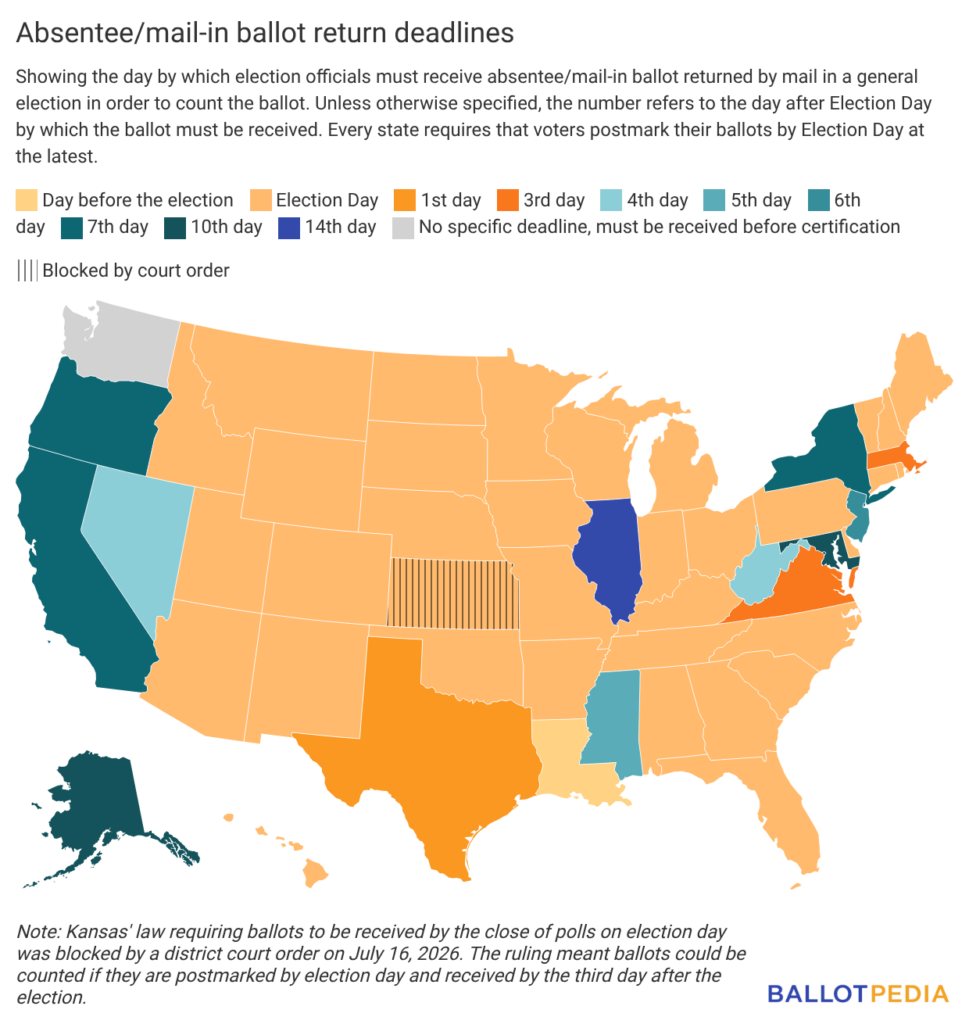
Nationally, 14 states allow all valid absentee/mail-in ballots postmarked by election day to be counted if they arrive within a set period of time after the election. Thirty-six states require ballots to arrive on or before election day in order to be counted.