


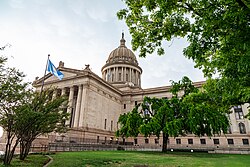
The Oklahoma Legislature adjourned its 2026 legislative session on May 14 after enacting five election-related bills and passing one constitutional amendment. Gov. Kevin Stitt (R) signed all five of the bills in May.
Oklahoma voters will see the constitutional amendment, SJR 47, on their ballot during the Aug. 25 primary runoff election. The amendment would require prospective voters to provide proof of identity, with requirements to be specified by the state legislature. Voters initially approved the state's statutory voter ID requirement via ballot measure in 2010.
The Senate approved the amendment 39-8 on March 26, with 39 Republicans voting in favor and eight Democrats against. The state House approved it 80-13 on April 15, with 77 Republicans and three Democrats voting in favor and 13 Democrats voting against.
Other election legislation enacted in 2026 included HB 4113, which amends existing law on voting rights for people convicted of a felony and establishes that people who have received a commutation or pardon for a felony are eligible to vote if they are not currently incarcerated, on parole, on supervision, or on probation for another felony conviction.
The final version of the bill passed the state Senate on 40-4 on April 29, with 36 Republicans and four Democrats voting in favor and four Democrats voting against. It then passed the state House 82-0 on May 5. Stitt signed the bill on May 12.
Other election bills enacted in 2026 were:
- HB 3919, which permits a board of county commissioners to determine by vote to form a five-member board of directors for a free fair association for a term of three years.
- SB 1286, which requires political subdivisions that own, rent, or lease a facility located near a precinct without a polling place to furnish rooms in the facility for use as a polling place for free upon request by the county election board.
- SB 1451, which requires that a voter registration application be deemed an applicant's request for the cancellation of any prior voter registration in another county or state. It also requires that the voter registration form provide a space for the applicant to list any prior registrations.
- SB 1491, which requires individuals appointed to fill a vacancy of a presidential elector to take an oath stating that the appointee will cast a ballot for the persons nominated for the offices of U.S. President and Vice President by the appointee’s political party.
Legislators enacted 12 election-related bills in 2025, seven in 2024, and 12 in 2023.