


Welcome to Ballot Bulletin: Ballotpedia's Weekly Election Policy Digest. Every Tuesday, we deliver the latest updates on election policy around the country, including nationwide trends and recent legislative activity.
In this week’s edition, we cover 31 bills state legislatures acted on last week and look at state-level voting rights acts in Delaware and other states.
The state of election legislation in the U.S.
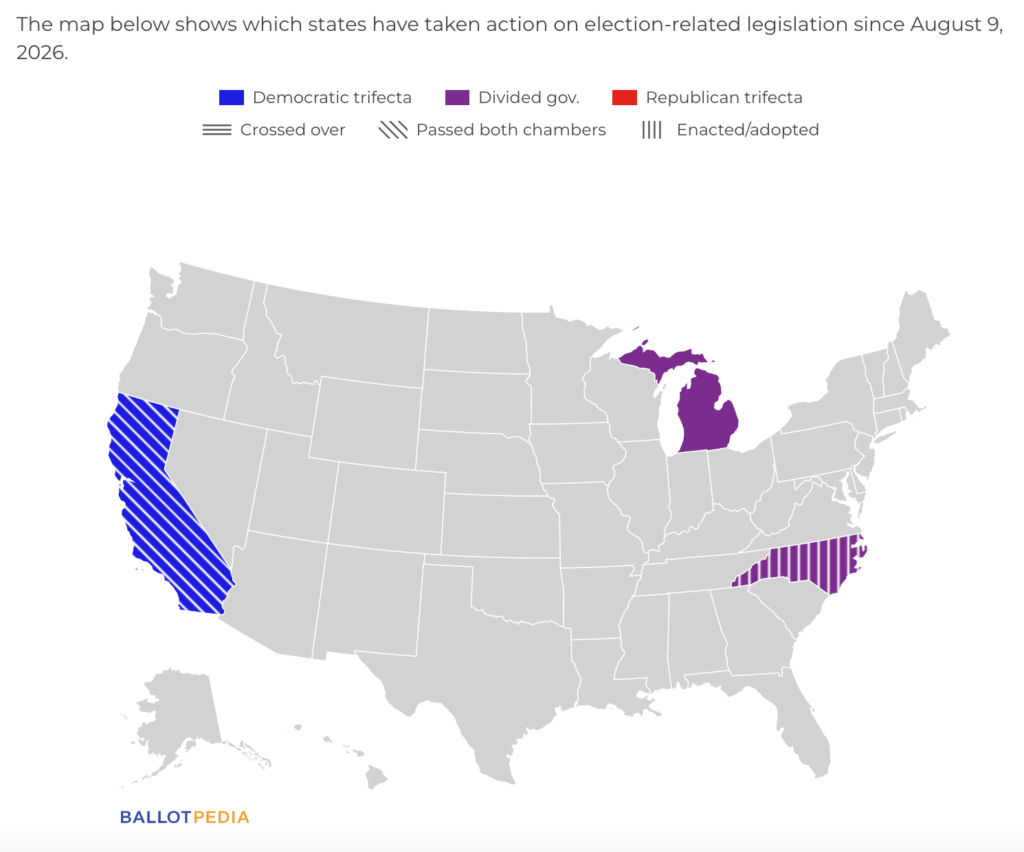
Lawmakers in three states acted on 31 election-related bills last week. Seven state legislatures are in regular or special sessions. Last week, one bill was enacted, four bills passed both chambers of a state legislature, and no bills were vetoed.
Of the bills acted on last week, 28 (90.3%) are in states with Democratic trifectas, none are in states with Republican trifectas, and three (9.7%) are in states with divided government. The most active bill categories last week were ballot measures (9), ballots and voting materials (6), ballot access (5), voter registration and list maintenance (5), absentee/mail-in voting (5), and election day voting (5).
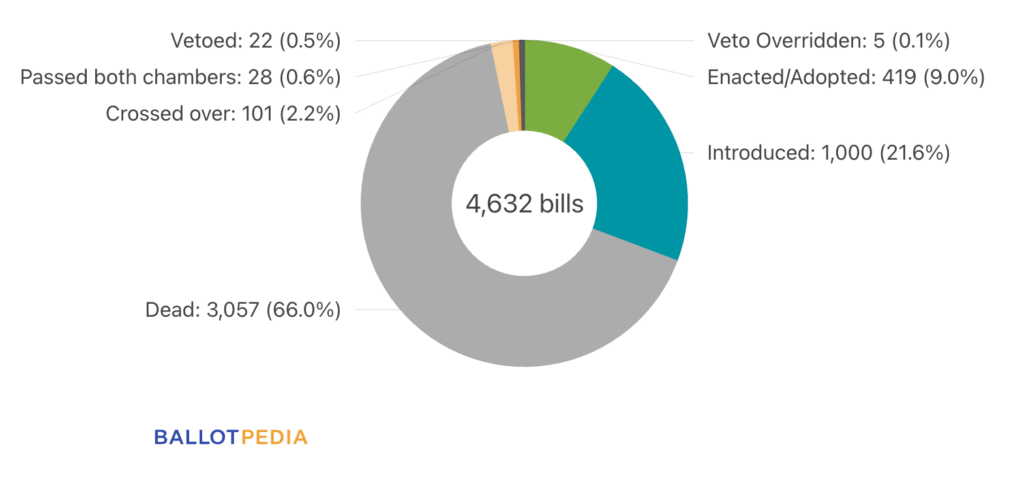
We are currently tracking 4,632 election-related bills across the country. The chart below breaks down the status of those bills based on where they stand in the legislative process:
Enacted bills
One bill was enacted or adopted last week. On Aug. 11, North Carolina Gov. Josh Stein (D) signed H 834 into law. It extends the window for voters to correct incomplete information on their voter registration form from the third business day after an election to noon on the fifth business day after an election. It specifies that voters casting provisional ballots will have their votes counted if their registrations are corrected by the deadline. Among other provisions, the new law also requires county boards of elections to notify voters of a missing signature on provisional ballot affidavits and cure instructions by the close of business the next business day after they review ballots.
Bills passing both chambers
Four bills passed both chambers of a state legislature last week:
To see a full list of bills awaiting gubernatorial action, click here.
Vetoed bills
No bills were vetoed last week.
To see a list of all bills vetoed this session, click here.
All bills
The chart below shows all bills Ballotpedia is currently tracking, broken down by partisan sponsor.
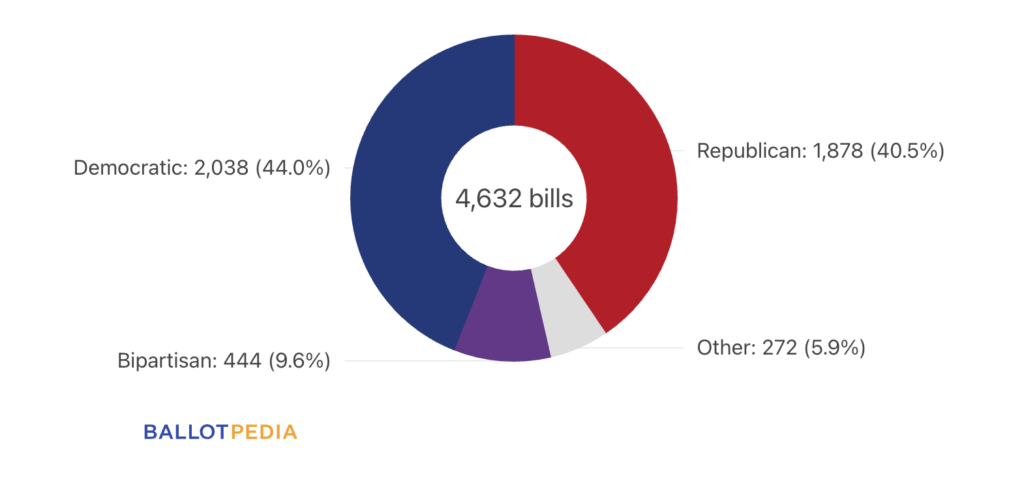
We are currently following 4,632 election-related bills, including bills carried over from the previous year.
- Trifecta status
- Democratic: 1,987 (42.9%)
- Republican: 1,650 (35.6%)
- Divided: 995 (21.5%)
- Partisan sponsorship
- Democratic: 2,038 (44%)
- Republican: 1,878 (40.5%)
- Bipartisan: 444 (9.6%)
- Other: 272 (5.9%)
In the news
On Aug. 11, the U.S. District Court for the District of Massachusetts temporarily blocked the implementation of portions of an executive order on mail voting and citizenship checks nationally. As covered in the July 7 edition of Ballot Bulletin, Judge Indira Talwani issued an order on June 25 that blocked two sections of President Donald Trump’s (R) March 31, 2026, executive order titled Ensuring Citizenship Verification and Integrity in Federal Elections in 23 states and the District of Columbia. That decision blocked two provisions, Secs. 2 and 3, which would require the DHS to create lists of citizens eligible to vote in each state and direct the U.S. Postal Service to provide states with a list of approved mail voters enrolled with USPS, respectively. The Department of Justice appealed the decision on July 1.
Talwani's Aug. 11 order, which came in a separate lawsuit brought by the League of Women Voters of Massachusetts, blocked Sec. 3 in all 50 states. In the opinion, Talwani said “the court finds that enfranchisement heavily outweighs the executive’s attempt to unconstitutionally insert itself into the domain of election regulation.” She also said that, since there are fewer than 90 days to the Nov. 3 general election, an injunction is needed to “prevent Defendants from changing election rules on the eve of the election.”
On Aug. 12, the Department of Justice sent a letter to the U.S. Supreme Court asking it to expedite a review of Talwani’s order in the 23-state case, stating that without relief, “the district court’s erroneous orders will effectively run out the clock on the government’s ability to implement Section 3 of the Executive Order for the federal elections in November, thereby causing irreparable harm to the federal government, the public, and election integrity.”
Here are other news stories from across the country:
- On Aug. 12, the U.S. Court of Appeals for the Fifth Circuit reinstated parts of a 2021 Texas elections omnibus bill that the U.S. District Court for the Western District of Texas permanently enjoined in Sep. 2024, Oct. 2024, and March 2025. Writing for the court, Judge Andrew Oldham said that the plaintiffs in LUPE v. State of Texas did not have the standing to challenge SB 1 in court. The District Court’s orders had blocked the portions of the bill requiring ID or social security numbers on applications for mail ballots, creating processes for curing ballots, and requiring oaths from individuals assisting voters filling out their ballots.
- On Aug. 14, the U.S. Court of Appeals for the Sixth Circuit denied a rehearing request from the U.S. Department of Justice in United States v. Benson. On June 24, the Sixth Circuit upheld a lower court’s ruling dismissing the DOJ’s lawsuit seeking access to Michigan’s unredacted statewide voter registration list. Also on Aug. 14, the U.S. District Court for the District of Nevada dismissed the DOJ’s complaint seeking access to Nevada’s voter list. For a list of federal lawsuits seeking access to statewide voter lists, click here.
- On Aug. 11, the U.S. Court of Appeals for the Eighth Circuit upheld a lower court’s ruling striking down a 2025 South Dakota law reducing the window for citizens to circulate ballot question petitions by three months. Writing for the majority of the court, Judge Raymond Gruender said that the law does not advance an important regulatory interest justifying the additional burdens on speech the law creates. On Aug. 29, 2025, the U.S. District Court for the District of South Dakota ruled that the law violated the First Amendment. On Aug. 11, South Dakota Attorney General Marty Jackley (R) announced that the state would seek an en banc rehearing of the case.
Policy spotlight: Delaware becomes the 12th state to enact a state-level voting rights act
The story below is adapted from a recent Ballotpedia News story by Andrew Bahl.
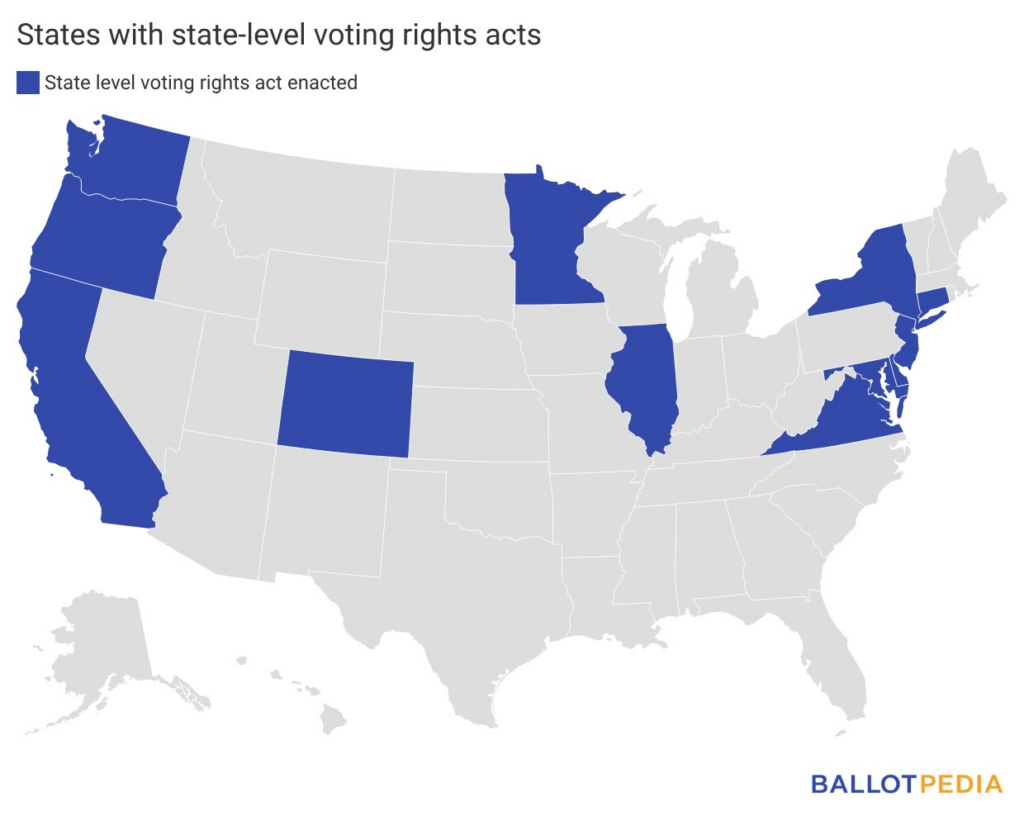
On Aug. 6, Delaware Gov. Matt Meyer (D) signed legislation making Delaware the 12th state to enact a state-level voting rights act.
California was the first to enact a state-level voting rights act in 2002, followed by Illinois in 2011. Every other state enacted its law between 2018 and 2026, and all had Democratic trifectas when they approved their laws.
Delaware is the fifth state this year to enact a new or expanded state-level voting rights act. Virginia and Washington both expanded existing state-level voting rights acts, while Maryland and New Jersey enacted new laws.
In 1965, Congress passed the Voting Rights Act, which prohibits racial discrimination in voting nationwide. Since 2002, some states have adopted state-level voting rights acts, which generally mirror or expand on the federal Voting Rights Act.
Four of the 12 states with a state-level voting rights acts require some local governments to get state approval for changes to voting policies. Eleven have a prohibition on vote dilution. Eleven allow private individuals or groups to sue over local or state policies they believe to be discriminatory. Five include requirements that voting materials be available in languages other than English.
House Bill 444 prohibits local or state agencies from engaging in voter suppression. The law defines voter suppression as any election policy or practice that creates a material disparity affecting the voter participation of protected class members or the impairment of the equal opportunity of protected class members to participate in the political process.
It also prohibits local governments from employing "a method of election that has the effect, is likely to have the effect, or is motivated in whole or in part by an intent to dilute the vote of protected class members."
Private individuals and groups who believe that either of these prohibitions have been violated, as well as the Delaware attorney general, may file a court action to remedy the alleged violations. A plaintiff must first give the local government a chance to remedy the issue before filing a lawsuit.
The law also requires political subdivisions that meet certain demographic criteria to provide assistance in languages other than English.
The law takes effect on July 1, 2027.
In a statement, Meyer said, "Democracy doesn't disappear overnight; it disappears when good people convince themselves someone else will protect it. By signing the John Lewis Voting Rights Act, we're ensuring that every Delawarean can control their own future and exercise the most fundamental right granted to them by our Constitution: the right to vote."
In a Facebook post, House Republican caucus policy and communications director Joseph Fulgham wrote that some members opposed the bill because of its costs to implement and because "the measure defines voter suppression so broadly that almost any election rule—such as voter ID, signature checks, or standard polling hours—could be challenged if statistical voting differences occur between designated minority groups and the general population."
The Delaware House of Representatives passed the bill 29-11 on June 18, with 26 Democrats and three Republicans voting in favor and 11 Republicans voting against. The Delaware Senate passed the bill 21-0 on June 30, with 15 Democrats and six Republicans voting in favor.
Click here for more information about the Delaware Voting Rights Act, and here to check out all 12 state-level voting rights acts.