


A close race for governor in Georgia could trigger the state’s new automatic recount law, which will be in effect for the first time during the 2026 elections. Cook Political Report, Inside Elections, and Sabato’s Crystal Ball have all classified the 2026 gubernatorial race as a toss-up.
Under SB 3EX, which was enacted in June, the secretary of state must automatically order a manual recount in the first or second state executive races listed on the ballot if the margin separating the top two candidates is less than or equal to 0.5%. The first and second state executive races in 2026 are governor and lieutenant governor.
A recount must be ordered within two days of the results being certified. There is no deadline in state law for completing the recount, but counties must finish a recount within 17 days of when it was ordered to be eligible for reimbursement of their costs.
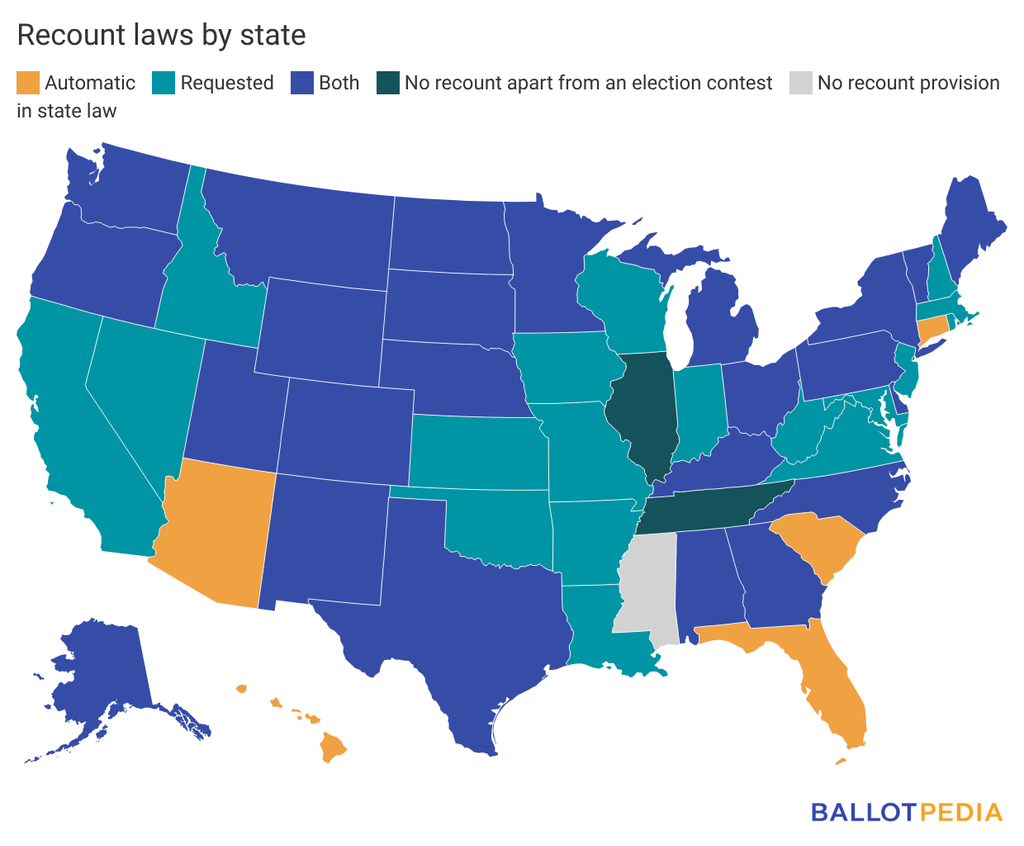
Georgia is one of 29 states to require automatic recounts. Automatic recounts typically must occur if a set margin separates two candidates or ballot measure positions, or if errors are discovered during vote counting or post-election auditing.
Five states only provide for automatic recounts. Two states, Illinois and Tennessee, do not allow recounts apart from an election contest, while one state, Mississippi, does not allow for election recounts. Forty-two states allow candidates and, in some cases, voters to request a recount. In 21 states, a specific margin of votes is required before an interested party may request a recount for some or all elections. In other states, a recount can be requested no matter the circumstances.
Who can request a recount varies by state and by circumstances. In most states with requested recount procedures, an interested party is either a candidate or a voter. Some states allow political party chairs to request a recount.
Forty-two states allow candidates to request a recount in at least some elections. In four states, voters may request a recount for any election. In 32 states, voters can request recounts only in some elections or only for ballot measures.
While state and county governments generally pay for automatic recounts, states have different laws about who pays for a requested recount.
In 22 states, the person seeking a recount pays the costs, while in six states the state pays. In 12 states, who pays depends on the circumstances of the election or the recount. In those states, the government may pay for a recount in close races or in races for certain offices, and the requester pays in all other circumstances. In three states, state law does not address which party pays for the recount.
In 27 states, a refund is available for a requested recount if it changes the election results or meets other criteria. In four states, a refund depends on the circumstances of the recount, and in six states, no refund is available. Six states have state-funded recounts and seven states do not have requested recounts.
In 27 states, a partial recount may be requested.
Seven states, including Georgia, enacted nine laws in 2026 related to recounts. Notable laws include:
- Connecticut HB 5001, which requires recounts depending on the results of a post-election audit.
- Iowa HF 2501, which amends recount procedures for ballot measures.
- Nebraska LB 1075, which requires a recount request to be filed within three days of the canvass, rather than five days.
- Rhode Island H 7782 and S 3113, which require a recount to be requested within nine days of the results being declared, rather than seven days.
For more information on recount laws, click here.