


Welcome to Ballotpedia’s Weekly Brew. Each week, we’ll bring you a collection of the most-viewed stories from the Daily Brew, condensed, along with other content from across Ballotpedia that we think you’ll like.
Today’s Weekly Brew brings together content from the week of October 19 - October 23.
This week’s top stories
Here are the Daily Brew stories our subscribers clicked on most this week.
Ballotpedia’s top 50 ballot measures and trends on Election Day
On Nov. 3, voters will decide on 145 statewide ballot measures in 39 states — below the average of 163 statewide measures that appeared on November ballots in even-numbered years from 2000 to 2024.
This week, we’re covering our top 50 measures to watch on Election Day, which include 42 statewide measures and eight local measures. Click “Read more” for a look at those measures by the trend they fall under this year.
A look at wave elections since 1918 and the thresholds needed for a wave election in 2026
The term wave election is frequently used to describe an election cycle in which one party makes significant electoral gains. As is often the case with midterms, pundits have speculated about whether or not this year's elections will amount to a wave election.
How many offices need to change party control, though, for an election to be a wave election?
According to our 2018 study, examining the results of 50 election cycles from 1918 to 2016, a wave election occurs when a party:
- Gains seven U.S. Senate seats
- Gains 48 U.S. House seats
- Gains seven gubernatorial offices
- Gains 494 state legislative seats
The definition is based on the results of the 20% of elections in that period that resulted in the greatest seat swings against the president's party.
A 2026 wave election for each office type, then, would result in Democrats holding:
- Fifty-four U.S. Senate seats
- Two hundred sixty-two U.S. House seats
- Thirty-one gubernatorial offices
- Three thousand seven hundred thirty-two state legislative seats
2026 ballot titles required 17 years of education to read, down from a record 21 years in 2025
The 164 statewide ballot measures voters have or will decide this year are written at an average reading level equivalent to 17 years of education, or a first-year graduate student reading level. This is a decrease from 2025, when the average reached 21 years of education — the highest since Ballotpedia began tracking readability in 2017.
Ballotpedia's readability report offers insights into the educational level voters might need to comprehend statewide ballot measure titles and summaries.
Using the Flesch-Kincaid Grade Level (FKGL) and Flesch Reading Ease (FRE), the report measures how accessible these texts are based on objective factors, such as the number of syllables, words, and sentences. These scores focus solely on language structure, not the complexity of the ideas themselves.
49 states allow election recounts — here’s how laws vary in each state
Forty-nine states could have an election this November head to a recount, though the exact requirements for when a recount occurs vary by state.
All states but Mississippi have a state law allowing for recounts in at least some circumstances. Recounts are either automatically triggered when certain circumstances are met or requested by an interested party.
Steeped in History
Welcome to Steeped in History, a new Weekly Brew column where we'll share a story from America's political past. Today’s column is adapted from Ballotpedia founder and CEO Leslie Graves’ weekly Substack column, Civic Blueprints.
Election Day in colonial America: Part exercise in democracy, part county fair
America’s history has many examples of voting practices we might find strange, fascinating, and sometimes repugnant. The general trend in voting has been to broaden the franchise to include more and more people. It’s also been inextricably linked to the social attitudes and political movements of the time, a connection that continues today.
Colonial America’s political system had its roots in English parliamentary government. The earliest representative body formed in the new colonies was the Virginia House of Burgesses, which first assembled in 1619. Each county sent two delegates to the new House. The electorate was made up of White male property owners and some long-term leaseholders.
How they voted was a case study in social mores. In his 2013 book The Grandees of Government, historian Brent Tarter wrote:
The eligible voters who appeared at the courthouse on election day voted viva voce, that is, each announced his vote out loud in the presence of everyone. The election was entirely public in that the candidates and the voters were all there, and everybody knew who everybody voted for. Personal, family, and financial ties no doubt weighed with the voters in the decisions that they made, but on most occasions, matters of public policy did not. It was improper for candidates to promise to vote for or against any particular measure if elected (a few members-elect got expelled for doing so), so a man’s chances of being elected depended largely on his personal reputation and connections within the community.
And with so many people gathered together, it’s perhaps no surprise that more than voting took place. Election days were causes for celebration, as eligible voters from across the county braved sometimes perilous journeys to get to the courthouse. It was commonplace for those gatherings to feature a great deal of alcohol.
In his second (and successful) campaign for a seat in the House of Burgesses, a young George Washington plied the assembled voters with a great deal of good cheer:
… Washington floated into office partly on the 144 gallons of rum, punch, hard cider and beer his election agent handed out—roughly half a gallon for every vote he received.
Today, states have a patchwork of rules and laws against electioneering at polling places, which are intended to insulate voters from coercion or other influence before they cast their ballots. These laws are continually evolving, but one of the biggest changes from the early days of voting was the abandonment of public voice voting and the widespread adoption of the secret ballot.
In other news
Go beyond the Daily Brew with Ballotpedia News. Explore this week's headlines below:
- California voters will decide on 462 local ballot measures in November, the second-lowest number since 2018
- Ohio Supreme Court candidates for two seats will have their party affiliation appear along with their names on the general election for the third time on Nov. 3
- Four states are holding direct elections for state insurance commissioner this year
- Forty-nine state financial offices are up in 2026, with majority control at stake
This week’s read
This week’s read comes from Hall Pass, a weekly newsletter that keeps you plugged into the conversations driving school board governance, the politics surrounding it, and education policy.
The state elections this November that will affect K-12 policy
Education is on the ballot this November, both literally and figuratively. In previous editions of Hall Pass (see here, here, and here), we’ve looked at the ballot measures that directly address K-12 education. This week, we’re looking at the state elections — gubernatorial, state legislative, and education-related — through which voters will indirectly shape their state’s education policies.
Gubernatorial elections
In 36 states this year, voters will choose a governor. Republicans and Democrats each hold 18 of the offices up for election. Fifteen incumbent governors are term-limited. Of those, six are Democrats and nine are Republicans.
As the chief executive of each state, governors implement state laws and manage the executive branch of the government, but they also propose the state budget and use — or threaten to use — their veto power to influence appropriations. In the first half of each year, governors lay out their policy priorities in annual reports to lawmakers, most commonly referred to as state of the state addresses. Education figured prominently in many of those speeches this year.
Governors can also direct resources toward addressing education issues through executive orders. This year, for example, Alabama Gov. Kay Ivey (R) signed an order establishing the Governor’s Commission on Screen-Based Instruction, which is tasked with studying screen-based learning and making recommendations about the role of screens in classrooms. In Connecticut, Gov. Ned Lamont (D) in April established the Governor’s Blue-Ribbon Commission on K-12 Education Funding and Accountability to study the state’s school funding formula and make recommendations. According to the announcement from the governor’s office, “The commission is required to look at the landscape of educational funding in Connecticut, any relevant models from other states, the primary cost drivers impacting Connecticut school districts, and proven strategies for delivering K-12 education that have resulted in improved outcomes and student success in Connecticut.”
In addition to influencing the budgetary process and implementing laws, most governors play a role in appointing the state officials who oversee K-12 public education. In 18 states, including 14 of the 36 holding gubernatorial elections, the governor appoints the chief state school officer. In 38 states, according to the National Association of State Boards of Education (NASBE), the governor appoints some or all members of the state board of education, typically with senate approval. Twenty-six of the 36 states holding gubernatorial elections on Nov. 3 fall into this category.
Read more about the state elections that will affect K-12 policy
This week’s watch
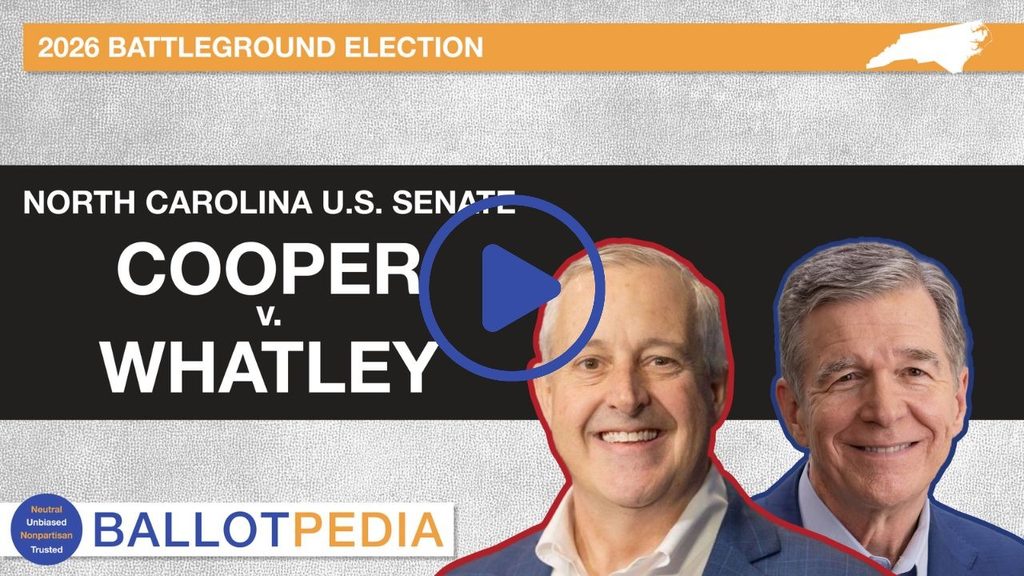
2026 Battleground Race: Roy Cooper (D) and Michael Whatley (R) for U.S. Senate in North Carolina
Democrat Roy Cooper, Republican Michael Whatley, and three others are running in the general election for U.S. Senate in North Carolina on Nov. 3, 2026.
The incumbent, Republican Thom Tillis, is retiring from public office.
It’s one of 12 battleground elections that could affect who controls the U.S. Senate in 2027. Currently, Republicans have a 53-45 majority in the chamber. Two independents in the chamber caucus with the Democrats.