


Welcome to the Tuesday, Nov. 10, 2026, Brew.
By: Lara Bonatesta
Here’s what’s in store for you as you start your day:
- Voters approve 10 election policy ballot measures on voter ID, noncitizen voting, and more
- Democrats won a majority of triplex offices up for election in 2026: Here’s a look at down-ballot state executive results
- Party control of at least one top-100 city mayor’s office changed in the Nov. 3 elections
Voters approve 10 election policy ballot measures on voter ID, noncitizen voting, and more
Voters decided 15 election policy-related statewide ballot measures on Nov. 3, covering issues ranging from voter ID and same-day voter registration to automatically restoring the voting rights of individuals convicted of a felony. As of Nov. 9, voters had approved 10 measures, rejected four, and the result of one was too close to call.
Voter identification
Nevada voters approved Question 7 62.2% to 37.9%, making Nevada the 37th state to require voters to present identification to cast a ballot in person, and the 25th state to require photo ID.
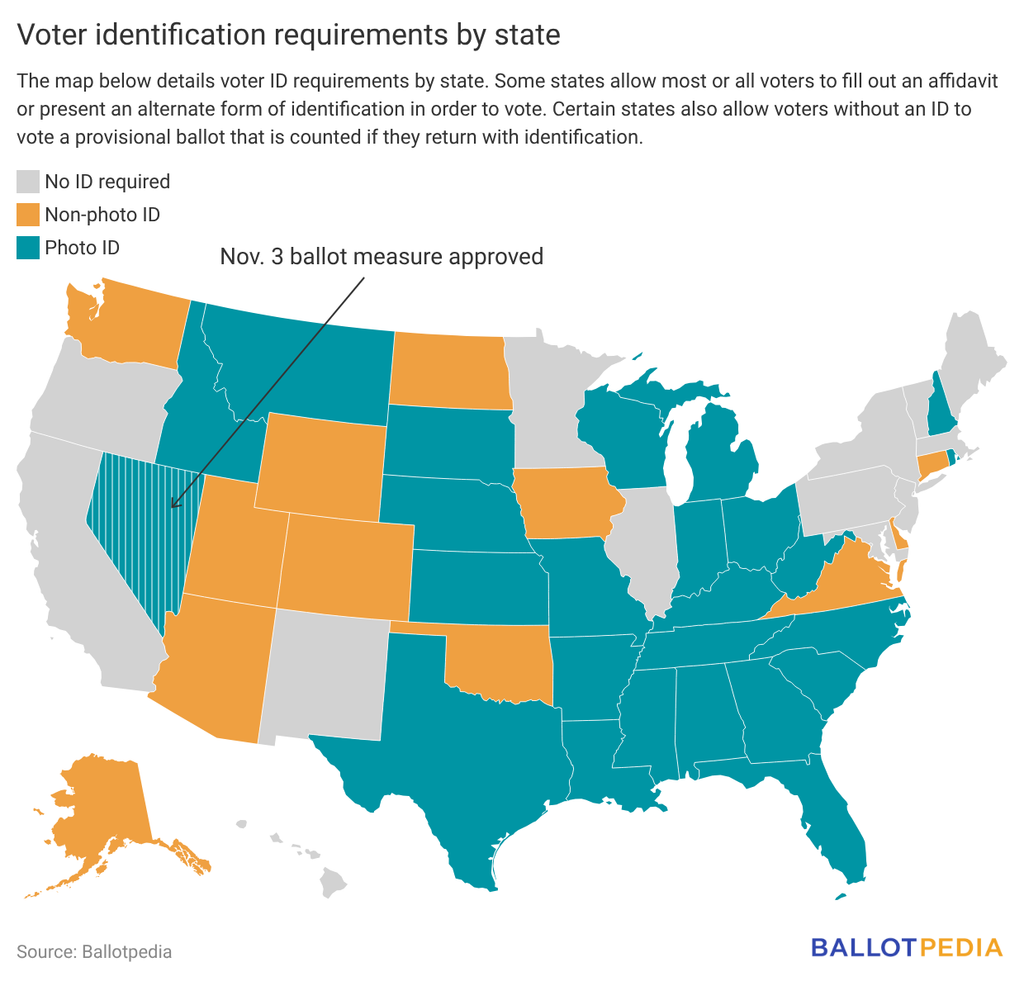
Previously, Nevada was one of 14 states that did not require ID to vote in most cases. Under the measure, voters must provide a photo ID, such as a driver’s license, ID card, or tribal ID, to vote in person.
Voters must also provide the last four digits of their driver's license or Social Security number "in the block provided next to the voter’s signature for election officials to use in verifying the voter’s identity" when returning an absentee ballot. Previously, Nevada had no identification requirements for voting by mail. The measure makes it the 41st state to require voters to provide an ID or ID number when requesting or returning an absentee/by-mail ballot.
Nevada is the eighth state with a pre-election divided government to have a voter ID law. Nationally, all 23 states that had a Republican trifecta before the Nov. 3 election also have voter ID requirements, as do six Democratic trifecta states.
Ohio approved a constitutional amendment on Nov. 3 placing its voter ID laws in the state constitution. North Carolina voters amended the state’s constitution to require photo ID for all voters. The constitution previously required photo ID for in-person voting, and existing state law required photo ID when returning an absentee ballot by mail.
Voters in Arizona, California, and Colorado rejected measures related to voter ID. The three measures defeated in 2026 match the total number of defeated voter ID measures between 2004 and 2025.
- Arizona voters rejected Proposition 144, which would have placed the state’s ID requirement in the constitution, 53.3% to 46.7%. The amendment would have also made other changes to state election law.
- California Proposition 39 would have required in-person voters to provide ID at the polls and those voting by mail to provide the last four digits of an identification number when returning their ballot. Voters rejected the measure 60.4% to 39.6%.
- Colorado voters rejected Amendment 84, 63.3% to 36.7%. The measure would have required voters to provide their signature and an identification number, such as a Social Security or driver’s license number, when casting a mail ballot.
Citizenship requirements for voting
Four states — Arkansas, Kansas, South Dakota, and West Virginia — approved constitutional amendments on Nov. 3 stating that only U.S. citizens can vote, bringing the number of states with language explicitly prohibiting noncitizen voting in their state constitutions to 22.
Alaska voters also approved an indirect initiated state statute that says only U.S. citizens may vote in the state’s elections. Alaska does not have a constitutional prohibition on noncitizen voting.
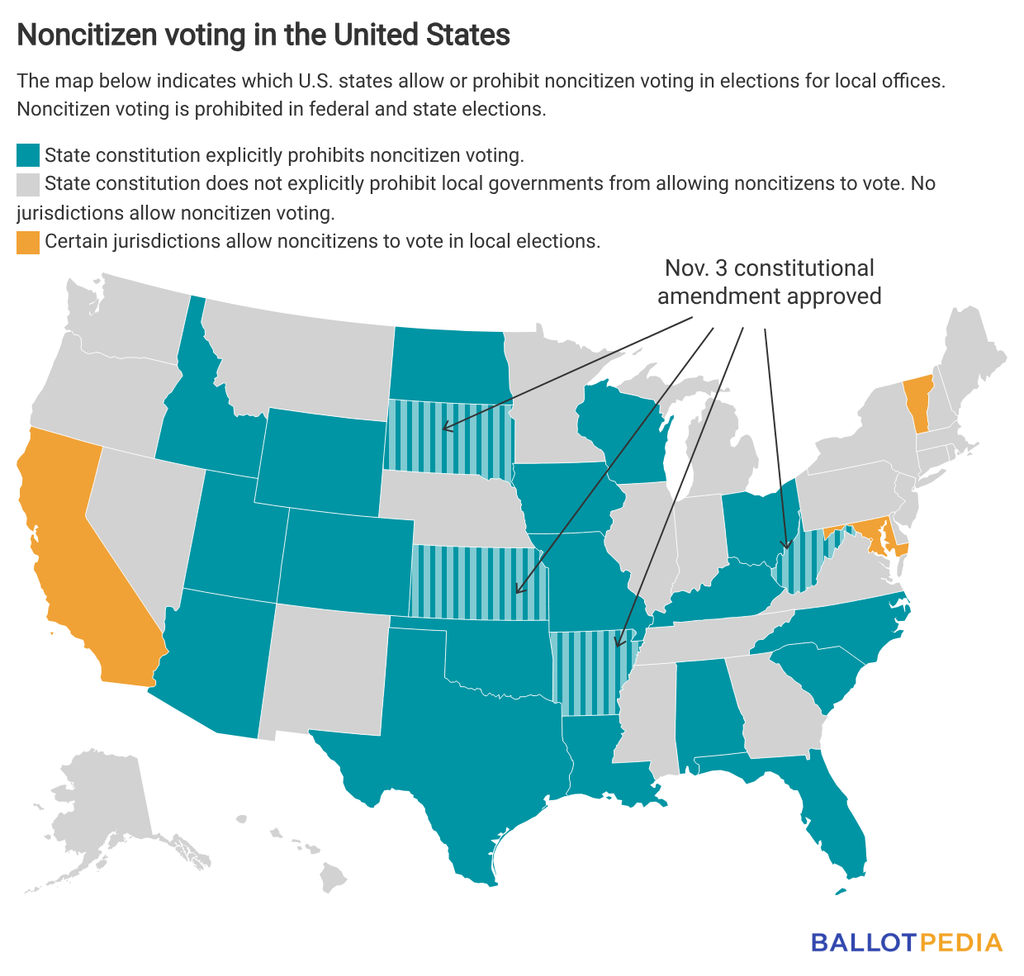
Sixteen of the 22 states with constitutional prohibitions on noncitizen voting had Republican trifectas heading into the election. Five had divided governments, and one, Colorado, had a Democratic trifecta. A majority of those states added those prohibitions in the last three years.
Arizona Proposition 144, which voters rejected, would have stated, in addition to other changes to election law, that “only citizens may register and vote in Arizona elections.” Unlike the other five states which approved citizenship ballot measures, Arizona has existing constitutional language prohibiting noncitizen voting.
Voting rights for individuals convicted of a felony
Virginia voters approved Question 3 56.6%-43.4%, making Virginia one of 40 states to restore voting rights for individuals convicted of a felony at a certain point after the completion of a sentence, which may include prison, probation, or parole, depending on the state. Virginia is now one of 24 states that restore a person’s voting rights upon completion of their prison sentence. Under the amendment, voting rights are automatically restored without any action required of the voter aside from registration.
In two states — Maine and Vermont — individuals convicted of a felony never lose the right to vote. In seven states, voting rights are not restored to individuals convicted of some or all felonies without state action to restore those rights. In Tennessee, individuals convicted of some felonies never regain the right to vote.
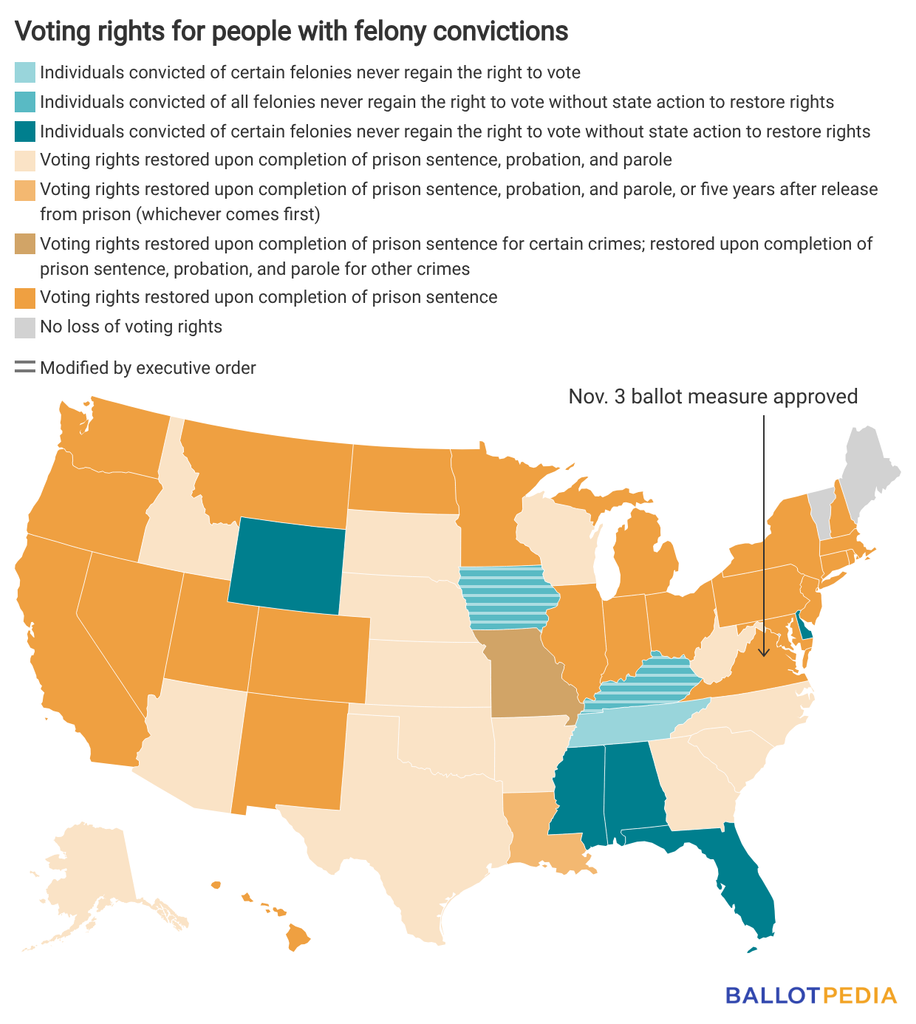
Previously, Virginia was one of eight states where individuals convicted of some or all felonies could not regain the right to vote without state action to restore their rights. In order for a person with a felony conviction to vote, the governor or another state authority would have to restore their civil rights. Some governors, including current Gov. Abigail Spanberger (D), restored voting rights to people with felony convictions without requiring individuals to apply for restoration.
Same-day voter registration
Massachusetts voters approved Question 4 56.3% to 43.7%, making Massachusetts the 21st state with same-day voter registration. The policy takes effect on Jan. 1, 2028.
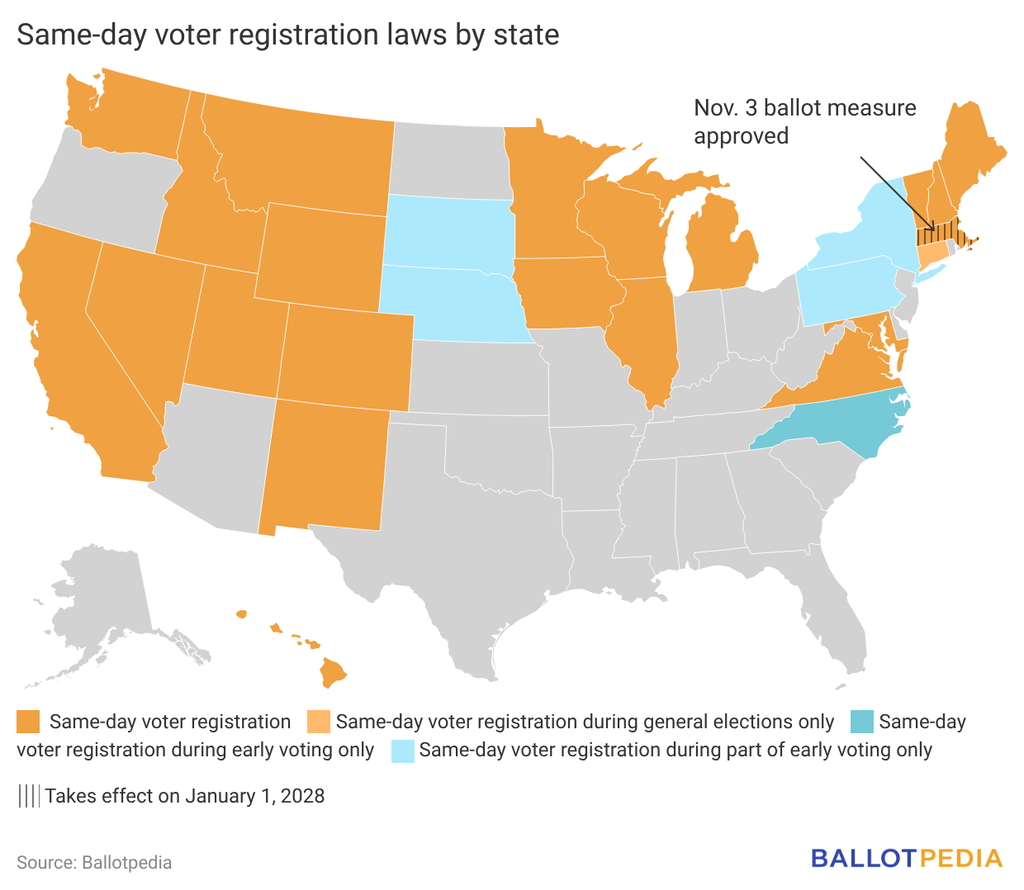
Twelve states with same-day voter registration had a pre-election Democratic trifecta, six states had a Republican trifecta, and three states had divided government.
Currently, Massachusetts allows voters to register at the polls during the eight days when the early voting and voter registration windows overlap.
Massachusetts is the first state to approve a same-day voter registration measure since Maryland and Michigan in 2018.
Electoral systems
Voters in Massachusetts rejected a measure 61% to 39% that would have implemented top-two primaries in the state.
A measure to repeal Alaska’s RCV and top-four primary system was still too close to call. As of Nov. 9, the measure was failing 51.8% to 48.1%, with 73% of precincts reporting.
In addition to statewide ballot measures, Ballotpedia covered three Nov. 3 local ballot measures related to ranked-choice voting:
- Longmont, Colorado, approved the use of ranked-choice voting (RCV) in mayoral and city council elections, starting in 2029. That makes Longmont the 41st locality in the country to use or plan on using RCV in some or all local elections. Five other localities in Colorado also use or are scheduled to use RCV, the second-most of any state in the country, behind California.
- Voters in Honolulu, Hawaii, defeated a measure to use RCV for mayoral, city council, and prosecuting attorney elections. It is the first time a locality has rejected a measure to adopt RCV since Clark and San Juan counties in Washington did so in 2022.
- In Irvine, California, a measure to use RCV for local elections, starting in 2028, was leading 51.5% to 48.5% as of Nov. 9, with all precincts reporting. California counts mail ballots postmarked by Election Day, provided they are received within seven days of the election.
Click here to read more on ballot measures in the 2026 election.
Democrats won a majority of triplex offices up for election in 2026: Here’s a look at down-ballot state executive results
In addition to elections for governor, various state executive offices were up for election on Nov. 3. These elections had the potential to affect aspects of state government such as whether the state had a triplex or divided government, and also policy issues like energy and insurance rates.
These offices include:
Attorney general: Thirty states held direct elections for attorney general this year. In another four states, the office was on the ballot indirectly, because of gubernatorial or legislative elections in states where the governor or legislature selects the attorney general. Pre-election, Democrats controlled 17 of these 34 offices, Republicans controlled 16, and one attorney general was independent.
In direct elections for attorney general, Democrats gained control of four Republican-held attorney general offices, and one election in Ohio remains uncalled. Of the three appointing governor’s offices up for election, Democrats retained the Hawaii governorship, and Republicans retained the Wyoming governorship. The governor’s race in Alaska is uncalled. In Maine, where the legislature picks the attorney general, Democrats retained the majority.
Heading into the election, Democrats controlled 22 attorney general offices, Republicans controlled 27, and one was independent. As a result of the election, Democrats will gain control of at least four offices, with two races still uncalled. Once all newly elected candidates are sworn in, Democrats will hold a majority of state attorney general offices for the first time since 2014.
Secretary of state: Twenty-six states held direct secretary of state elections, and seven states held elections for the appointing governor. Pre-election, Democrats and Republicans each held 13 of the directly elected offices. Democrats gained control of three secretary of state offices, bringing their total to 16 and Republicans' total to nine. Of the indirectly elected offices, Republicans held five and Democrats held two. Post-election, Democrats will control five of those bodies to Republicans’ two.
In all six states where Democrats gained control, the secretary of state serves as the chief elections officer with ultimate oversight over state elections and voter registration. As a result of this year's elections, Democrats will hold at least 21 of the 37 secretary of state offices that oversee elections and Republicans will hold at least 15. Kansas’ secretary of state, which oversees that state’s elections, is still uncalled.
Triplex status changed in six states. Two states changed from Republican triplexes to Democratic triplexes, one changed from a divided government to a Democratic triplex, and three changed from Republican triplexes to divided governments. Alaska, Kansas, and Ohio’s statuses remained unclear due to uncalled elections.
Insurance Commissioner: Four insurance commissioners were up for direct election. Pre-election, Democrats controlled one office, and Republicans controlled three. Democrats won two of these races, and Republicans won two. In Georgia, voters elected a Democratic commissioner over the Republican incumbent, the first gain for either party since 2016. In 32 states with gubernatorial elections this year, the governor appoints the insurance commissioner. Post-election, Democrats will control four insurance commissioner offices to Republicans’ seven. The remaining 39 insurance commissioner offices are nonpartisan.
Public Service Commissions: Nine states held direct elections for public service commissions. Heading into the election, Democrats controlled none of the directly elected commissions, while Republicans controlled nine. Democrats won control of one commission, and Republicans retained eight. The Democratic gain of the public service commission in Georgia is the first gain for either party since 2019. Additionally, there were 30 indirect elections for public commissions. Democrats gained four governorships that pick the commissioners. Alaska and Kansas’ governorships remain uncalled. Following the election, Democrats will control two commissions to Republicans’ nine. The other 39 public service commissions are nonpartisan.
State financial officers (treasurers, auditors, and comptrollers): Forty-nine state financial officers were directly on the ballot, including 25 treasurers, 14 auditors, and 10 comptrollers. Of these, Democrats held 10 treasurers, six auditors, and six comptrollers, while Republicans held 15 treasurers, eight auditors, and four comptrollers. Democrats gained two treasurer offices and three comptroller offices. Republicans gained one comptroller office. Treasurer and auditor elections in Ohio remain uncalled.
Post-election, nationwide, Democrats will control 26 state financial offices to Republicans' 21. Democrats will also control a majority of state comptrollers, and control of treasurer and auditor will be determined by the uncalled Ohio elections. No appointing body of state financial officers changed partisan control. Democrats now hold a majority of elected state financial officers following the elections.
To read more about state executive official elections, click here.
Party control of at least one top-100 city mayor’s office changed in the Nov. 3 elections
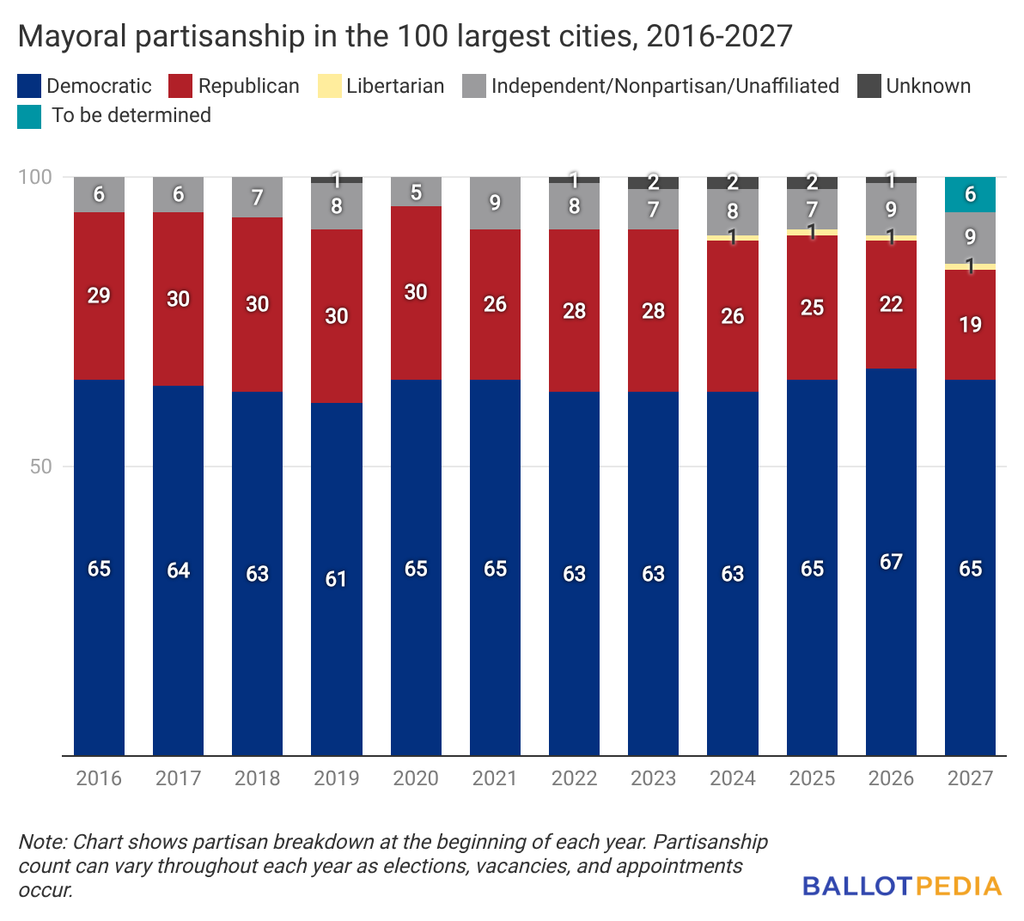
Party control of at least one mayor’s office in the 100 largest cities by population changed in the Nov. 3 elections, out of 15 top-100 city mayors on the ballot that day. Reno, Nevada, voters elected Kate Marshall (D) to succeed Hillary Schieve (Nonpartisan) in the city’s first open race for mayor since 2014.
Five mayoral elections are either uncalled or advanced to runoffs that will be held later in the year. The Santa Clarita, California, city council selects the city’s mayor in December. Party control of two top-100 city mayors changed in elections earlier this year.
Once mayors take office in the cities where races have been called, there will be at least 65 Democratic, 19 Republican, four nonpartisan, four independent, one libertarian, and one unaffiliated mayor.
The six undecided mayoral races are:
- Corpus Christi and Laredo, Texas, where the Nov. 3 mayoral elections advanced to runoffs.
- Anaheim, Irvine, and Santa Ana, California, where the Nov. 3 mayoral elections were still uncalled as of Nov. 9.
- Santa Clarita, California, where members of the Santa Clarita City Council select the mayor each December.
Two incumbents were defeated in the mayoral elections on Nov. 3. Democrats retained both offices.
- In Los Angeles, City Council member Nithya Raman defeated incumbent Karen Bass. The Los Angeles branch of the Democratic Socialists of America (DSA) endorsed Raman, and former Vice President Kamala Harris (D), Gov. Gavin Newsom (D), and U.S. Rep. Nancy Pelosi (D) endorsed Bass.
- In St. Petersburg, Florida, former Florida Gov. Charlie Crist defeated incumbent Kenneth Welch. Crist had previously been affiliated with the Republican Party until becoming an Independent in 2010. He became a Democrat in December 2012.
City council elections
Here’s what happened in a few city council elections that we were watching:
- Tallahassee, Florida: Progressives won the mayor’s office and a 3-2 majority on the City Commission, of which the mayor is also a member. According to the Tallahassee Democrat, the outcome reversed the balance of power that the commission had for six years. According to Bolts Magazine, heading into the elections, three centrists formed a majority on the city council. In the mayoral election, City Commissioner Jeremy Matlow defeated former state Sen. Loranne Ausley. In District 3, PJ Perez defeated Tom Derzypolski, and in District 5, incumbent Dianne Williams-Cox defeated Dorothy Inman-Johnson.
- Louisville, Kentucky: Democrats won 13 seats on the Louisville Council, and Republicans won 12. According to Louisville Public Media, one independent incumbent was re-elected. The city held nonpartisan elections for the first time this year. Local political parties still endorsed candidates in the elections. Democrats have had more seats on the council than Republicans since the Council was formed in 2003.
- Los Angeles: As of Nov. 9, the races for Districts 3 and 9 were still too close to call. In District 3, Timothy Gaspar led Barri Worth Girvan 51.7% to 48.3%. Gaspar’s campaign website listed endorsements from several local police and labor unions. Former Mayor Antonio Villaraigosa endorsed Worth Girvan. In District 9, Jose Ugarte led Estuardo Mazariegos 50.5% to 49.5%. The Democratic Socialists of America (DSA) endorsed Mazariegos. The Los Angeles Democratic Party endorsed Ugarte. All of the other districts’ general elections were canceled after candidates won outright in the primaries.
School boards
Here’s a look at the results of two of the biggest school board contests we covered:
- Chicago Public Schools, Illinois: Chicago voters elected all 21 members of the Board of Education for the first time. Before 2024, the mayor appointed the board’s members. The current mayor, Brandon Johnson, is a former teacher and organizer with the Chicago Teachers Union. As we mentioned in the Nov. 5 edition of the Daily Brew, candidates that the Chicago Teachers Union supported won at least six seats and are leading in three others. Candidates the group didn’t endorse won 11 seats. Four races were still uncalled. According to the Chicago Tribune, most candidates who the Chicago Teachers Union had not supported had “support from several pro-school-choice groups that have opposed CTU, including the Illinois Network of Charter Schools, Common Ground Collective, and the Urban Center.”
- Cobb County School District, Georgia: The Cobb County School District school board changed from a 4-3 Republican majority to a 4-3 Democratic majority when Micheal Garza (D) defeated incumbent David Chastain (R) in the election for District 4.
There were 488 local general elections in which all candidates on the ballot completed our survey.
These included mayoral elections in four top-100 cities: Los Angeles, Chula Vista, California, Henderson, Nevada, and Reno, Nevada.
Click here to learn more about our coverage of local elections from Nov. 3.