



States have enacted 236 election-related bills so far this year, 66% more than at this point in 2024 and nearly two-and-a-half times the total from 2022.
These figures come from Ballotpedia's State of Election Policy 2026 Spring Report, which covers election-related legislative activity captured in our Election Administration Legislation Tracker through April 24 of this year.
Those 236 bills were enacted across 34 states. Republican trifecta states enacted the most bills, accounting for 53.4% of all bills enacted. Democratic trifectas accounted for 37.7% of all enacted bills, while 8.9% were enacted in states with divided governments.
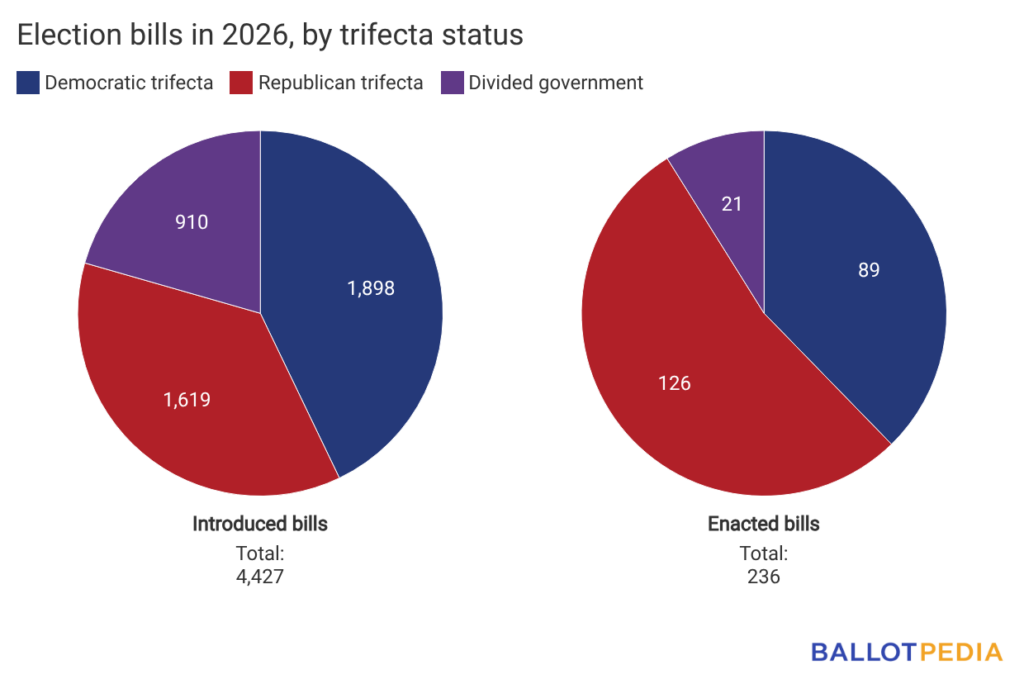
At this same point in the 2024 session, states had enacted 142 election-related bills. In 2022, 96 election bills had been enacted.
As of April 24, legislators had introduced 4,427 election-related bills and resolutions — nearly as many as were introduced in all of 2025. Democratic trifecta states introduced the most legislation, accounting for 42.8% of all bills introduced. Republican trifectas accounted for 36.6% of all introduced bills, while 20.6% were introduced in states with divided governments.
At this same point in the 2024 session, states had introduced 2,149 election-related bills. In 2022, legislators had introduced 1,434 election bills.
Lawmakers across the country have considered election-related bills related to each of the 127 election legislation categories Ballotpedia covers. Legislators have given particular attention to seven noteworthy policy topics.
The administration of absentee/mail-in voting
All states allow for some form of absentee/mail-in voting. Fourteen states require voters to provide a valid excuse to vote absentee/by mail. Twenty-eight states allow any eligible voter to cast an absentee/mail-in ballot. Eight states have automatic mail-in ballot systems, also known as all-mail voting systems.
No states have made changes relevant to these broader categories this year, though legislators enacted 16 laws that changed elements of the absentee/mail-in voting process. Notable bills enacted include Mississippi HB 908 and Virginia SB 58 and HB 82. Click here and here to see our coverage of these bills.
Lawmakers in 40 states have introduced 330 bills and resolutions related to absentee/mail in-voting. These bills address different elements of the absentee/mail-in voting process, including how and when voters can request and return an absentee/mail-in ballot, when election officials must mail ballots, and deadlines and procedures for curing problems with an absentee/mail-in ballot.
Regulations governing law enforcement presence near polling places
Ten states have introduced or advanced 22 bills or resolutions concerning the presence of law enforcement, National Guard members, or immigration authorities at or near election sites.
The majority of the bills would prohibit law enforcement personnel from being within a set distance of polling places, tabulation sites, or election offices.
The only bill enacted on this issue to date was New Mexico’s SB 264. Click here to see our Daily Brew coverage of that bill.
Changes to how primary elections are run
Currently, 14 states require open primaries, 13 require closed primaries, 10 require semi-closed primaries, five require top-two style primaries, and in 11 states parties have discretion to choose participation rules for their primaries.
No states have enacted changes to these broader categories via legislation this year, but six states have enacted laws changing a primary date or how primaries are administered. Notable bills enacted include Arizona HB 2022 and Rhode Island S 2147. Overall, legislators have introduced 167 bills related to primary elections.
Policies prohibiting or authorizing the use of ranked-choice voting
In 2026, two states with Republican trifectas,Indiana and Ohio, enacted legislation prohibiting the use of ranked-choice voting (RCV).
Virginia, meanwhile, became the first state since 2023 to approve legislation, SB 176, that allows or requires the statewide use of RCV for state or local elections. Click here to see our Ballot Bulletin coverage of SB 176.
Seven states have laws authorizing or requiring the use of RCV for certain elections, while 19 states have laws prohibiting or restricting its use.
In total, lawmakers have introduced 67 bills related to RCV. Forty-seven of those would authorize or require the use of RCV in at least some elections, while 20 would prohibit or repeal RCV.
Mid-decade redistricting
Indiana, Maryland, and Virginia considered mid-decade redistricting in their 2026 regular sessions, with Alabama, Florida, Louisiana, and Tennessee meeting in special session to consider redistricting. On April 21, Virginia voters approved a legislatively-referred constitutional amendment that would have enacted new maps. The Virginia Supreme Court nullified the amendment vote on May 8.
Changes to voter ID requirements
Thirty-six states require voters to present identification to vote at the polls on election day, but many states have exceptions to these rules. Of these states, 24 require voters to present identification containing a photograph, with certain exceptions, and 12 states do not explicitly require photo identification. The remaining 14 states do not generally require voters to present identification in order to vote at the polls on election day.
None of the 14 states without voter ID requirements have advanced bills in 2026 to require it. And no state that allows non-photo identification has enacted legislation to require photo identification.
However, nine states have enacted bills modifying existing voter ID requirements. Notable enacted bills include Florida HB 991 and New Hampshire HB 323. Oklahoma SJR 47 would place the state’s existing voter ID requirement in the state constitution if approved by voters in August. Click here, here, and here to see our past coverage of those bills.
Legislators have introduced 196 bills related to voter ID. In 2025, there were 279 such bills, more than in 2024, 2023, or 2022.
Policies related to voter registration
Legislators in 44 states have introduced 602 voter registration bills, accounting for 13% of all bills introduced this year. Overall, 29 bills have been enacted related to voter registration.
These bills change various aspects of the voter registration process, including creating documentary proof of citizenship requirements, changing the data sources election officials are required to use for voter list maintenance, and expanding automatic voter registration systems.
A notable focus for state legislators was bills requiring documentary proof of citizenship for voter registration. Twelve states have laws requiring proof of citizenship to register to vote in at least some cases.
In 2025, Wyoming was the only state to enact a requirement that voters provide documentary proof of citizenship when registering to vote. In 2026, four states enacted new proof of citizenship requirements or expanded existing laws. Those bills were Florida HB 991, Mississippi SB 2588, South Dakota SB 175, and Utah HB 209. Click here to see our Ballot Bulletin coverage of those bills.
Ballotpedia publishes three reports each year that provide ongoing coverage of legislative activity affecting election administration. Click here to see our past reports.