


Welcome to Ballot Bulletin: Ballotpedia's Weekly Election Policy Digest. Every Tuesday, we deliver the latest updates on election policy around the country, including nationwide trends and recent legislative activity.
In this week’s edition, we cover 38 bills state legislatures acted on last week and look at the restoration of voting rights to individuals with felony convictions in Virginia and other states.
The state of election legislation in the U.S.
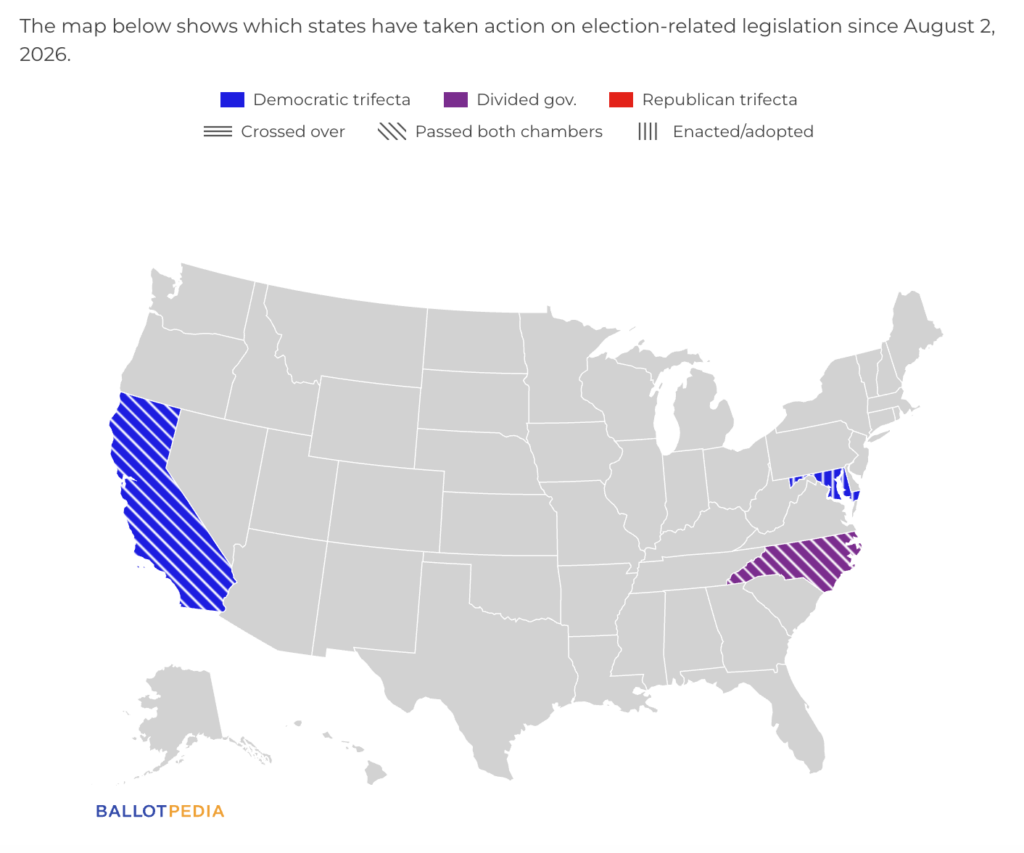
Lawmakers in three states acted on 38 election-related bills last week. Eight state legislatures are in regular or special sessions. Last week, two bills were enacted, four bills passed both chambers of a state legislature, and no bills were vetoed.
Of the bills acted on last week, 34 (89.5%) are in states with Democratic trifectas, none are in states with Republican trifectas, and four (10.5%) are in states with divided government. The most active bill categories last week were redistricting (10), election law disputes and voting rights (10), ballot access (8), and ballots and voting materials (8).
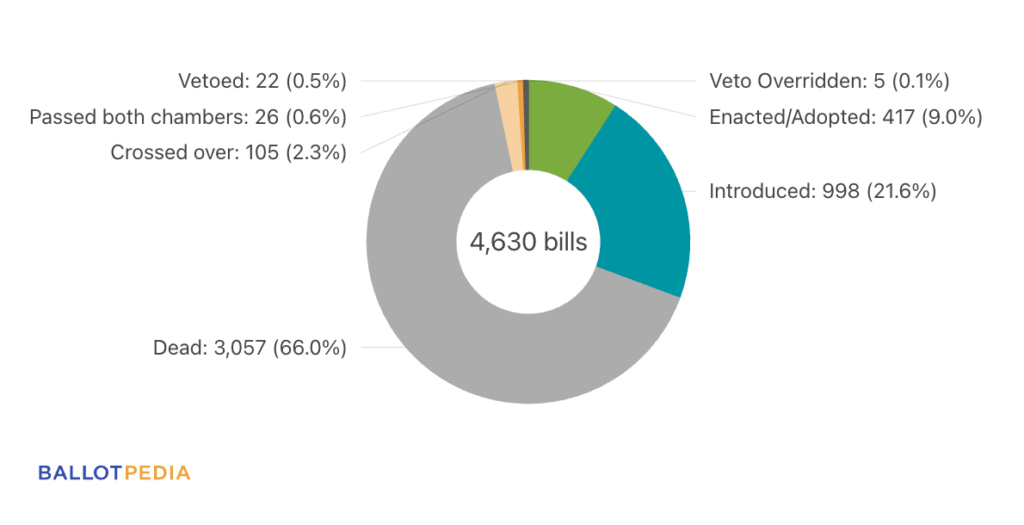
We are currently tracking 4,630 election-related bills across the country. The chart below breaks down the status of those bills based on where they stand in the legislative process:
Enacted bills
Two bills were enacted or adopted last week.
On Aug. 5, Maryland Gov. Wes Moore (D) signed HB 2100 into law. It establishes that the contiguousness, compactness, and population distribution criteria for redistricting in the state constitution only apply to state legislative districts, not congressional districts. It also establishes that the General Assembly has the power to grant original jurisdiction to the Maryland Supreme Court to review congressional redistricting plans.
On Aug. 6, Delaware Gov. Matt Meyer (D) signed HB 444 into law. Read more about this noteworthy bill in the news section below.
Bills passing both chambers
On Aug. 6, the North Carolina General Assembly approved H 834 and H 958, sending the bills to Gov. Josh Stein (D). H 834 allows individuals voting an absentee or provisional ballot to correct registration errors or cure a ballot within five business days following an election (rather than within three business days under current law), among other provisions. H 958 requires that ballots cast on election day be counted immediately until completed. It also reduces the early voting period for primary elections, primary runoffs, and special elections to 10 days (from 17). The bill also requires the state auditor to conduct post-election audits of election systems and controls in randomly selected counties, among other provisions.
Two other bills passed both chambers of a state legislature last week:
To see a full list of bills awaiting gubernatorial action, click here.
Vetoed bills
No bills were vetoed last week.
To see a list of all bills vetoed this session, click here.
All bills
The chart below shows all bills Ballotpedia is currently tracking, broken down by partisan sponsor.
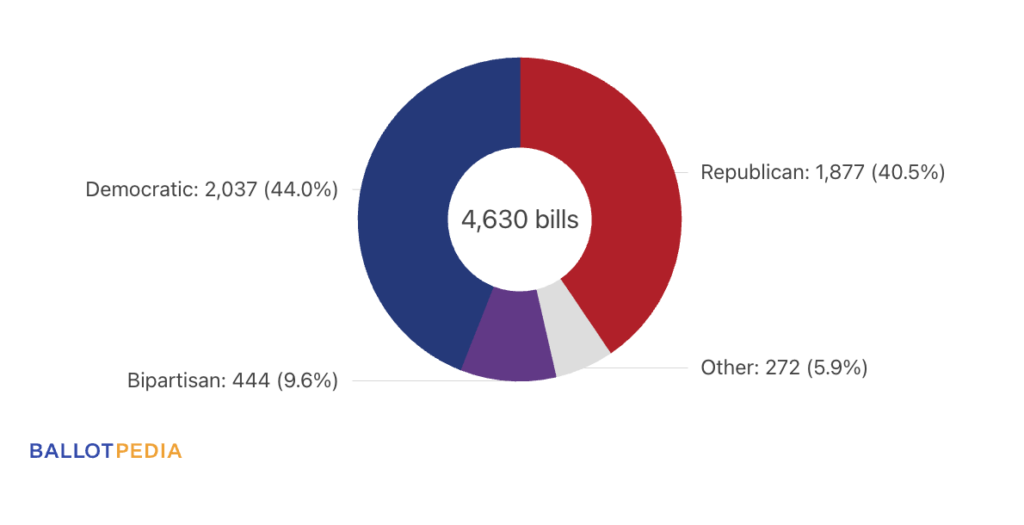
We are currently following 4,630 election-related bills, including bills carried over from the previous year.
- Trifecta status
- Democratic: 1,987 (42.9%)
- Republican: 1,649 (35.6%)
- Divided: 994 (21.5%)
- Partisan sponsorship
- Democratic: 2,037 (44%)
- Republican: 1,877 (40.5%)
- Bipartisan: 444 (9.6%)
- Other: 272 (5.9%)
In the news
On Aug. 6, Delaware Gov. Matt Meyer (D) signed legislation making Delaware the 12th state to enact a state-level voting rights act. HB 444 prohibits local or state agencies from engaging in voter suppression, defined as any election policy or practice that creates a material disparity affecting the voter participation of protected class members or the impairment of the equal opportunity of protected class members to participate in the political process. It also prohibits local governments from employing "a method of election that has the effect, is likely to have the effect, or is motivated in whole or in part by an intent to dilute the vote of protected class members."
The Delaware House of Representatives passed the bill 29-11 on June 18, with 26 Democrats and three Republicans voting in favor and 11 Republicans voting against. The Delaware Senate passed the bill 21-0 on June 30, with 15 Democrats and six Republicans voting in favor. Delaware is the fifth state in 2026 to enact a new state-level voting rights act or to expand an existing law. Virginia and Washington both expanded existing state-level voting rights acts, while Maryland and New Jersey enacted a new law.
Here are other news stories from across the country:
- On Aug. 4, the Dane County Circuit Court ruled that Wisconsin’s requirement for paper absentee ballots violates the rights of disabled individuals under the Americans with Disabilities Act (ADA). Writing for the court, Judge Everett Mitchell said that requiring paper ballots for certain disabled absentee voters restricts their “equal opportunity to vote absentee privately and independently” under the ADA. Mitchell’s order did not explicitly require electronic absentee voting, and a trial could be set following a scheduled Aug. 12 hearing.
- On Aug. 3, the U.S. District Court for the District of Colorado dismissed a lawsuit from the U.S. Department of Justice (DOJ) seeking access to Colorado’s unredacted voter rolls. Chief Judge Philip Brimmer wrote that Colorado’s statewide voter registration list did not constitute a record to which the DOJ is entitled under the Civil Rights Act. He also said that the DOJ’s request did not contain a required “statement of the basis and the purpose” for the demand. For a list of federal lawsuits seeking access to statewide voter lists, click here.
- On Aug. 4, Missouri Secretary of State Denny Hoskins (R) rejected a veto referendum on the state’s newly enacted congressional maps and a ballot initiative to limit the Legislature’s ability to block initiatives and referenda or modify them after passage. Following Hoskins rejecting the referendum, the political action committee People Not Politicians filed a lawsuit in the Cole County Circuit Court. On Aug. 8, the group Respect MO Voters also filed a lawsuit challenging Hoskins’ rejection of the initiative and referendum powers ballot measure. Previous legal challenges related to the veto referendum were covered in the May 26 edition of Ballot Bulletin.
Policy spotlight: Virginia Gov. Abigail Spanberger restores voting rights to thousands of individuals with felony convictions
The story below is adapted from a recent Ballotpedia News story by Andrew Bahl.
On July 31, Virginia Gov. Abigail Spanberger (D) announced that since taking office on Jan. 17, she has restored the voting rights of 66,085 Virginia residents with felony convictions.
Virginia is one of three states, along with Iowa and Kentucky, where individuals convicted of any felony never regain the right to vote without some form of state action to restore their rights, under state law. However, executive orders in Iowa and Kentucky, and a court ruling in Virginia, have changed the states’ policies.
Since 2018, 13 states, not including Virginia, have expanded voting rights for individuals with felony convictions.
The Virginia Constitution states that individuals convicted of a felony lose their right to vote unless their “civil rights have been restored by the Governor or other appropriate authority.” Individuals with felony convictions must apply to the governor's office for restoration of their rights. People convicted of certain felonies may also petition the courts for restoration of their civil rights if they completed their prison sentence, probation, and parole more than five years ago.
Spanberger resumed the practice of restoring voting rights to individuals with felony convictions who had completed their prison sentence without requiring them to apply.
Starting in 2010, Gov. Bob McDonnell (R) began automatically restoring voting rights to individuals convicted of nonviolent offenses who had completed their prison sentences, probation, and parole. Gov. Terry McAuliffe (D) used a similar review system for individuals convicted of all felonies, and Gov. Ralph Northam (D) expanded the system when he removed a requirement that individuals complete parole before being eligible for restoration.
In 2023, Gov. Glenn Youngkin (R) announced that individuals seeking to have their rights restored must apply and have their applications considered on a case-by-case basis. At the time, Secretary of the Commonwealth Kay Coles James (R) wrote, "Virginians trust the Governor and his Administration to consider each person individually and take into consideration the unique elements of each situation, practicing grace for those who need it and ensuring public safety for our community and families."
A press release from Spanberger's office stated, "The Secretary of the Commonwealth’s Office is working to proactively identify Virginians who lost their right to vote, confirm that these Virginians are eligible, and restore their rights. The Spanberger Administration is also accepting restoration of rights applications from Virginians through a streamlined, online system that removed unnecessary questions added during the Youngkin Administration."
Opponents of Virginia's current policy have challenged in court the requirement that individuals with felony convictions petition the governor or a court to have their rights restored.
On Jan. 22, 2026, U.S. District Court Judge John Gibney ruled that Virginia's law violated a federal law governing the commonwealth's readmission to the U.S. following the Civil War.
Gibney granted an injunction preventing Virginia from disenfranchising individuals convicted of felonies created after the passage of the Virginia Readmission Act of 1870. Individuals convicted of some crimes, such as arson, burglary, manslaughter, murder, and rape, would still need to petition the governor to have their voting rights restored.
On Nov. 3, Virginia voters will decide on a constitutional amendment that would automatically restore voting rights for people with felony convictions after they complete their prison sentence.
Spanberger supports the amendment. She said in her July 31 statement, "This fall, voters can cast their ballots for Virginia to no longer strip so many of our neighbors of their fundamental rights — a shameful relic of our Jim Crow past. I hope Virginians will join me in voting yes."
John Massoud, chairman of Virginia’s 6th Congressional District Republican Committee, wrote in opposition to the amendment: "We can all agree that the current system for receiving a state pardon is rather complicated and does need to be reformed. However, this is not the way to go about doing so. There are different types of felonies in Virginia. Some are non violent, others are violent. Passing this amendment would allow violent felons to serve on juries — do you really want a rapist serving on a jury?"
If voters approve the amendment, Virginia would become the second state in 2026 to change its policies on restoring voting rights to people with felony convictions.
On July 13, Missouri Gov. Mike Kehoe (R) signed HB 1871, which restored voting rights to people convicted of certain felonies upon completion of their prison sentences. Previously, an individual had to complete their prison sentence and any parole or probation before being able to register to vote. For 11 crimes, voting rights are still restored to people upon completion of prison time, parole, and probation.
Legislators in Delaware also passed HB 180, a constitutional amendment that would automatically restore voting rights to individuals with felony convictions upon their release from prison. The amendment must be passed again in the next legislative session before it takes effect, but it would not need voter approval.
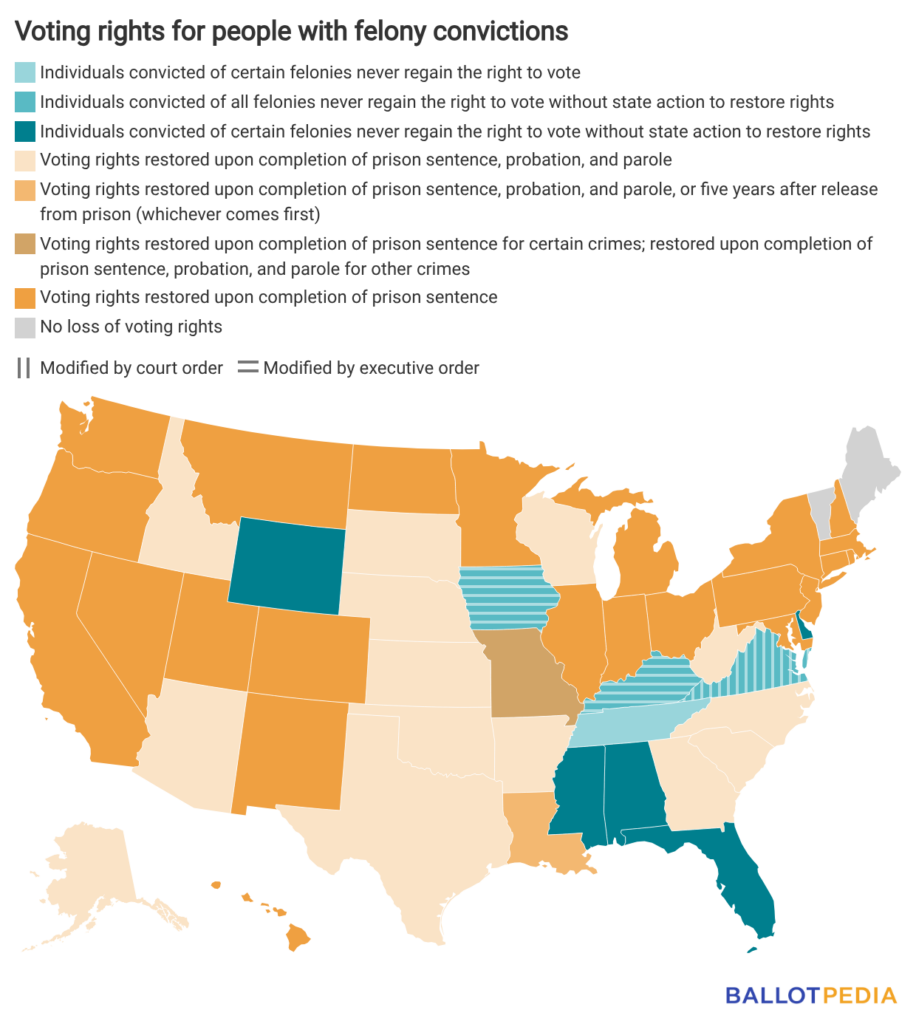
Here’s how current laws compare across the U.S.:
- In two states and Washington, D.C., people with felony convictions never lose the right to vote.
- In 23 states, voting rights are restored upon completion of the prison sentence.
- In Missouri, voting rights are restored for individuals convicted of 11 crimes upon completion of the prison sentence, parole, and probation, and for those convicted of all other crimes, voting rights are restored upon completion of the prison sentence.
- In Louisiana, voting rights are restored upon completion of the prison sentence, parole, and probation, or five years after release from prison (whichever comes first).
- In 14 states, voting rights are restored upon completion of the prison sentence, probation, and parole.
- In five states, voting rights are never restored for individuals convicted of certain felonies, unless the state acts to restore the person’s rights.
- In three states — including Virginia — voting rights are never restored for individuals convicted of any felony without the state acting to restore the person’s rights, under state law.
- In Tennessee, voting rights are never restored for individuals convicted of certain felonies.